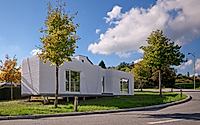
Tiny House LUX: 3D-Printed Concrete Home for Tight Urban Plots
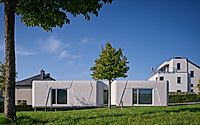
Tiny House LUX lands in Niederanven, Luxembourg as a compact house by ODA Architects, conceived with the municipality as a real-world pilot for missing-middle housing. The project addresses narrow, leftover parcels with on-site 3D concrete printing, a wood frame, and a swift build schedule. It’s small, but rigorous. Clear standards, local materials, and a digitally driven process push the model toward replicability without sidestepping national performance benchmarks.


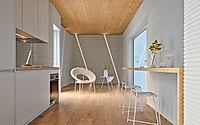
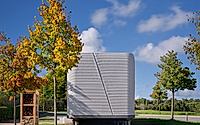
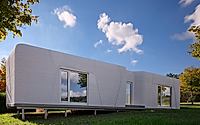
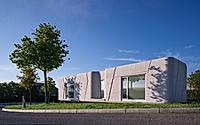
A long, tight lot draws the eye in a straight line from garden to door, daylight sliding across ribbed, printed walls and a light wood roof. The plan reads cleanly in one run, with storage and service zones tucked to each side and a clear axis pulling through the interior.
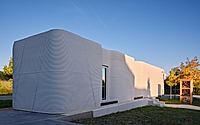
This is a small house in Niederanven, built as a municipal pilot by ODA Architects with local partners, and engineered for a narrow site. The story turns on construction method and material: on-site 3D concrete printing with local aggregates, coupled to a lightweight timber frame and roof.
Print The Walls
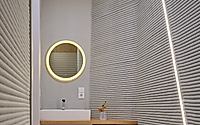
Construction centers on a mobile printer that extrudes standard batching-plant concrete, not imported dry mixes, to build the shell with speed and precision. Printing takes about a week, and the whole build—finishes included—wraps in roughly four weeks, which trims schedules and cuts the number of follow-on trades. Openings, niches, and service cavities are formed as the walls rise, so the shower recess and the wall-hung toilet pocket arrive cast-in and exact.
Set A Light Base
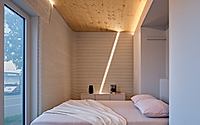
Instead of concrete footings, the house rests on a wooden floor platform supported by screw foundations, reducing groundwork and embodied carbon while allowing future disassembly. The move keeps weight low and shortens the messy phase of excavation—useful on tight urban plots with limited access. Above, a wood frame and roof continue the light-touch structure and align with a circular mindset for future reuse.
Run A Clear Spine
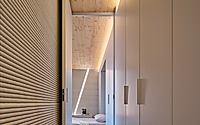
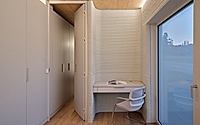
The plot measures 3.5 meters by 17.7 meters, yielding about 47 square meters of usable area, so planning leans on a central axis to stretch perception. Storage, furniture, and services sit along both flanks, leaving a continuous view from front to back that quiets the interior and helps the compact footprint live larger. That clarity matters here. It reduces clutter, shortens routes, and keeps daylight moving.
Use Local Matter
The printed mix uses local aggregates, cutting transport and proving the viability of regionally supplied material for 3D construction. Mineral-based insulation and reinforcement avoid synthetics, keeping the envelope durable and simple to recycle. South-facing windows harvest solar gain, while roof panels generate electricity for the house and a film-based floor heating system that carries a light thermal touch.
Build A Playbook
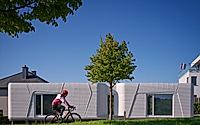
Beyond a single address, the project functions as a template that municipalities can adapt to leftover parcels tucked inside existing neighborhoods. A design-to-print workflow translates architectural intent into precise toolpaths, turning narrow, overlooked sites into credible homes with fewer unknowns. It’s a method, not a one-off, and it folds innovation into ordinary permitting and neighborhood fabric.
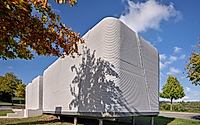
Late sun grazes the layered wall surfaces, the grain of the printed concrete catching soft shadows beneath the timber roof. The house stays compact and exact, engineered to its plot and tuned to its climate. A modest build—yet a clear path for more.
Photography by BoysPlayNice
Visit ODA Architects