Park Slope Townhouse Recasts a 1910 Home with Split Levels Inside
Park Slope Townhouse reworks a 1910 house in Brooklyn, Kings County, NY, United States, with architecture and interiors by Leroy Street Studio. Completed in 2024, the renovation opens a narrow townhouse footprint into a more fluid sequence of rooms, terraces, and double-height moments. Art, built-in shelving, warm wood, and broad garden glazing shape a house that feels more expansive, more vertical, and closely tied to the rear landscape.


About Park Slope Townhouse
From the front rooms, the house reads long and calm. A blue geometric rug, low seating, and large paintings set an even pace before the view pulls forward to glass, trees, and a wood-lined room beyond.
Light keeps moving. It lands on white walls, slips across pale floors, and gathers at the rear where the house steps down toward the garden.
Located half a block from Prospect Park in Brooklyn, Kings County, NY, United States, Park Slope Townhouse is a 1910 British Regency house reworked by Leroy Street Studio in 2024. The renovation removes floor area at the rear to loosen the typical townhouse squeeze, creating taller volumes, longer sightlines, and a route through the house that turns daily circulation into a way of encountering art.
That sequence is the point. Rather than flattening the plan into one continuous room, the project uses shifted levels, framed openings, and built-in elements to make movement legible from one end of the house to the other.
Open The Rear
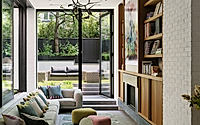
The biggest change happens at the back. Two nearly double-height levels give the living areas more air and draw the eye outward to planted terraces and the garden beyond.
In the sunken sitting area, a sofa runs low beneath tall glazing, with white-painted brick, a linear hearth, and bookshelves holding the side walls in place. Steps mark the shift. They slow the descent just enough to make the garden feel close at hand rather than simply adjacent.
Thread The Collection
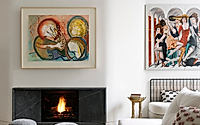
Art appears early and often. Large canvases anchor the living room, dining area, bath, and smaller work zones, giving each stop on the route its own visual weight.
That strategy matches the house’s changing levels and axes, which were shaped in part to display a broad collection without reducing the interior to a series of blank galleries. Furniture helps. Sofas, stools, and banquettes sit low and clear, leaving walls, corners, and long views available to paintings, textiles, and built-in storage.
Turn Along Wood
Millwork organizes much of the movement. A wood portal frames the transition from the front living room to the rear library, where shelves rise to the ceiling and a rolling ladder tracks the wall.
The same material carries into the kitchen, where pale oak cabinetry and a marble island stretch the room lengthwise and keep circulation direct. Nothing feels abrupt. Even the dining corner, with its glass table, bench seating, and patterned tile border, reads as another pause along a continuous interior path.
Climb Toward Sky
Vertical movement becomes more pronounced as the house rises. The project’s stair is described as sculptural, and the interiors support that reading with repeated shifts in level, framed landings, and moments where the axis subtly changes.
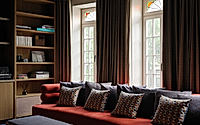
Private rooms continue the sequence rather than breaking from it: a dark blue sitting room gathers height at tall original windows, a compact desk niche is folded into stone and lacquered panels, and the bath pairs a freestanding tub with a mural-like wall drawing. The roof is the final turn. A new rooftop addition completes the upward run that begins at the garden edge and continues through the house.
Craft keeps these transitions precise. Custom rugs, furniture textiles, stone surfaces, and built-in places for art give each room a distinct character without interrupting the overall flow.
What remains strongest is the sense of passage. From street-facing rooms to the planted rear facade and up to the roof, the house trades the old townhouse pinch for a sequence of measured openings, landings, and views.
Garden and interior stay close. At every level, glazing, terraces, and green edges make the route outward feel continuous with the route inside.
Photography courtesy of Leroy Street Studio
Visit Leroy Street Studio