Limestone Project Uses Earth Tones to Shape Quiet Guest Rooms Inside
Limestone Project is a hotel in Odesa, Ukraine, designed by Scapes Concept Studio and arranged to keep the sea close at hand. The interiors read as pared back and warm, with earth-toned surfaces, wood joinery, soft curtains, and a bathing area drawn to the window. Across the rooms, the palette stays restrained, letting light, texture, and the horizon carry the atmosphere.


About Limestone Project
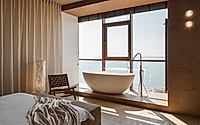
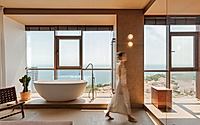
Morning light reaches deep into the room, catching the grain of dark wood, the matte floor tile, and the soft folds of full-height curtains. Beyond the glass, the sea stays in view. A freestanding tub sits at the edge of that horizon, turning the window wall into the suite’s clearest point of focus.
Limestone Project is a hotel in Odesa, Ukraine, by Scapes Concept Studio. Its rooms are organized less by enclosed boundaries than by a steady palette and a clear sequence of use: sleep, bathe, work, pause, look out. Warm browns, sand tones, and off-white surfaces keep that sequence legible, even as each zone remains visually open to the next.
Set A Warm Base
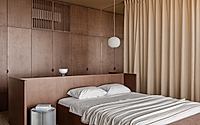
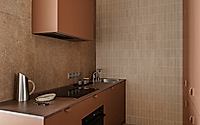
The material range is deliberately narrow. Wood paneling wraps walls and built-ins, fine linear tile covers the floor, and stone-like surfaces bring a dry, sandy weight to the bathroom and kitchenette. That restraint matters here, because the room depends on tonal shifts rather than contrast, letting the bed, bench, desk, and storage read as parts of one continuous interior field.
Pull The View In
The suite opens itself to the window wall. A raised platform gives the tub a direct line to the water, and the glazing extends that same outlook to the bed and sitting chair nearby. Light does the rest. It moves across the floor in long bands, softens at the curtains, and turns the room’s muted surfaces into something more atmospheric without asking for ornament.
Shape Daily Rituals
Several elements are pushed into precise, compact forms. The desk runs long and low with open shelving beneath, the kitchenette stays linear and spare, and the vanity rises as a stone pedestal with a slim mirror above it. Nothing feels crowded. Each component is given enough definition to support use, yet the room still reads as one calm volume rather than a set of separate stations.
Soften The Edges
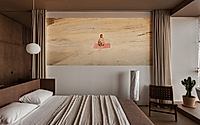
Curtains do important work throughout the interior. They screen, divide, and temper the harder surfaces, especially around the bed and window, where fabric introduces a quieter rhythm against wood panels and glass. Lighting follows the same logic. Globe pendants, recessed spots, and small wall fixtures keep illumination close and even, avoiding glare and letting the sea remain part of the room after dark.
A few pieces of furniture sharpen the mood without overcrowding it: woven-seat chairs, a perforated lounge chair, a low cylindrical side table, and a simple upholstered bench at the foot of the bed. The ceiling fans reinforce the unforced tone. In the end, the hotel room is less about spectacle than steadiness—texture under light, a measured palette, and the constant pull of the water beyond the glass.
Photography courtesy of Scapes Concept Studio
Visit Scapes Concept Studio