The Monochrome Frame House: Light-Filled Living For Urban Families
The Monochrome Frame House unfolds as a calm, graphic house in Tel Aviv, Israel, composed by designer Narkis Rubin Barazani. Large steel-framed openings, pale floors, and dark built-in volumes align living, dining, and kitchen into one continuous everyday realm. The result is a monochrome interior that leans warm rather than cold, tuned to family life and the soft Mediterranean light that washes in from the garden.


Light pours across pale flooring and catches on black metal lines. A long living volume stretches toward the garden, where sliding glass dissolves the threshold on mild days.
This house in Tel Aviv, Israel, is organized as an open-plan ground level where living room, dining area, and kitchen read as one continuous interior. Narkis Rubin Barazani arranges a controlled monochrome palette, using shades of white, gray, and black to give quiet order to family life. The focus stays on how furniture, built-in elements, and glazing frame daily rituals rather than on decorative display.
Living Room In Monochrome
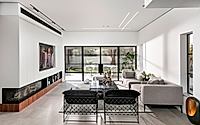
The living room sits along the garden façade, anchored by a low gray sectional and two black metal lounge chairs with open mesh backs. A long, thin fireplace runs beneath the wall-mounted television, its flame bed wrapped in a warm wood plinth that cuts through the otherwise cool palette. Coffee tables in glossy black glass mirror the grid of the large-format floor tiles, so furniture and finish read as one calm field. Soft daylight bounces off white walls, leaving the black window frames and furniture to draw crisp lines through the room.
Kitchen As Dark Core
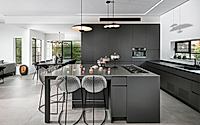
Beyond the sofas, the kitchen forms a solid charcoal volume that grounds the open plan. Tall cabinetry, an island, and the surrounding counters hold to a deep matte gray, keeping appliances and storage visually quiet. Bar stools with pale seats and fine black frames sit along the island, bringing a lighter note to the darker core. Slim pendant lights drop from the ceiling, their circular shades echoing the island below while linear LED strips trace the ceiling plane overhead.
Dining Line And Texture
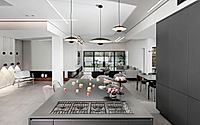
The dining area nests between kitchen wall and exterior glazing, defined by a long black table and matching chairs that stretch toward the garden view. Overhead, a minimal chandelier tracks the table length, reinforcing the strong horizontal reading already set by the window mullions and the cabinetry run. Within the tall dark storage wall, a single recessed niche lined in warm wood displays ceramics under soft lighting, bringing color and texture to the otherwise restrained composition. Nearby, sculptural vases on the table play against the strict geometry, giving the room a more human scale during everyday meals.
Edges Between Inside And Out
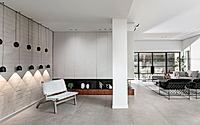
Across the ground level, black framed doors open to the terrace, where a simple white outdoor dining set extends the social zone into the garden. The same pale floor tone continues visually to the exterior, so the living area reads as an elongated platform that reaches toward the lawn. At the entry, a wall of vertical panels and small black sconces creates a soft-lit gallery, with a single white lounge chair set against the textured surface. Every threshold, from foyer to patio, is marked by a shift in light and furnishing rather than a change in color.
From morning brightness to evening firelight, the monochrome palette stays steady while the character of the rooms changes around it. Barazani’s arrangement lets material, furniture, and daylight carry the experience, so residents move through a clear, quiet interior that frames the garden and the routines of daily life.
Photography courtesy of Narkis Rubin Barazani
Visit Narkis Rubin Barazani