Black Bear House by forma ARCHITECTURE
Black Bear House settles into the hillside above Carbondale, United States, as a compact house by forma ARCHITECTURE shaped around light, slope, and climate. Nordic–Japanese fusion guides the restrained geometry and the warm, charred timber skin, giving this family retreat a clear presence against the rugged terrain. Inside and out, the project balances minimal lines with tactile materials to keep views, sun, and weather at the center of daily life.


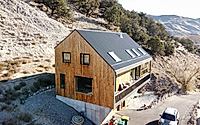
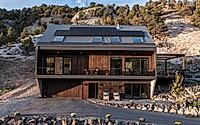
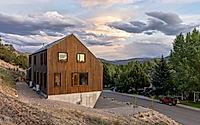
From a distance, the house reads as a dark, compact volume resting against the hillside, its length catching the sun along the valley. Closer in, the charred timber skin carries a textured sheen, and the long south face stretches toward the open landscape.
This is a house in Carbondale, United States, designed by forma ARCHITECTURE as a clear, functional volume keyed to slope, sun, and wind. The project follows a Nordic–Japanese fusion, pairing calm geometry with natural materials, but its real anchor is the relationship between daily living and the surrounding mountain climate. Each move in plan and massing supports that dialogue, from the shaded balcony to the solar-ready roof.
Shaped By The Hillside
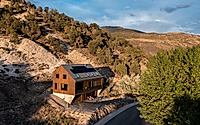
The building rises from the hillside like a stone that has slipped from higher ground and settled into the grasses and rocks. Its compact form stays pure and legible, yet the elongated body reaches toward the valley to catch both view and sun. This stretch creates a clear directional pull, aligning everyday routines with the contours of the terrain and the movement of daylight.
Balcony As Climate Edge
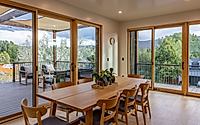
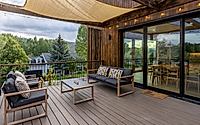
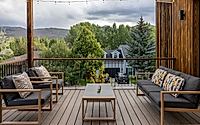
Along the south side, the volume extends to form a generous balcony that acts as a threshold between interior rooms and the wider valley. That outdoor band expands the living areas outward, giving residents a place to occupy the mild seasons with direct views into the landscape. The overhang above does more than define a silhouette; it shades south-facing glass from intense summer sun while still allowing low winter light to reach deep into the home. Climate response and daily use meet at this edge, turning a simple projection into the main environmental mediator.
Roofline For Sun And Snow
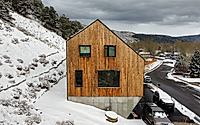
The sloping roof is oriented to the south, forming a broad, clean plane ready for solar panels and steady snow shedding. Its angle reinforces the house’s directional pull toward the valley while giving the structure a firm stance against the slope behind. By concentrating solar collection on this single surface, the architecture keeps the form legible and the technical layer quiet, yet tightly aligned with the region’s strong sun.
Charred Timber And Terrain
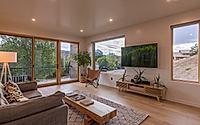
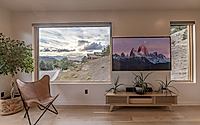
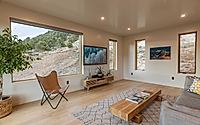
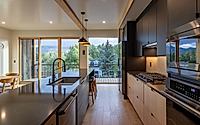
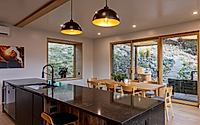
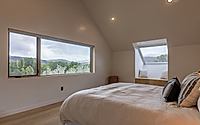
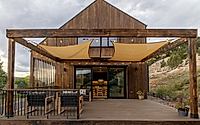
Vertical wooden planks, treated with shou sugi ban, give the façade a dark, weather-ready shell that echoes the rough textures of nearby rock and earth. Light charring protects the timber from moisture and aging, while also deepening grain and shadow so the walls read as one continuous, tactile surface. Against that dark skin, large, carefully placed windows open to precise views of mountains and valley, cutting moments of brightness into the solid mass. On the lower level, a wide opening leads directly to an outdoor terrace and pergola, tying indoor living to open air and seasonal change.
Anchored into the rugged slope yet reading as an autonomous object, the house sits like a considered stone set into the landscape. Its restrained geometry, honest materials, and measured openings keep the focus on light, weather, and view rather than on display. As the charred wood weathers and the surrounding grasses grow, the building settles further into its valley climate, continuing the quiet dialogue between form, function, and place.
Photography by Lucas De Cesco
Visit forma ARCHITECTURE