Zilker Park House by Specht Novak
Zilker Park House stands as an urban house in Texas City, United States, by Specht Novak, set within a neighborhood where small lots meet increasing density. The project responds to both the bungalow grain and taller neighbors, using varied massing, tactile materials, and a stepped section to hold its ground between street life, heritage oaks, and long views down the hillside.


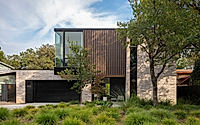
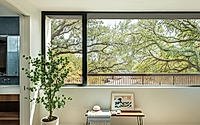
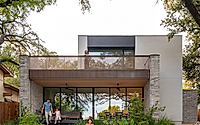
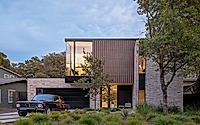
A low brick volume meets the sidewalk, its surface catching light while a single glazed opening hints at the life within. Above, a corner window frames tree branches and sky, signaling how the house engages its tight urban lot.
This house sits in Austin’s Zilker neighborhood, a fringe district where downtown density presses against small single-family parcels. Specht Novak shapes Zilker Park House as a measured urban infill project, aligning its scale and character with older bungalows while answering contemporary demands. Context drives each move, from its massing against adjacent roofs to the way terraces step down a fifteen-foot drop toward distant city views.
Austin’s push toward larger buildings often produces bulky, featureless houses that fill their lots and turn blank faces to the street. Here, the team resists that tendency by using modulated volumes and a tactile palette that register at a human scale, so the house participates in neighborhood life instead of overwhelming it.
Modulating The Street Edge
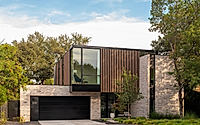
Along the street, the composition breaks into rectilinear pieces that adjust in height to meet each neighbor. A lower volume on the north side lines up with the adjacent bungalow, while taller forms on the south acknowledge a larger structure and the canopy of heritage oaks. The required garage fronts the narrow lot, yet it reads as a deliberate block in the composition rather than a blank, utilitarian box.
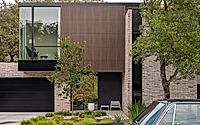
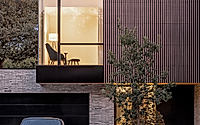
At the ground level, privacy stays tight with a largely solid base relieved by one carefully placed glazed entry. Above that solid weight, a large corner window from the playroom opens outward to the trees, adding a more public, watchful element that visually connects the interiors to the street and to the leafy surroundings.
Material Warmth And Texture
Material choices push against the white stucco norm that has spread through densifying districts. Natural Texas brick forms the primary envelope, tying the house to local construction traditions while giving depth and shadow to the façade. Vertical wood battens with dark trim wrap and articulate portions of the exterior, underscoring craft and catching changing light across the day.
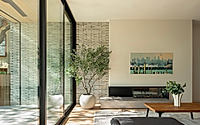
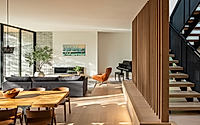
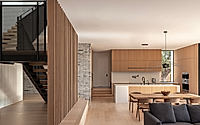
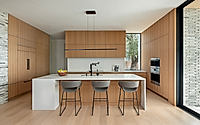
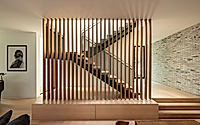
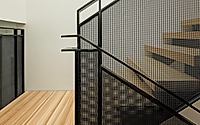
Those same textures continue inside the 3,300-square-foot home, blurring the threshold between street, shell, and rooms. Brick moves indoors to anchor key walls, and the batten rhythm reappears as a vertical screen around the stair. That screen softens daylight from a central skylight, filtering brightness down through the core and lending a quiet, shifting pattern of light and shadow.
Stepping Down The Slope
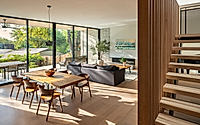
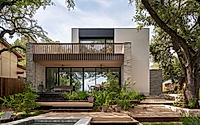
The site drops fifteen feet from front to back, a topographic challenge that becomes the organizing structure of the project. Interior floor levels shift in measured increments, so moving from entry to living room feels like a slow descent into a more sheltered zone. At the rear, a wide stretch of operable glass opens the recessed living area toward a sequence of outdoor rooms.
Beyond that glass, xeriscaped terraces step with the hillside instead of resisting it. Each planted platform creates another level of outdoor use, leading down toward a pool set at the back of the yard. This layered landscape maintains privacy from neighboring houses while opening long sightlines to the tree canopy and the downtown skyline in the distance.
Context-Responsive Urban Infill
Zilker Park House occupies its entire lot, yet it does so with calibrated mass and porous edges. The arrangement of volumes, windows, and terraces preserves mature trees and respects adjacent roofs, proving that full utilization does not require visual aggression. Inside, modern spatial compositions unfold around those contextual decisions, from the central skylit stair to the playroom perched above the street.
Across the project, context and material work together rather than compete. Brick, wood, and stepped ground reconnect the house to its neighborhood, while the plan negotiates privacy, openness, and density on a constrained urban parcel.
At day’s end, light slides across the brick base and filters through the battened stair, tying street, interior, and yard into a continuous experience. The house settles into its hillside and its block, offering a clear model for context-responsive infill in growing urban districts.
Photography by Leonid Furmansky
Visit Specht Novak