Forestone Cabin by Institute for Advanced Architecture of Catalonia
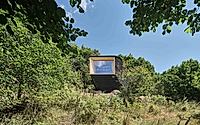
Forestone Cabin stands on a sloping Pyrenean hillside in Spain, a compact blackened timber cabin by the Institute for Advanced Architecture of Catalonia. Conceived as part of IAAC’s Master in Ecological Architecture and Advanced Construction, the experimental dwelling supports regenerative forestry while giving two guests a small, crafted retreat beside the existing hostel at MónNatura Sort.


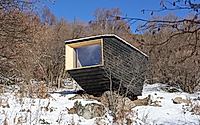
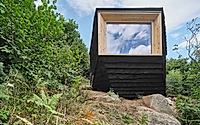
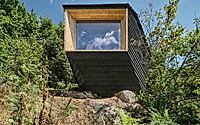
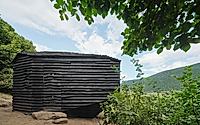
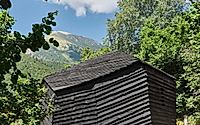
Dark, charred boards catch the mountain light as the cabin settles into the slope, its facets echoing nearby rock outcrops and the jagged Pyrenean profile. From the path above, the compact volume reads as a grounded object, with crisp openings cut into the shell to pull in cross-breezes and mountain views.
This is a 20 m² experimental wooden dwelling in the Pyrenees, conceived as part of the Bio for Piri initiative and built by IAAC’s 2025 Master in Ecological Architecture and Advanced Construction cohort. The Institute for Advanced Architecture of Catalonia works with local forestry partners to treat the cabin as both prototype and accommodation, aligning construction with regenerative woodland management. Material decisions drive the project, tying structure, enclosure, furniture, and textiles back to local resources and regional craft.
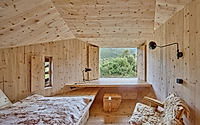
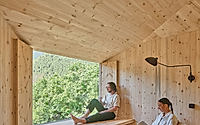
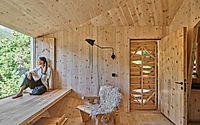
A few steps from the existing hostel at MónNatura Sort, the small cabin offers temporary living for two people with a sleeping area, workspace, and bathroom. Within this tight footprint, inclined walls and a sloping roof adjust height and proportion, giving each zone a distinct character while maintaining a continuous timber envelope.
Charred Timber Envelope
Outside, the cabin is wrapped in pine boards with natural edges, charred using the Yakisugi or Shou Sugi Ban technique for protection and depth of tone. Students cut and burned each board themselves, turning a traditional Japanese method into a tool for local resilience against insects, water, fire, and mold. The darkened skin also takes on symbolic weight, referencing fire management in a mountain range whose name ties back to the Greek word for fire. Operable wooden shutters close over the openings at night, delivering full darkness for stargazers and preventing light spill during astronomical activities.
The sculpted geometry evokes a boulder that has rolled down the mountainside and come to rest, yet every plane works hard. Angled walls and roof slopes respond to solar exposure and prevailing winds, balancing shade, winter sun, and natural ventilation within a very modest volume.
CLT Interior Craft
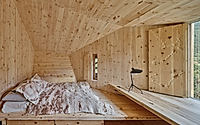
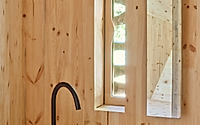
Inside, the cabin becomes a continuous wooden room where structure, lining, and built-in elements share one material language. Custom cross-laminated timber components form the bed platform, integrated storage, washbasin counter, and seating, all fabricated by students at Valldaura Labs. This approach reduces the number of trades on site while tightening the connection between drawing, fabrication, and assembly. Occupants move through a clear sequence from entry to workspace to sleeping area, always in contact with warm timber surfaces and precise joinery.
Because the CLT is both structural and tactile, its detailing matters. Joints, edges, and transitions handle wear, carry loads, and frame daily rituals in a single coordinated system.
Wool, Stone, and Local Cycles
The project extends material thinking beyond the forest into nearby fields and rivers. During an annual wool festival in Sort, students worked with local farmers to collect raw sheep’s wool that would otherwise hold little economic value. Back at Valldaura, they washed, dried, and felted the fibers into blankets, rugs, and pillowcases, turning agricultural by-products into soft interior layers. These textiles bring varied texture underfoot and in the hand, while tracing a direct line between pastoral labor and architectural comfort.
On the same visit, a stone gathered from the surrounding landscape was carved into a basin using power tools, becoming a singular object within the timber interior. The carved washbasin grounds the bathroom in local geology, reinforcing the cabin’s connection to its setting through weight, color, and tactile contrast.
Prototype for Forest Living
From the beginning, Forestone Cabin is planned as a model that others can adapt rather than a one-off object. Modular CLT elements and dry-assembly methods support disassembly, repair, or relocation, reducing disturbance to forest ground and existing ecologies. Local timber supply chains and regional knowledge inform each construction step, offering a blueprint for small-scale dwellings that sit within working forests without clearing or heavy foundations.
Education, local industry, and regenerative forestry converge in this compact project, from charred cladding to wool textiles and the carved stone basin. From January 2026, guests at MónNatura Pirineu can stay inside the prototype, waking to mountain light on charred pine and felted wool while inhabiting a built essay on low-impact forest habitation.
Photography by Adrià Goula
Visit Institute for Advanced Architecture of Catalonia