Borová Lada Cottage by Studio Plyš
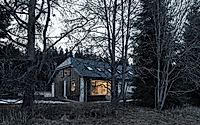
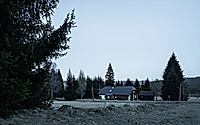
Borová Lada Cottage stands beyond the village in the Bohemian Forest, its late 19th-century frame renewed by Studio Plyš with a measured, material-forward hand. In Borová Lada, Czech Republic, the renovation sustains a cottage typology while opening it to light, garden, and shared use. The project reads as a calm rural house, not a showpiece, with interventions that respect memory and make room for new life.


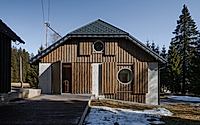
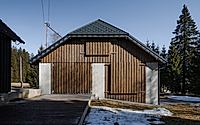
Frost lifts from the meadow as shutters slide back and the first light reaches the old gable. The cottage waits quietly, its new bones working behind weathered timber.
This is a careful renovation of a late 19th-century cottage in the Bohemian Forest by Studio Plyš. The work focuses on material clarity—how concrete, timber, steel, and fibre-cement add strength and comfort without drowning out the house’s long memory. Old fabric remains legible, and the new layer stands in plain sight.
Stabilize the Core
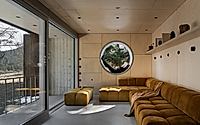
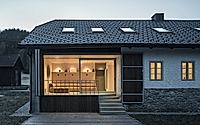
Three reinforced concrete columns now carry the roof, tying into new barn foundations that replace unsound repairs from the 80s and 90s. The move resets the structure, concentrates loads, and frees the ground floor for a living area that opens to the garden and draws toward the preserved kitchen. The result feels calm. Loads move straight down, and daily life flows around them.
Rework the Roof
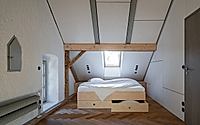
The original truss stays in service, its heft lightened when heavy concrete tiles gave way to aluminium tiles. Some rafters gain exposed steel beams, a frank reinforcement that buys both headroom and a continuous thermal layer in the roof envelope. The silhouette doesn’t flinch. Detail at the eaves nods to the classic “zmijovka” cap worn by generations of cottage-goers.
Insert the Volume
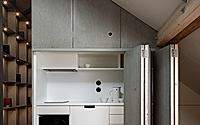
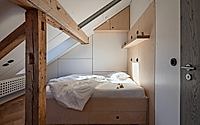
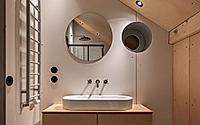
A new timber volume is screwed into the house, spanning the attic and former stalls, clad in fibre-cement boards and plywood made from natural and recycled content. It concentrates the sanitary rooms and separates sensitive functions from historic fabric, with insulation and a vapour-open approach that manages moisture rather than trapping it. Old and new don’t blur. They meet cleanly at deliberate joints.
Openings and Weather
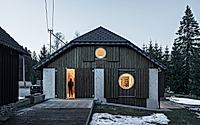
Large-format glazing brings daylight deep into the plan, while overscaled shutters slide on visible rails to temper weather and views from the road. The rails stay exposed, as does concrete where it works best, so the protective logic reads in plain daylight. Privacy is adjustable. So is solar gain when the season turns.
Living Together
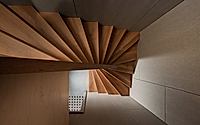
A central stair links two units and shared rooms, enabling multigenerational use without carving the house into strangers. The barn’s vertically extended volume becomes an in-between hall for autumn gatherings—half inside, half out, warm enough to linger with a coat. Everyday heat comes from an air-to-water heat pump, while a tiled stove keeps rituals alive (and hands warm) on colder evenings.
Carry the Grain
Parts of the ground-floor boards remain underfoot, burnished by time, with a custom oak ensemble—table, bed, bench—built with lean, precise joinery. The set, named Bedřich, sits among refurbished pieces, knitting rooms in the preserved wing without noise or fuss. The material language stays simple. Oak, plywood, and mineral surfaces take the lead.
Wind moves the shutters and scatters resin scent from cut timber. In that quiet, the house shows its layers, old surfaces steadying the new work that keeps it standing. The cottage is neither disguised nor staged—it’s readied for use, and for the weather that always returns.
Photography by Tomáš Slavík
Visit Studio Plyš