Octothorpe House by Mork-Ulnes Architects
Octothorpe House settles low in Bend, United States, where Mork-Ulnes Architects explore a cross-laminated timber house shaped by light and memory. Four slender shed-roofed wings organize the home into public and private realms, drawing desert views deep indoors while small planted courts mark pauses along the way. The result is a calm, contemporary dwelling that treats circulation as both route and room.


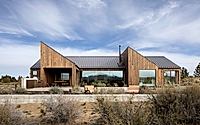
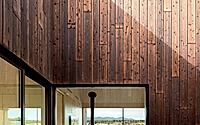
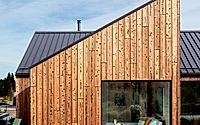
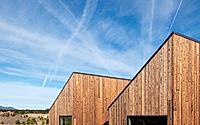
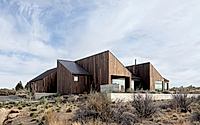
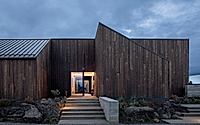
Low against the high-desert sky, Octothorpe House meets the scrubland with dark timber planes and sharp shed roofs. From the edge of the site, thin concrete plinths, gravel beds, and native planting lead the eye toward bands of glass that cut through the charred wood—a first hint that the interior reads as another strand of the landscape.
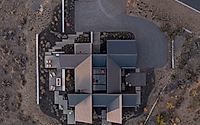
This is a house of bars and crossings. Conceived by Mork-Ulnes Architects as four intersecting shed-roofed volumes, the house in Bend, United States organizes daily life along slim corridors of living, sleeping, and working, each wrapped in cross-laminated timber. At their joints, planted courts punch daylight and air into the plan, so circulation follows a clear sequence of compression and release.
Intersecting Bars Plan
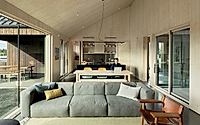
Four elongated wings divide the house into public and private realms, their shed roofs tilting rhythmically across the desert foreground. One bar holds the social rooms, where living, dining, and kitchen areas align in a continuous volume framed by large panes of glass on both sides. Another wing gathers bedrooms and quiet corners, turning slightly away from the main outlook to give more focused views toward sage and stone.
Movement through the house follows these bars, so every step tracks parallel to landscape and light rather than internal walls. The narrow proportions ensure that no room sits far from an exterior edge, making circulation feel direct and legible even as the volumes interlock.
Courtyards As Hinges
Where the shed-roofed bars cross, the plan carves out courtyards instead of solid rooms. At the center, a fully enclosed planting court anchors the octothorpe-like diagram, giving sunlight and seasonality to the heart of the house. Around the perimeter, seven semi-enclosed courts tuck between the bars, shaping sheltered terraces and small outdoor rooms that buffer the interior from wind and glare.
These courtyards act as hinges between functions, mediating shifts from social to private zones without abrupt doors or dead-end halls. A resident moving from bedroom to living room grazes the edge of a planting court, glimpsing sky and vegetation before re-entering the warm timber interior.
Rooms Open To Landscape
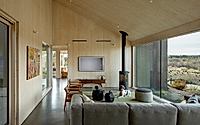
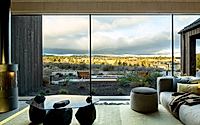
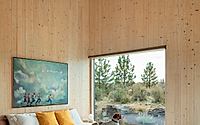
Inside, raw cross-laminated timber lines walls and ceilings, creating tall, simple rooms that keep the focus on the desert beyond the glass. Floors of smooth concrete run unbroken from one bar to the next, reinforcing the house as a continuous path rather than a series of enclosed boxes. In the main living room, a low sofa and a few grounded pieces of furniture sit toward an expansive window wall, directing attention to the horizon more than to themselves.
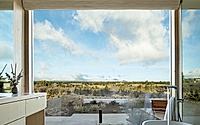
Bedrooms and the bathroom follow the same clarity. Headboards, freestanding tub, and compact tables orient toward broad windows, so morning routines begin with wide views of scrub, sky, and distant hills instead of artifice. Sliding doors connect interior to adjacent terraces, making it easy to move outside for air or to cross toward another bar.
Material Story And Memory
The house stands on ground once marked by wildfire, and its material palette acknowledges that event without sentimentality. Exterior cladding uses ashen Shou Sugi Ban cedar boards, their vertical patterning echoing the charred trunks that once occupied the site. Inside, the untreated cross-laminated timber maintains a pale, uniform tone, so light reflects softly across ceilings and down tall walls.
Generous glazing on opposing faces of each bar works in tandem with this timber shell, drawing daylight deeply into the plan while keeping views in constant play. As the sun rotates, courtyards catch shifting shadows, and rooms alternate between direct light and calm, indirect glow, giving each route through the house a subtly changing rhythm.
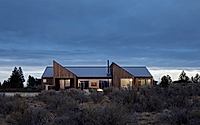
By evening, the intersecting volumes read as a low, precise silhouette against the lingering sky, bands of interior light slipping between charred boards. The plan that organizes movement during the day now traces a warm diagram across the landscape, tying courtyard, room, and path into one continuous line.
Photography by Jeremy Bittermann – JBSA
Visit Mork-Ulnes Architects