Casa Binôme: Reimagining a Madrid Duplex Around a Living Stair Core
Casa Binôme unfolds as an 80 m² attic house in Madrid, Spain, reworked by Gon Architects into a precise duplex centered on a reimagined stair. Within a narrow plan and a protected urban setting, the project turns circulation, storage, and everyday rituals into one continuous sequence that extends from kitchen to terrace. The result is a home that supports both sociable evenings and introspective days with equal care.
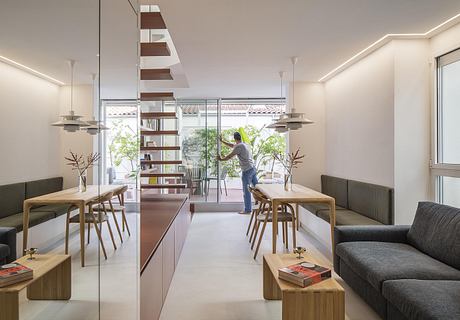
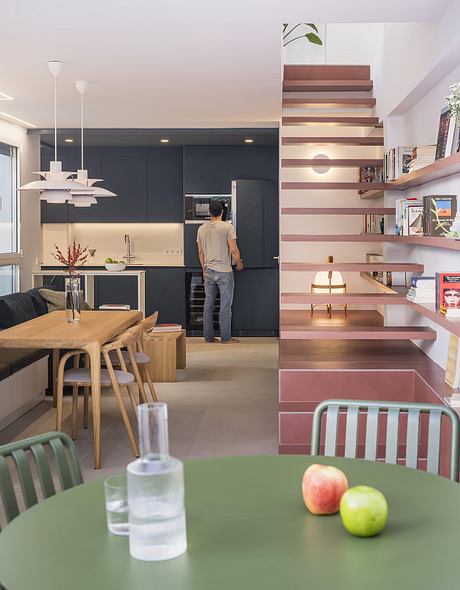
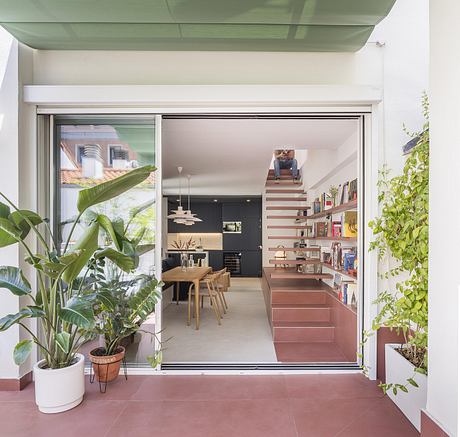
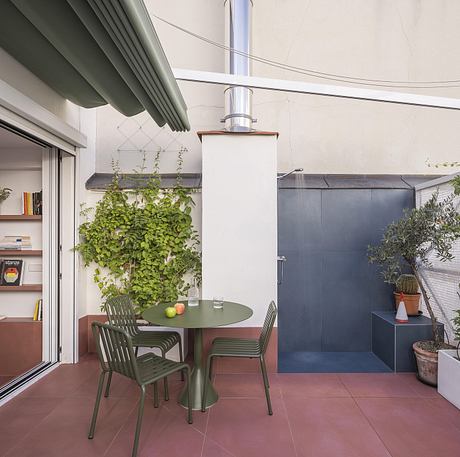
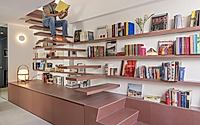
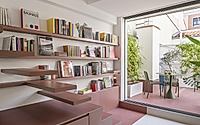
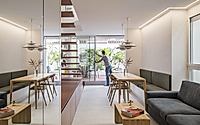
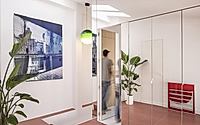
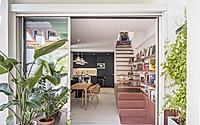
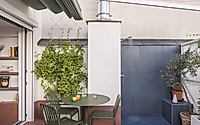
Light cuts across the narrow interior and lands on a run of slim steel treads that read as shelving before they read as steps. From the terrace, tomette-red flooring pulls the eye inward, drawing the exterior into the living level and up through the duplex in one steady movement.
This is a compact house in Madrid’s Conde Duque neighborhood, reconfigured by Gon Architects as a duplex where the staircase becomes the project’s central device. The brief is straightforward yet charged: keep the location and square meters, but invent a new domestic life for a resident whose days oscillate between social gatherings and deep solitude. Rather than hide the constraints of a 3.25-meter-wide plan, the architects work with them, turning vertical circulation into structure, furniture, gallery, and pause point.
Philippe has already lived here for years, so the renovation begins from lived experience rather than blank-slate ambition. Overly partitioned rooms, hotel-like bathrooms, a disconnected terrace, and an over-scaled kitchen once carved the duplex into fragments that did not reflect his routines. The existing welded steel stair sat heavily in the center, casting shadows and producing leftover corners that no activity could claim with confidence.
Relocating The Vertical Core
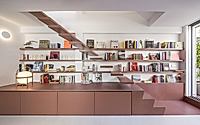
The first decisive act is to shift the stair to the east wall, directly opposite its original position. Opening a new void in the upper slab requires a near total gutting of the interior and leaves, for a time, a single 181 m³ volume that lays bare beams, columns, and light paths. In this cleared shell, circulation is no longer a fixed obstacle but a negotiable line that can absorb storage, seating, and display without crowding the narrow plan.
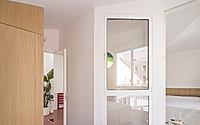
With the move, both levels reorganize around clearer programs that follow daily use rather than old partitions. The lower floor holds the shared areas, from kitchen and living room to terrace and guest bathroom, while the upper floor gathers bedrooms, a bathroom, and a flexible central zone that can shift between work, reading, or quiet retreat.
Staircase As Domestic Instrument
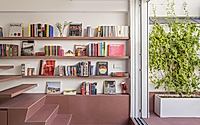
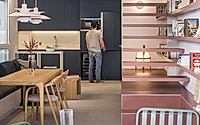
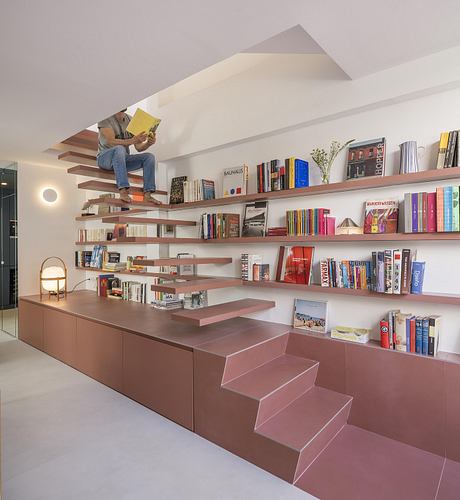
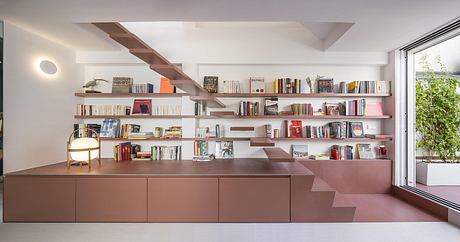
Between existing metal columns, Gon Architects insert 7 cm thick steel shelves that step up vertically to form cantilevered treads of the same depth. Hidden welded structure carries each tread back into the wall so that the stair reads as an extension of the shelving system rather than a separate object. Below, a compact grounded volume aligns with the first three steps and acts as a solid base, reinforcing the sense that the upper run floats in place.
In use, this linear element works as far more than passage between floors. Residents sit on the lower steps to read, lean against the shelves to study artwork or books, or stretch out for a brief nap when sunlight lands just right. Circulation, storage, display, and inhabitable perch fold into one continuous piece that turns a former obstacle into the project’s most generous domestic surface.
Sequences Of Light And Air
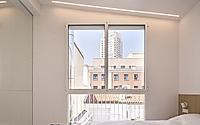
Repositioning the stair clears new pathways for daylight that once stopped at the steel flight and its balustrades. Now light travels from terrace to upper bedrooms with fewer interruptions, making both levels feel taller and more open despite the narrow width. Every room keeps a direct relationship to the exterior so cross-ventilation becomes an everyday condition rather than a seasonal luxury.
On the lower level, movement flows from entrance to kitchen, living room, and terrace in a simple loop that suits gatherings as easily as quiet nights. Upstairs, circulation bends around the stair landing to reach bedrooms and the central flexible area, so privacy is maintained yet no corridor feels residual or leftover.
Tomette Red And Chromatic Order
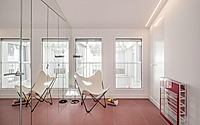
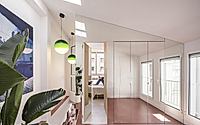
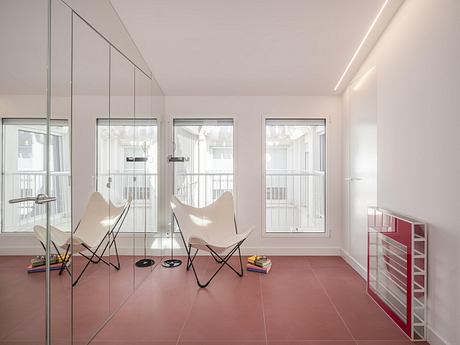
The material palette answers both memory and climate, tying the reorganization of movement to surfaces that work hard over seasons. Continuous ceramic flooring draws on tomette tiles from southern France, whose terracotta tones store warmth in winter and release coolness during hot months. Here the reference shifts into a large-format piece at 1.20 x 0.60 m, laid inside and out so that the tomette red extends from terrace through living areas and up the stair.
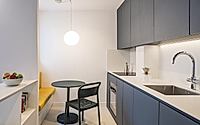
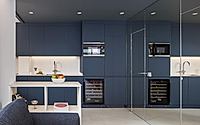
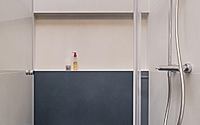
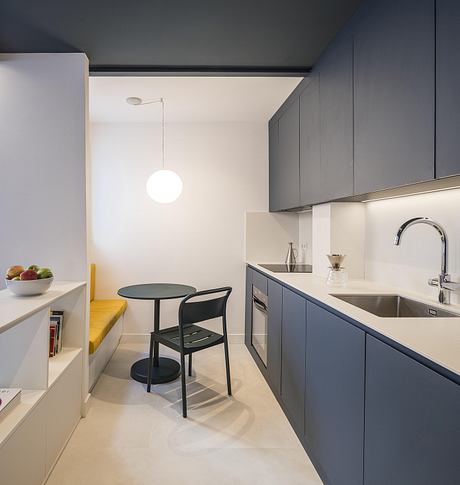
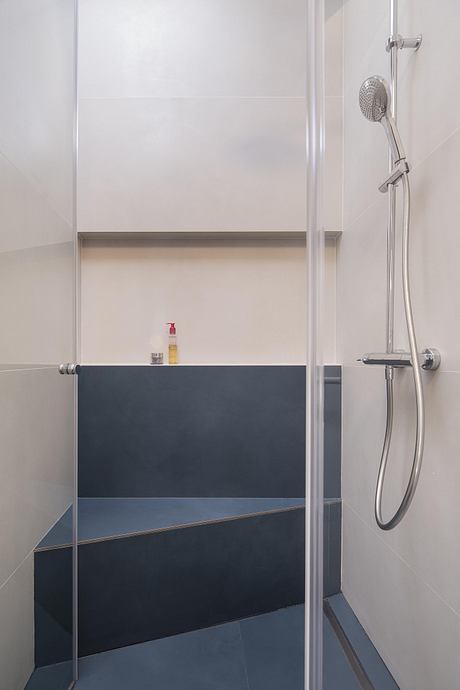
Bathrooms, bedrooms, and the kitchen are finished in the same format but in gray and blue tones to register changes in program. This measured chromatic variation signals shifts from public to private routines while keeping a single material logic that resists visual clutter. Underfoot, the ceramics give each step and threshold a tactile continuity that links Philippe’s memories of Plateau de la Brie to his daily life in Madrid.
Mirrored Rooms Within Rooms
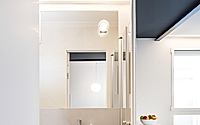
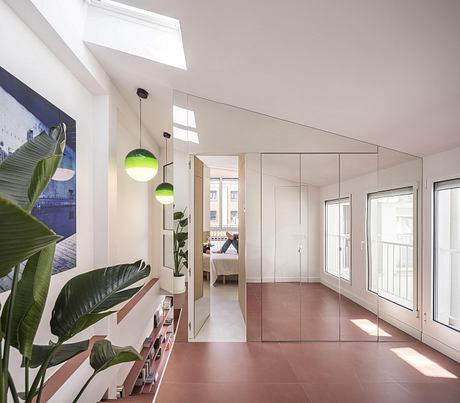
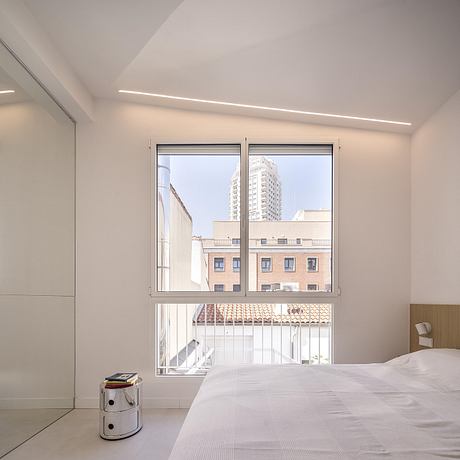
Two volumes clad in mirror, one on each level, deepen the sense of extension without adding a single extra square meter. On the lower floor, the mirrored bathroom prism multiplies books, lamps, and the red floor, so the living area reads as larger and more animated throughout the day. Above, the master bedroom volume receives the same treatment, its reflective skin softening edges and scattering light into adjacent areas.
These mirrored rooms both reveal and conceal, bouncing images while keeping their own interior activity private behind doors and panels. Reflections dissolve the weight of these boxes, turning once-solid partitions into shifting surfaces that respond to the resident’s movements, the hour, and the angle of sun.
As the day closes, the stair again becomes the central actor in the house, catching last light from the terrace and carrying it upward in thin bands across steel and tile. Philippe moves easily between shared table, mirrored bathroom, and high attic bedroom, following a route that now aligns with how he actually lives. In Casa Binôme, the duplex reads as two exterior planes joined by one precise vertical instrument, making a compact urban home feel expansive in use rather than in size.
Photography by imagensubliminal
Visit Gon Architects