Storage Barn in Utriai — Rural Storage Welcomes Overnight Guests Too
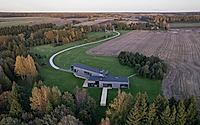
Storage Barn in Utriai stands on a Lithuanian farmstead in Klaipėda, Lithuania, where Architectural Bureau G. Natkevicius & Partners rethink what a barn can hold. The project folds machinery storage, workshops, and guest quarters into one metal-clad volume, tracing a line between agricultural grit and domestic comfort without losing sight of either side. Inside, the plan and materials quietly argue that rural infrastructure can support real life as well as work.


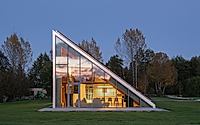
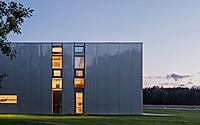
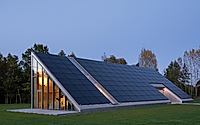
Metal cladding catches the rural light, reading as a single sharp wedge against the fields. Behind the stainless steel-colored shell, glow and shadow reveal a very different interior life.
This barn in the village of Utriai is conceived by Architectural Bureau G. Natkevicius & Partners as a hybrid farm building, balancing agricultural storage with generous rooms for work and guests. The project stays rooted in its utilitarian role yet reworks daily use: under one mono-pitch roof, heavy machinery, workshops, and overnight accommodation share a flexible, clearly organized plan.
Dividing Work And Rest
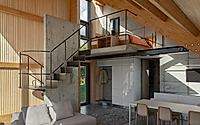
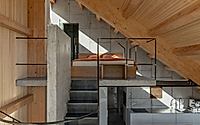
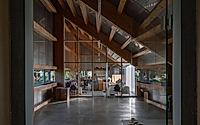
The volume is split in two, with a high, open hall for “clean” storage set against a more intimate western wing. Wide sectional doors pull tractors and equipment straight into the tall bay, where a simple, unobstructed floor keeps agricultural tasks efficient and easy to reconfigure as the farm evolves. On the opposite side, a separate entrance marks a shift to human scale, leading into auxiliary rooms and a mezzanine that support work during the day and sleeping at night.
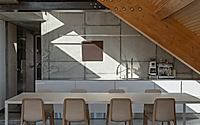
This smaller wing reads as a universal core, less warehouse than workshop and living loft. Surfaces and openings are calibrated so the same rooms can hold tools, long tables, or beds without losing clarity or comfort as their role changes.
Material Warmth In A Barn
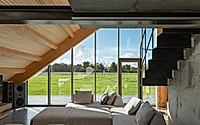
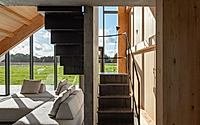
Inside, exposed glued laminated timber frames (GL28h class) set the rhythm, their repeated spans giving the barn a steady, legible order. The massive wood elements bring warmth and tactility to the interior, softening the hard polish of concrete underfoot and tempering the industrial reading of the volume. This concrete-and-timber pairing supports a loft-like character where a workshop can tolerate mud and tools, yet still feel calm enough for quiet evenings with guests.
Avoiding “cheap” finishes, the architects rely on honest surfaces that withstand agricultural use. Robust materials help daily life move easily between mechanical work, social gatherings, and rest without constant maintenance or visual clutter intruding on the rural calm.
Light For Daily Routines
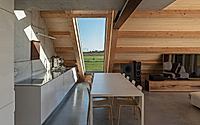
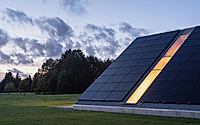
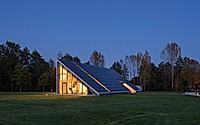
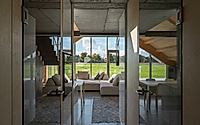
Natural light underpins the building’s shift from storage hall to lived-in barn. A large glass showcase on the western facade frames sunsets for the guest and work wing, turning evening light into a daily ritual for anyone staying overnight. Overhead, a dramatic skylight that bends down into a vertical window on the northern facade pulls daylight deep into the volume, brightening even the farthest corners.
This move is crucial for the mezzanine, which acts less like an attic and more like an observatory over fields and machinery. With light and views on two levels, the upper rooms support reading, conversation, or sleep as easily as spare storage, keeping the hybrid program coherent throughout the day.
Shell And Rural Setting
From outside, the barn stays deliberately opaque, almost mute to the surrounding village. A stainless steel-colored sandwich panel envelope wraps walls and roof in a continuous skin, turning the mono-pitch, wedge-shaped silhouette into a singular rural object. This outer shell works hard: strong, low-maintenance, and ready to endure use and weather without fuss.
The 35-degree roof pitch sharpens the profile and prepares the building for energy independence with solar power. Under that pitched armor, the rhythms of farming, craft, and hospitality overlap, giving this outbuilding a daily life that goes well beyond storage.
At dusk, the metal shell glows from within while machinery rests and guests look out to the fields. The barn holds both quiet labor and shared evenings, proving that an agricultural building can host work, conversation, and sleep without breaking its rural stride.
Photography by Lukas Mykolaitis
Visit Architectural Bureau G. Natkevicius & Partners