Library in the Earth by Hiroshi Nakamura & NAP
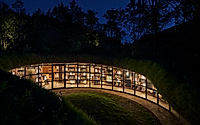
Library in the Earth sinks quietly into the soil of Kurkku Fields in Japan, a working agricultural landscape shaped by Hiroshi Nakamura & NAP. Conceived as a library for farmers, the underground volume restores a damaged valley while sheltering readers in earthen rooms that follow the contours of the ground. Daily labor above and slow reading below share one continuous terrain of soil, water, and light.


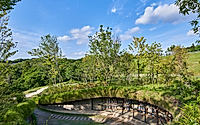
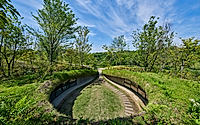
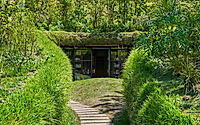
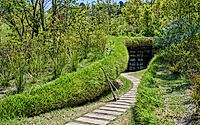
You walk across plowed earth and clipped lawn, the ground quiet underfoot. Then a narrow cleft opens, drawing you down toward shelves, soil, and a cooler light.
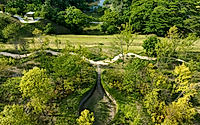
Set within Kurkku Fields in Japan, this library by Hiroshi Nakamura & NAP sits below the cultivated surface so farmers can move from field to reading room without leaving the terrain they work each day. The project restores a former valley packed with construction debris and turns it into a modest earthen volume for rest, reflection, and books. Context drives every move, from the droplet-shaped plan to the way irrigation and water retention are tuned through planted slopes overhead.
Cutting A Cleft
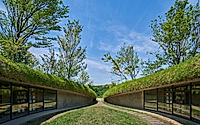
From above, the intervention reads as a teardrop cut into the ground, a small incision rather than a dominant object. Visitors slip through this cleft after crossing the plowed surface, transitioning from bright, exposed fields to a shaded corridor lined with books. The cultivated soil layer remains intact above, free for plants and microorganisms, while the library inhabits the volume beneath. Architecture retreats so the terrain stays continuous for farmers and the wider ecosystem.
Earthen Rooms Below
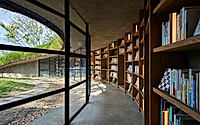
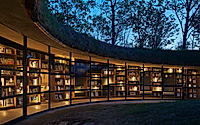
Inside, floor, walls, and ceiling share the same earthen finish, curving gently so boundaries soften and the underground volume reads as a carved interior. Concrete void slabs cantilever from retaining and wing walls, removing visible beams and columns and keeping the ceiling plane clear around the books. Along the vertical edges of these slabs, lawn planted up to the lip spills downward, lending a sense of moisture and seasonal change. That simple detail also lets the team adjust irrigation and water retention as weather shifts across the year.
Reading Along The Slope
Ceiling height follows the natural gradient of the ground above, so the route slips from compressed passages to taller halls without breaks in the earthen envelope. Low portions create intimate nooks and small rooms sized for children, places that feel discovered rather than announced. Deeper in, the route widens into a stepped storytelling hall where books gathered by farm workers stand beside volumes for younger readers. The stepped seating folds outward from the floor, turning the deepest section into a shared living room for the local agricultural community.
Bookshelves As Structure
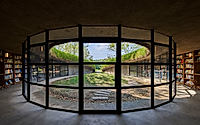
Bookshelves do more than hold paper; their thin vertical frames rise past eye level to support the room itself. Each 40mm element leans on its neighbor, forming a chain of reciprocal support that circles the hall. No single member dominates, yet together they carry the larger volume overhead and define its quiet perimeter. Out of this structural mutuality grows a social room, one that reflects the interdependence of the farmers who share their collections here.
Light From The Pond Sky
At the center, a top light opens to the sky, framing a disc of blue and cloud that recalls the nearby Mother Pond and its restored valley. Sunlight drops onto earthen surfaces and stacked books, reminding readers that the library sits within the same soil that feeds the surrounding fields. As day moves on, the changing light keeps that connection vivid, turning a compact underground room into a place to think about land, labor, and shared knowledge.
By tucking the program under a reconstituted ground plane, Library in the Earth lets the agricultural landscape heal while giving farmers a place to pause. Readers sit within earthen walls, look up to a round slice of sky, and feel the weight of planted soil above. The library stays modest in form yet deeply tied to the cycles and communities that surround it.
Photography by Koji Fujii / TOREAL
Visit Hiroshi Nakamura & NAP