Atria Institute in New York by Rockwell Group
Atria Institute in New York transforms a medical facility in New York, NY, United States into a residential-style retreat by Rockwell Group. The project folds preventive care, advanced diagnostics, and hospitality into a layered interior where travertine, walnut, and gold leaf frame a calm experience. Patients move from lobby to lecture garden and private suites with a sense of rhythm rather than rush, supported by precise material choices and controlled light.


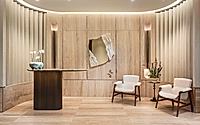
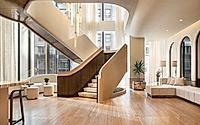
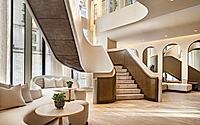
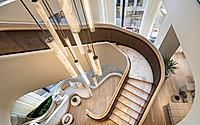
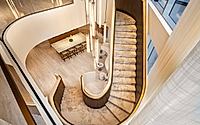
Light falls through a skylight into stone and plaster, catching the edges of travertine and fluting. Atria Institute in New York greets patients with a lobby that feels closer to a grand residence than a clinic, using scale, tactility, and calm sightlines to steady those arriving for advanced care.
This medical facility in New York, NY, United States gathers diagnostic technology, pediatrics, and longevity medicine under one roof while Rockwell Group builds the experience around hospitality and material warmth. The interiors read as a sequence of living rooms, library, lecture hall, and suites where color, texture, and crafted surfaces anchor the preventive care program. Interior palette and furnishing drive the narrative, turning clinical routines into something that feels paced and considered.
A guest steps under the central skylight and meets walls of travertine and fluted plaster, which set a tone of permanence and craft from the first steps. A custom cantilevered marble desk by Karen Pearse acts as both reception and sculptural marker, its solid mass balanced by clear circulation toward the library and patient areas. Nearby, a Tech Showcase pulls advanced tools for health into view, while elegant, streamlined furniture in tactile fabrics softens the threshold between waiting and consultation.
Layered Warmth In The Library
Beyond the entrance, the library becomes a meditative core without direct sunlight, so the designers turn to a 23-karat Caplain gold-leaf ceiling to bounce light back into the room. Reflections lift the ceiling plane and bring a quiet glow to shelving, a fireplace on the west wall, and carefully aligned furniture that points toward the patient wing entrance. A vestibule between library and treatment rooms filters sound and gives patients a brief pause before moving from social areas into more private care zones.
Lecture Garden And Lounge
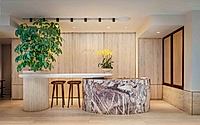
Tall archways link the library to a two-story stair and a lounge that doubles as a Lecture Garden, where natural light floods in for talks and informal exchanges. A custom modular sofa and groupings of armchairs create a soft amphitheater, shaped more like a living room than an auditorium. A kitchen island with counter stools and a wall of Ivory Ice Onyx continues the residential cue, allowing physicians and patients to linger after presentations rather than rushing back to corridors.
Material Story In Everyday Rooms
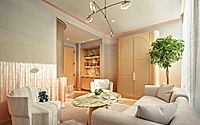
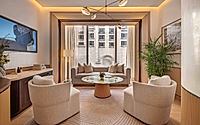
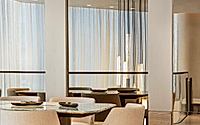
In one light, airy room, a custom travertine table on a matte brass base holds a ring of Capellini armchairs beneath Apparatus pendants, with a custom ombre rug from Loloey grounding the group. Slatted wood, brass screens, and fluting repeat along walls as quiet rhythms, giving waiting areas and circulation routes a shared language of vertical lines and warm metal. Across the institute, the palette pulls from a spectrum of skin tones: rich walnut, pink-hued travertine, venetian plaster, supple fabrics, and chevron white oak underfoot.
Pediatrics, Suites, And Privacy
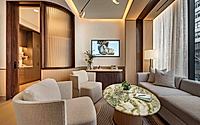
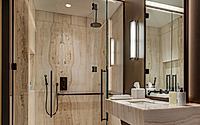
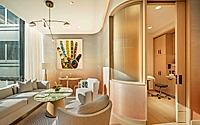
The pediatrics wing on Level 4 shifts to lighter woods and more colorful furniture, tuned to adolescents and children while still maintaining a refined sensibility. Patient lounges and exam rooms balance playfulness with calm, supported by curved frosted glass partitions that bring light into exam zones while protecting privacy. Suites pair lounge area, en-suite bathroom, and exam room; Ravalli chairs by Caste rotate so patients can decide how to sit, where to face, and how to engage. A fixed sofa built into framed window openings creates a cocoon-like seat with a lower center section for clearer views outside and more personal distance between occupants.
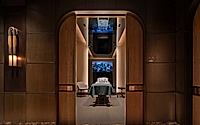
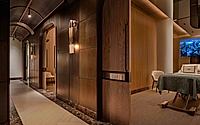
In the diagnostic area, advanced medical technology sits within a room scaled for reassurance rather than spectacle, with moon-phase wall illumination and an ambient cocoon effect. Corridors lead through the institute on a circuitous path, where dark walnut clads exterior patient room walls and venetian plaster lines imaging and back-of-house surfaces. Movement tracks past consistent materials and soft furnishings, so even a walk to testing feels measured rather than harsh.
Back near the lobby, travertine, bronze, copper, and marble return to close the loop on the interior story. Patients exit under the same skylight that greeted them, carrying impressions of gold leaf, warm wood, and quiet textiles instead of sterile glare.
Photography courtesy of Rockwell Group
Visit Rockwell Group