A45 Penthouse by Architecture Discipline
A45 rises as a 5,900-square-foot penthouse in New Delhi, India, shaped by Architecture Discipline for a single owner with a serious love of art. The home stretches along the treetops, wrapped in glass and carved around a sculptural stair, setting up a calm urban aerie where collections, light, and measured material choices drive every room. What results is a precise yet warm retreat above the city’s dense texture.


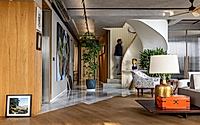
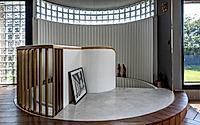
Late afternoon light washes across white marble steps before sliding onto warm timber underfoot. Beyond the glazing, Gulmohar and Banyan canopies press close and green. Inside, a restrained palette lets artworks pull the eye further along the long, linear home.
This penthouse, A45, occupies the upper level of a New Delhi residence as an expansive bachelor home framed by trees on two sides. Architecture Discipline organises the penthouse as a linear sequence, with shared rooms, a semi-private study, and bedrooms set within a glass enclosure that tracks views and daylight. The throughline is clear: calm surfaces, measured color, and carefully placed furniture create a monochrome armature for a substantial collection of sculpture, painting, and heirlooms.
A central spiral stair becomes the hinge between communal rooms and private quarters, exaggerating the length of the plan while drawing the eye upward to a terrace, conservatory, and pool. Every zone reads as a gallery for a specific piece, yet the home still functions as an easy setting for intimate gatherings and daily life.
Stair As Sculptural Anchor
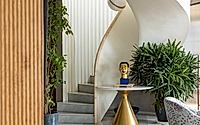
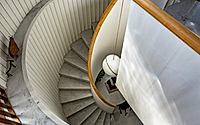
At the heart of the plan, a sinuous white marble staircase breaks the rectilinear order of the interior. Its curved run wraps a suspended Crescent Pendant by Lee Broom, which in turn aligns with G. Ravinder Reddy’s bold ‘Head’ sculpture at the base. Light from the floor above falls down the stairwell, sliding along the white surfaces and sharpening edges during the day. The element acts as circulation and as an object in its own right, setting a confident tone for the rooms that radiate from it.
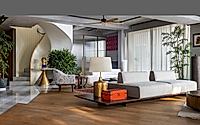
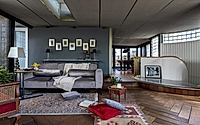
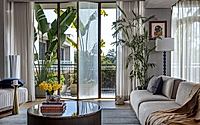
On one side of this vertical anchor, the living area stretches in a long band under glass, divided into formal and informal zones by furniture rather than walls. A low-seater sofa with an extended ledge is oriented around a large brass lamp by Beyond Design, allowing the lamp to act as both sculpture and soft light source. This built-in ledge mediates between seating and circulation, making the transition between social pockets feel intuitive. Across the room, exposed ducting runs overhead, underscoring the modern character and keeping services legible rather than hidden.
Monochrome Rooms For Art
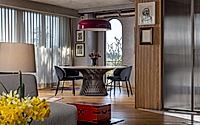
A45 leans into a largely monochromatic interior scheme, but not a cold one. White walls and pale stone work alongside warm wooden flooring to set up a quiet envelope for vivid artwork and objects. In the dining area, the theme of softness comes through in form more than color: a circular monolithic marble table, rounded chairs, and a Smithfield pendant by Jasper Morrison offset the linear composition of a contemporary painting and fluted timber wall behind. Stone tones and upholstery hues are tuned to echo the timber floor, so the eye reads one cohesive field rather than a collection of separate pieces.
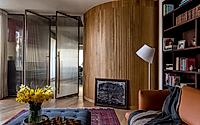
A zig-zag junction of glass partitions wraps the shared rooms, giving them a delicate perimeter. Clear and fluted glass alternate, riffing on the folds of drawn curtains and changing the quality of light that reaches the interior. Views filter through to treetops just beyond, so art on the walls shares attention with the living canopy outside. Long balconies lined with potted plants extend this dialogue, their greenery reinforcing the calm, grey-and-wood interior palette rather than competing with it.
Piano Nook And Study Sequence
Near the living area, a piano nook takes on a more playful character. A vivid red sculpture of monkeys by designer Arun Kumar stands against the glossy black piano, creating a sharp chromatic contrast. A compact Binic lamp by Lonna Vautrin adds another small but precise object, turning the corner into a miniature composition of color, sheen, and light. Natural light from a nearby bay window supports this corner, preventing the strong hues from feeling heavy.
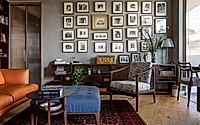
Beyond the piano, the study unfolds within the bay, wrapped in timber and bathed in daylight. Desk and chair sit within the window recess, giving direct views into the surrounding vegetation and grounding work hours in the changing atmosphere outside. Natural oak flooring from the adjacent living room continues into this zone to maintain continuity, so the study reads as an extension rather than a closed cell. Photographs of family heritage and select antique pieces sit in pride of place, with furniture and finishes deliberately restrained so these smaller artifacts carry emotional weight.
Private Rooms With Quiet Detail
A marble-lined corridor leads away from the social areas toward the quieter wing. Here, the flooring becomes an argyle of three marbles—Carrara, Swiss white, and Thassos—laid so their subtle tonal shifts suggest a woven surface. The pattern delivers the intricacy of a textile while preserving the durability of stone underfoot. Bedrooms open off this hall, each with its own balcony, which keeps the connection to air and planting intact even in the most private zones.
Within the bedrooms, chevron-patterned wooden flooring pairs with white walls to form a simple frame for selected furniture. Cornices provide a measured layer of depth on the otherwise pristine walls, avoiding ornament overload yet softening junctions. In the master room, a contemporary reinterpretation of an antique bed quietly acknowledges the owner’s Calcutta roots, grounding the otherwise contemporary setting. A sliding glass partition draws the room toward a Banyan tree outside, so waking up means facing foliage at close range rather than distant skyline.
Terrace Conservatory And Climate Shell
Above, the terrace shifts the tone from apartment to open-air retreat. A British-style conservatory stands as a glass box for relaxed gatherings, its facade divided into vertical elements reminiscent of Georgian bar windows. On the southern side, glass bricks temper the strong sun, letting light enter as a dappled, playful glow across the lounge. Thermally insulated ash timber flooring in a herringbone pattern extends the material story from below while addressing the harsher rooftop climate.
Furniture on this level leans toward reuse, with re-upholstered pieces giving the conservatory an eclectic character. Insulating glass with jute liners helps control heat gain, while an insulated corrugated metal roof, cut by a skylight and fitted with exhausts, supports cross-ventilation during intense summers. Instead of a solid parapet, a stepped plantation and herb garden trace the perimeter, so the boundary is formed by planting rather than a hard edge. Outside the private realm, the facade gathers brown-textured paint, brown-tinted glass, and antique brass railings into an earthy composition that sits comfortably against the city’s larger fabric.
As day recedes, the prismatic box of A45 glows gently against the trees, its interior artworks and objects catching soft layers of artificial light. Rooms remain calm, more gallery than showroom. In that balance of controlled palette, detailed furnishing, and steady connection to vegetation, the penthouse finds a personal version of urban luxury.
Photography courtesy of Architecture Discipline
- by Matt Watts