Le Très Petit Collectif: Timber Pods Recast a 1950s Coastal Home Life
Le Très Petit Collectif stands on a coastal plot in Carry-le-Rouet, France, where AT Architectes reworks a modest 1950s house into compact contemporary dwellings. The project forms a very small collective of three adaptable units, using a new timber structure to wrap the original masonry shell while preserving the sandy garden and its established trees. Each apartment opens toward the Mediterranean light, framing outdoor terraces as extensions of everyday life.


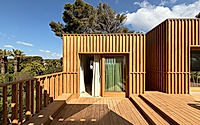
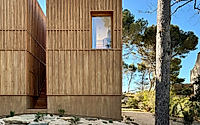
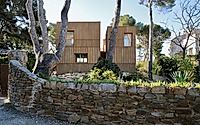
Sun cuts across the rhythm of vertical timber slats as it moves over the upper terraces, casting striped shadows that slide over deck, railing, and door. From the garden path, the stacked wooden volumes sit above pale gravel and low planting, their warm cladding catching the light off the nearby sea.
This very small collective reworks a detached 1950s house in Carry-le-Rouet into three distinct dwellings, each conceived to adapt over time for a single extended family. AT Architectes uses a new timber structure to extend and wrap the existing building, turning a once conventional suburban lot into a compact cluster of coastal rooms. Material choices drive the project’s transformation, from the lightweight wood superstructure to the thick exterior lattice that tempers sun and frames outdoor living.
Building Above The Old
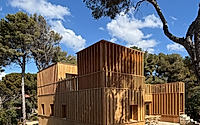
The original masonry house stays in place, now encased by a surélévation in timber structure and cladding that rises as a series of rectilinear volumes. This construction strategy limits added weight on existing foundations and preserves the permeable ground around the footprint, a clear response to both technical constraints and environmental pressure. Vertical battens articulate the façades, giving depth to flat planes and creating a quiet play of light and shade across the upper walls.
Timber As Thermal Shell
Beyond its visual warmth, the new timber envelope resolves the poor thermal performance of the 1950s construction, built at a time when energy cost barely entered the brief. The added structure forms a continuous insulated shell around and above the old house, reducing heat loss while protecting interiors from strong Mediterranean sun. Deep frames around windows and doors act as small loggias, pulled slightly outward so interior rooms gain shade without losing clear views to trees and sea.
Rooms Opening To Terraces
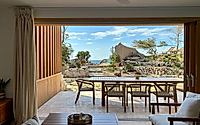
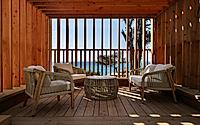
Glazed doors slide wide to connect living rooms with broad timber decks that step along the upper level, turning circulation into generous outdoor rooms. One terrace holds a dining table under open sky, another becomes a more intimate lounge screened by closely spaced slats that direct views to the water while softening afternoon glare. These external platforms work as shared thresholds between interior comfort and the rocky, planted garden that surrounds the house.
Interior Warmth And Clarity
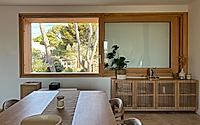
Inside, white walls and pale stone or tiled floors set a calm base for joinery in the same honey-toned wood as the exterior. Large picture windows frame pine trunks and distant sea, while sliding interior panels manage privacy between different rooms. Simple furniture in natural fibers and timber keeps volumes legible so the material continuity from façade to cabinet becomes the quiet theme of daily use. Each apartment can act as a home for grandparents, an adult child, or even a small office, yet all share this same tactile, daylight-driven shell.
As day ends, shadows from the façade lattice lengthen across decks and down to the gravel garden, knitting the new timber volumes back to the ground. The once single house now reads as a compact cluster, its construction logic visible in every slat and frame. Material choices carry the transformation, turning a modest suburban relic into resilient coastal housing tuned to its light and soil.
Photography courtesy of AT Architectes
Visit AT Architectes