Matisse Apartment Recasts a 1990s Plan into Fluid Brazilian Living
Matisse Apartment sits in Moema, São Paulo, Brazil, where Gurgel D’alfonso reshapes a 1990s apartment into a generous, connected home. The renovation turns former sharp angles and level changes into calm transitions, while a restrained palette and Brazilian furniture anchor family life. Art, natural materials, and carefully tuned light give the residence a collected character that feels both urbane and grounded in local craft.


Soft light washes across off-white floors as the elevator doors open. Curved edges and quiet textures guide movement, trading the old apartment’s hard lines for measured calm.
This is an apartment renovated to be lived in fully, where furniture, art, and material choices hold the story of a growing family. Matisse Apartment, an apartment in Moema, São Paulo, Brazil by Gurgel D’alfonso, turns a once-compartmentalized 1990s layout into an open sequence defined by material continuity and Brazilian pieces. The work foregrounds surfaces, objects, and tactility, letting the plan recede behind a clear palette and a precise sense of rhythm.
Across its three staggered levels, the apartment becomes a study in how materials choreograph daily life. Monolithic floors, curved walls, and sculptural stone objects knit rooms together, while modern and contemporary Brazilian furniture adds warmth and memory. Every major element feels tuned for use: places to sit, gather, cook, and read are all drawn from the same restrained vocabulary.
Reworking The Plan
The renovation starts by reading the existing levels not as problems but as opportunities for sequence. Instead of flattening everything, the architects broaden steps into landings with curved edges, so each shift in height becomes a gentle threshold. Short runs of stairs double as transitions between social zones and as platforms for sculptural pieces, turning circulation into a slower, more deliberate path.
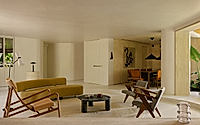
Corners once defined by hard right angles now resolve as soft arcs. That simple move pulls the eye through rooms and helps the off-white flooring, which wraps up walls and ceilings, feel continuous rather than patchwork. The result is a series of interconnected rooms where edges rarely interrupt movement, and where family life stretches easily between living room, balconies, and TV rooms.
Material Calm And Light
Material continuity underpins almost every decision here. A monolithic off-white finish by Monofloor runs underfoot and up vertical surfaces, minimizing joints and visual noise while standing up to the daily wear of a child and a dog. That pale base acts like a quiet field, strengthening the presence of wood, stone, leather, and textiles.
Light plays against these surfaces rather than competing with them. Strategically enlarged openings and reflective finishes draw natural brightness deeper into the apartment, while pieces like the Vela sconces—in steel and resin—add sculptural points of focus after dark. Marble threads from the entry’s underlit bench to the central totem, dining sideboard, TV shelf, kitchen island, and bathrooms, so the stone becomes a familiar companion rather than an isolated luxury gesture.
At the entrance, the materials set the tone immediately. A continuous textured shell wraps walls and ceiling, hiding joints and sharpening the silhouette of a simple marble bench lit from below. Just inside, the marble totem, partially resting on the first step, acts as both ritual surface for keys and lamp and as a small piece of inhabitable sculpture, balancing mass with a sense of suspension.
Rooms For Gathering
The main living room takes its cue from a circular Botteh rug that quietly fixes the center of gravity. Seating radiates from that circle: the C-Curvo sofa, Brazilian armchairs, a wooden bench, and a low coffee table together build a flexible field for conversation. Natural materials do much of the work; wood, stone, leather, and textured fabrics lend warmth without crowding the eye.
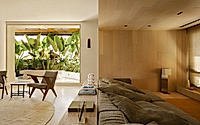
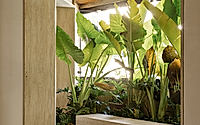
On one balcony, Estúdio Musgo’s planting folds greenery into daily routines. Dense foliage creates privacy and filters the city beyond, while a custom stone bench, resting on two cylindrical supports, aligns the body toward the skyline. Another balcony mirrors interior finishes as the floor runs outward and a wooden slat ceiling overhead echoes joinery inside, framing a round table set for meals among trees.
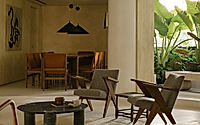
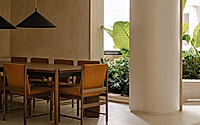
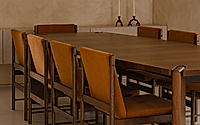
The dining room condenses these cues into a more intimate volume. Textured beige walls and ceiling, close in tone to marble, create a box that foregrounds the furniture: a solid wood table by the architects, chairs with wooden frames and caramel upholstery, pendant lights that read as objects as much as luminaires. A custom buffet and an artwork in the background tether meals to the broader curatorial thread of Brazilian modern pieces.
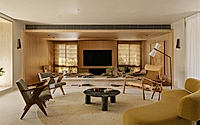
In the main TV room, located at the lowest social level, the material emphasis shifts toward enclosure. Wooden slats wrap walls and ceiling, improving acoustics and tightening scale, while a wooden portico marks entry and hides lighting and technical systems. A stone fireplace anchors the primary wall beneath the TV, and a deep, custom-built sofa grows out of the existing step, paired with a continuous low stone shelf that holds books and objects.
Kitchen And Everyday Rituals
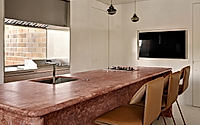
Cooking and entertaining inform the kitchen’s composition. A long counter runs toward a vertical wine cellar and grill, folding prep, storage, and social interaction into one linear arrangement. At the center, a Rosso Travertine island, with softened edges and a light base, reads as a grounded but gentle block, positioned where a former breakfast nook once stood.
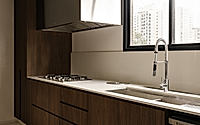
The stone’s presence extends the apartment’s language of curved transitions and tactile surfaces. It anchors gatherings around food, while steel and glass doors modulate separation between the entertaining side and the technical kitchen. In the service zone, wood and stone keep the palette measured, and a stainless-steel volume absorbs the range hood so equipment recedes behind clear forms.
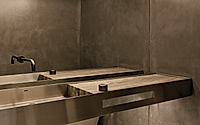
Even the compact powder room becomes a study in contrast and material precision. Cement-textured walls and ceiling form a quiet envelope, within which brushed stainless steel and Silver Travertine organize wet and dry areas. Metal meets stone in a composition that favors clean edges and hand-scale textures, giving visitors a concentrated experience of the apartment’s broader palette.
Intimate Private Realms
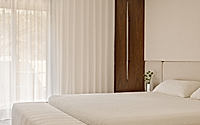
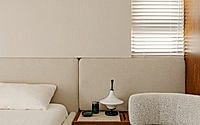
In the master suite, wood and stone again frame daily routines rather than dominate them. A chamfered Sucupira portico outlines the main wall, merging effortlessly into integrated side tables with Roman Travertine tops that discreetly hide power outlets. Above, a slim wall sconce adds a vertical line, balancing the horizontality of bed and bench.
The bed, upholstered with an attached bench at the foot, shows how furniture here tends to serve layered roles: seating, storage, and support for reading or rest. A June armchair shapes a reading corner, while the headboard, wall upholstery, and rug stay within a single tonal range, relying on shifts in texture rather than color to encourage calm. Just beyond, a generous walk-in closet uses tailored cabinetry to keep daily clutter out of view.
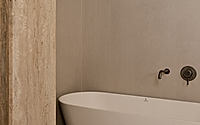
In the master bathroom, the material dialogue tightens. Roman Travertine sculpts basins and key surfaces, set against dark cabinetry that grounds the room. Integrated lighting at the mirrors casts even illumination across stone and wood, supporting everyday tasks without drama. A private sauna completes this realm, extending the project’s material logic into a quiet zone for recovery.
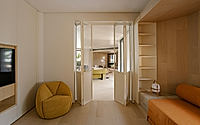
Even secondary rooms hold to the same palette. A children’s TV room, separated from the main living room by glass and metal-framed doors, layers color through upholstery and textiles, while fixed cabinetry and blinds stay within a restrained range of wood and neutral tones. The room doubles as a guest area with a sofa bed, underscoring how flexible furniture and consistent materials support changing family needs.
By the time one returns to the entry, marble, wood, and that continuous off-white surface read as familiar companions. Light moves differently across each level throughout the day, yet the apartment holds together through recurring textures and Brazilian furniture. Matisse Apartment demonstrates how a once-fragmented interior can carry a strong, quiet identity when material choices and objects are tuned closely to daily life.
Photography courtesy of Gurgel D’alfonso
Visit Gurgel D’alfonso