MG.01: Quiet Luxury for a Garden-Lined, Art-Filled Madrid Apartment
MG.01 sits in a 1980s building in Madrid, Spain, where architect and interior designer Iñigo Iriarte leans into the existing structure’s generous proportions and garden views. The apartment unfolds around a central living nucleus, turned into a layered arena for reading, lounging, and dining that respects the original carpentry while dialing up warmth, tactility, and color for its owner Andrés and his family.


Afternoon light passes through the 1980s glazing and lands softly on walnut, marble, and velvet. From the threshold, the garden outside reads as a constant companion.
Within that perimeter view, MG.01 gathers living, reading, and dining into a continuous sequence, then dresses it with confident color, texture, and art.
This apartment in Madrid, Spain, orbits around a generous central room that connects to the rest of the home, always facing the planted plot. Iñigo Iriarte treats that nucleus less as a blank slate and more as a canvas already marked by strong carpentry, glass, and proportions. Rather than erase those bones, he layers furniture, lighting, and personal objects so the interior palette echoes both the building’s 1980s character and the daily life of Andrés and his family.
Calming Entrance Sequence
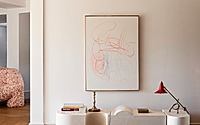
The visit starts in a low-key entrance hall, where simple geometry and raw materials lower the eye line and slow the pace. A sculptural plaster ensemble of naïve inspiration, designed by the studio, holds the center, its matte volume catching light in shallow relief. Nearby, a painting by the designer’s daughter, framed in untreated wood, sets an intimate tone and grounds the room in the family’s present moment. A vintage lamp in muted raspberry from Veluto and sparse decoration keep the composition gentle and warm.
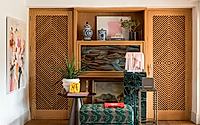
Beyond, the anteroom acts as a luminous hinge between hallway and main living. Original carpentry and a glass partition stand almost like an altar, so Iriarte works by counterpoint rather than contrast. An upholstered pouf in Dedar fabric, a round walnut table carrying a work by Gipuzkoan artist Egi-ka, and a green Alpi marble pedestal create a measured cluster of textures. Customizable seating in polychrome Dedar textile, inspired by seventeenth-century patterns, deepens the historical thread without crowding the view.
Reading Corner As Retreat
At the edge of the main room, a reading area compresses intimacy and sophistication into a compact setting. A custom central daybed upholstered in striped tailoring fabric from Dedar, echoing the world of ties, anchors the corner with linear rhythm. The Hortensia armchair by Andrés Reisinger adds a sculpted counterform, while a limited edition Native Object 01 Natural Beige floor lamp by Hot Wire, made from used nylon powder and sand, introduces a subtle granular texture. A plaid from Veluto softens the composition and invites lingering with a book.
This corner distills the project’s attitude: few elements, strong presence, and a precise mix of contemporary pieces with personal artifacts. Nothing shouts. Everything carries weight.
Curves, Color, And Contrast
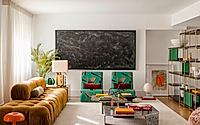
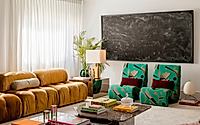
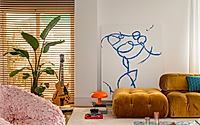
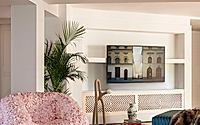
In the living room, organic volumes take the edge off the building’s rectilinear frame. The Camaleonda sofa by B&B Italia, designed by Mario Bellini in the 1970s and upholstered here in amber velvet, coils into the center like a soft landscape. Opposite, two Amoebe armchairs by Verner Panton for Vitra wear a printed Dedar fabric that fuses references to oriental lacquer and futuristic geometry, shifting the mood toward a measured pop energy. An Akari lamp by Isamu Noguchi and a slate piece by Madrid artist Alex Guijarro pull the eye upward and outward.
Warm and cool materials interlock throughout this room. Walnut and bronze shelving from Momocca’s Julia collection, a bronze mirror pedestal from Veluto, and coffee tables in Bidasoa marble and cast metal designed by the studio establish a mineral register. On the floor, an orange Nesso lamp by Artemide punctuates the setting, while a drawing replicated from Reisinger’s daughter introduces another familial thread.
Dining Around Art
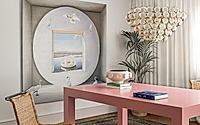
The dining room gathers many of the project’s themes into a single composition. One of Andrés’s graphic works commands the wall, asserting the homeowner’s voice at the room’s core. Underneath, rattan Cantilever Mr10 chairs by Mies van der Rohe line up around a geometric table designed by Andrés Reisinger, while a single white Steltman chair by Gerrit Rietveld breaks symmetry and underscores the dialogue between eras. A bust sculpture, reinterpreted by Iriarte, leans into that conversation between past references and present authorship.
Above, a Sfera Glass crystal lamp from Veluto throws a softer glow over the setting. A recovered Turkish rug from the same source introduces pattern and warmth underfoot, tying the sociable volume back to the quieter textures of the entrance and anteroom.
By the time the route loops back toward the hall, the sequence reads as one continuous room tuned to different tempos. Garden views, 1980s joinery, and contemporary objects align into a single, lived-in whole. As evening light changes on marble, velvet, and glass, MG.01 holds steady as a generous frame for art, conversation, and family routines.
Photography courtesy of Iñigo Iriarte
Visit Iñigo Iriarte