Hartdene Barns: Charred Timber Eco Homes In The English Countryside
Hartdene Barns gathers nine new houses in Edenbridge, United Kingdom, where Nissen Richards Studio translates a once-derelict dairy farm into carbon-net-zero rural living. The development folds barn silhouettes, advanced fabric construction, and a rich material palette into luxury homes that retain the memory of agricultural life while committing to RIBA Climate Challenge 2025 criteria. Each dwelling treats landscape, structure, and finish as part of one precise, low-carbon vision.


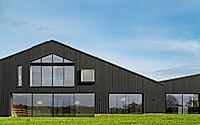
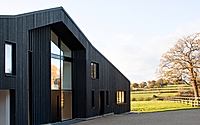
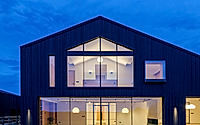
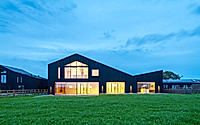
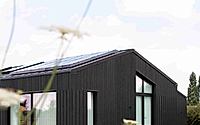
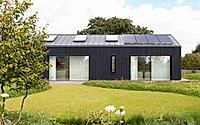
Visitors arrive along the former farm approach as dark, curved roofs lift above hedges and fields, their charred timber skins catching shadow rather than glare. Light slips between black zinc and glazing, revealing a courtyard framed by barn-like volumes that still read as a working yard, even as their purpose shifts to domestic life.
This is a house development with nine luxury, carbon-net-zero homes set in forty acres of countryside on the West Kent and East Sussex border. Nissen Richards Studio works with Q New Homes to retain agricultural forms while pushing the envelope of low-carbon construction and material performance. The project concentrates on how structure, envelope, and surface choices drive energy use, durability, and the sensory experience of daily living.
Recasting The Farm Frames
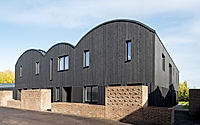
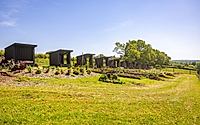
The starting point is a former dairy farm, long in one family and left in disrepair, reduced to dilapidated sheds and lean-tos around a compromised yard. Planning consent required that new dwellings retain most structural frames from the agricultural buildings, so the architects kept existing footprints and let those geometries guide the new envelopes. Curved roof forms and barn proportions remain legible, but charred timber, dark multi brickwork, and black standing seam zinc reassert the buildings as contemporary houses rather than simple conversions. Demolition of smaller outbuildings opens a central courtyard and longer views out to the landscape, so the remembered farmyard now works as a shared rural threshold.
Charred Timber And Dark Brick
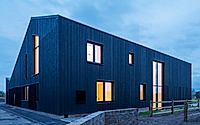
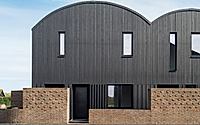
Externally, the composition leans on a tight palette: black zinc roofing, dark black spruce cladding finished through charring, Michelmersh Selected Dark brickwork, and clear glazing cut with black aluminum frames. Timber is charred to stabilize the boards, reduce movement, and extend lifespan without ongoing treatment, turning what was once a delicate material into a hard-wearing skin. Across the nine homes, variations in cladding patterns are used almost as masonry detailing would be, marking entrances, giving depth to long elevations, and differentiating one barn form from another. Vertical boarding with alternating widths, rectangular boards, and vertical fins with open joints break down scale so that gables, curves, and walls catch light differently through the day.
Fabric-First Low-Carbon Shell
Behind the dark exterior, the construction strategy follows a fabric-first agenda shaped by the RIBA Climate Challenge. Structural insulated panels form the primary walls, combining a foam core with rigid facings to cut embodied carbon by around forty percent compared to traditional masonry. These SIPs create a continuous thermal envelope around each dwelling, reducing cold bridges and allowing air source heat pumps, solar photovoltaic panels, and MVHR systems to operate at higher efficiency. Lightweight timber structures replace heavier masonry, while glulam and steel beams work with low-carbon concrete to manage spans and loads without unnecessary material mass.
Former concrete slabs and farmyard paths are lifted, crushed, and reused as hardcore, reducing waste and new aggregate demand in one move. Floor structures rely on metal web joists, manufactured off-site to use less timber while allowing easy threading of mechanical and electrical services, an arrangement that shortens installation time and improves on-site coordination. Airtightness is reinforced by an internal vapour control layer and an air seal wrap, so heating demand drops and the energy systems can be scaled to genuine need rather than convention. Fireplaces burning bioethanol bring a renewable heat source back into the living areas without undermining the low-carbon remit.
Interiors Expressing Form
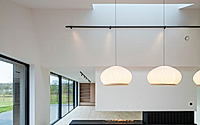
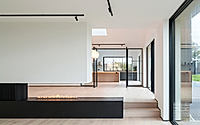
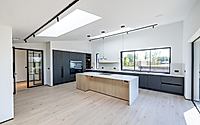
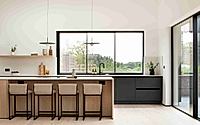
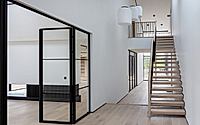
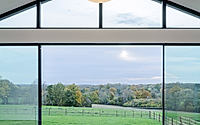
Inside, the material story inverts: where exteriors are dark and textured, interiors stay light, neutral, and tuned to natural tones. Vaulted ceilings follow the roof lines so occupants understand the barn geometries from within, rather than reading them only in silhouette from the yard. Full-height, glazed Crittall-style doors link primary living rooms to entrance halls, turning circulation routes into places of daylight and long views. Feature fireplaces act as low partitions that organize large open-plan kitchen, living, and dining areas, giving each generous volume a clear center around which furniture can gather.
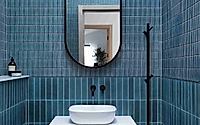
Joinery and fittings continue the material clarity, with quartz worktops paired with timber cabinetry in the kitchens and bespoke timber wardrobes in master bedrooms. Bathrooms use a neutral base, with dark tapware cutting through white, dove grey, or green tiling depending on room hierarchy. Large format tiles meet smaller textured tiles to distinguish shower zones, vanity walls, and quieter corners without resorting to loud pattern. Throughout, stairs shift from light to solid depending on layout, with metal balusters, slatted or solid timber balustrades, and carefully profiled handrails reinforcing the crafted reading of circulation.
Rural Ground And Habitat
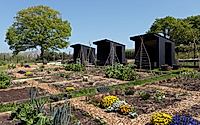
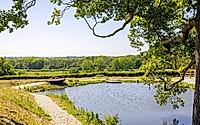
Beyond the envelopes, the forty-acre site absorbs the houses back into the High Weald landscape that once supported dairy herds. Each home has its own garden and an allotment allocation, while one plot incorporates a pond formed originally by a World War II bomb crater, now folded into the domestic scene. Planting strategies prioritize native species to strengthen local habitats and support wildlife, in concert with the nearby Ashdown Forest and its protected status. Low-carbon funding mechanisms and whole-life carbon assessment tie the project into a broader shift in how rural housing is financed and measured, binding material choice directly to climate targets.
As daylight drops across the courtyard, the blackened cladding deepens and window openings glow, outlining the old barn forms in reverse. Residents move between generous rooms, high ceilings, and long sightlines that still point toward fields and forest. The project closes the loop between agricultural memory and contemporary low-energy construction, using material discipline and careful assembly to root new rural luxury in performance rather than excess.
Photography by Gareth Gardner, Camilla Ulloa
Visit Nissen Richards Studio