Casa EME: Reshapes a Bow-Tie Plan in Madrid’s Historic Core
Casa EME is an apartment renovation in Madrid, Spain, by Gon Architects. Designed in 2025, the project reworks a 108 m² apartment in the city’s historic core by preserving its existing wood floor and resetting the plan around daily life. Rooms are reassigned rather than erased, giving the home a clearer order while keeping its material memory in place.


About Casa EME
The story of Casa EME begins with a memory and a desire. For Manuel, the owner, both arrived before the purchase, during one of many visits to apartments in central Madrid, when this one felt strangely familiar, as if he had already lived in a place with the same spirit in another time.
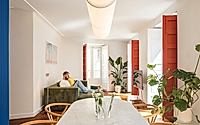
There was also a very specific wish. He imagined himself reading there on an ordinary Sunday afternoon, seated on the sofa as light entered through the five large living room windows and framed views of Plaza Mayor, Calle Toledo, Plaza de Puerta Cerrada, and the Collegiate Church of San Isidro el Real.
Set within a corner building in Madrid de los Austrias, Casa EME occupies a position like a watchtower in a dense urban fabric of Baroque origin, already recorded on Pedro Texeira’s 1646 map and now shaped by the bustle and tourism of the contemporary historic center. The original 108 m² (1,163 sq ft) apartment faced entirely outward, yet its bow-tie geometry did not produce a clear domestic order.
Five rooms of different sizes, six balconies, and two street-facing windows were tied together by a continuous floor of solid tropical IPE wood in multiple tones. It read almost like a carpet. The wood extended through the whole apartment except for the bathroom, where the finish shifted to ceramic.
The arrangement of uses was poorly resolved. The kitchen, paired with an oversized bathroom, was pushed to the back of the home; the bedroom was small, far from the bathroom, and entered through two doors, one opening directly from the living room, which made both rooms difficult to organize; and at the center of the apartment, the darkest room—also the most singular because of its trapezoidal shape—remained an empty circulation area without a defined role.
That missed opportunity becomes the starting point for the intervention. The proposal is built on a strict premise: to preserve the existing wooden floor in its entirety, not simply as a surface finish but as a material memory that anchors the apartment to a place and a time.
The floor stays exactly where it is. It keeps the marks of repeated use and the slight instability that time gives to things. Working from that condition, the project maintains the system of rooms from the previous layout and shifts the program across the plan like sliding pieces, creating a new order and a clearer reading of domestic life.
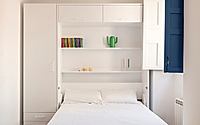
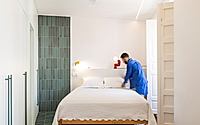
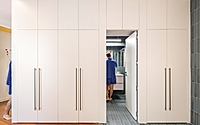
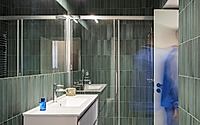
One of the most significant changes links the bedroom directly to the bathroom. Inside, the bathroom recalls an outdoor landscape through greens in varied tones. The connection is made through a closed cloud-green pass-through volume that supports flexible use and incorporates clothing storage.
Both rooms are tied together through the footprint of the former bathroom. Rather than hide that trace, the project leaves it visible in ceramic, making time legible and keeping the house’s memory present within the new arrangement.
The kitchen moves to the center of the apartment. It becomes the social core and the gathering point when friends come together to eat Manuel’s specialty, beef ragu lasagna. At the entrance—the narrowest and most fragile part of the plan, just one meter wide and positioned between the public and private parts of the home—the ceiling is lowered and marked in yellow to redefine the threshold.
Another precise move changes the living room relationship. One of the former doors is removed, turning an adjacent room into an unnamed and flexible area that can serve for study or for guests without interrupting daily routines.
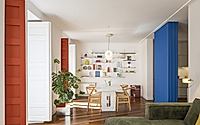
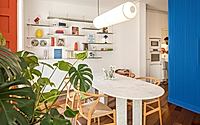
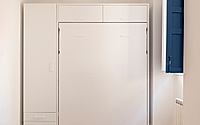
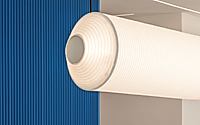
Each room is shaped by furniture made for a specific role. Some pieces are integrated as continuous floor-to-ceiling storage, while others belong to a broader system of objects that gives each room its character. On the far side of an electric-blue column clad in a zigzag-textured material that echoes the geometry of the apartment and improves acoustic performance, the living-dining room is organized as a loose landscape of objects: sofa, table, lamp, shelving, television.
Nothing is fixed into a rigid hierarchy. The removal of corridors produces a new domestic topography, where trapezoidal and irregular rooms connect organically rather than through leftover passage.
Transitions between rooms occur without doors. Instead, thresholds are defined by color and texture. Wood, metal, fabric, aluminum, ceramic, and resin sit alongside a vivid chromatic range—red, blue, yellow, white, and green—forming a subtle layer of domestic information that reaches beyond the visual and formal toward touch and smell.
Casa EME reflects on acting with intention rather than excess. It chooses preservation over demolition and reuse before new construction. What emerges is a home in which movement through the apartment passes constantly through paired conditions—public and private, compressed and expanded, open and closed—reactivating a house that, in many ways, was already there.
Photography by imagensubliminal
Visit Gon Architects