Devín Cabin Balances Off-Grid Living with Seasonal Comfort
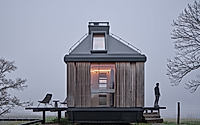
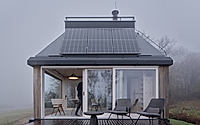
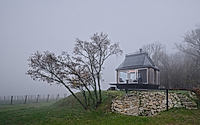
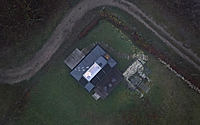
Devín is a cabin in Bratislava, Slovakia, designed by Ark-Shelter as a compact weekend dwelling with full off-grid capability. Completed in 2024, it works within a 20-square-meter footprint while opening broadly to vineyard views, fold-down terraces, and a carefully choreographed interior that shifts from daily routines to sleep with remarkable economy.


About Devín
Designing a fully functional weekend dwelling within a 20-square-meter footprint calls for unusual precision. Here, that constraint is met without giving up comfort, seasonal resilience, or a direct relationship to the landscape.
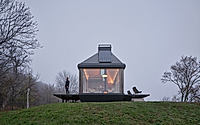
Set at the edge of the Zlatý Roh vineyards, roughly 3 kilometers above the ECK restaurant, the cabin looks past the vines toward sunset and the Austrian Alps beyond. Its position above Devín Castle gives the site unusual charge, and the architecture answers that condition by making shelter and exposure work together rather than compete.
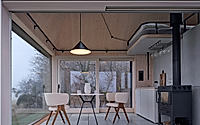
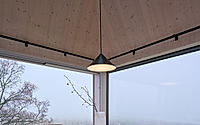
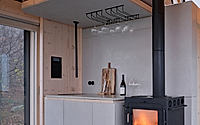
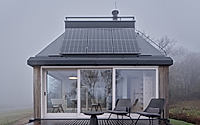
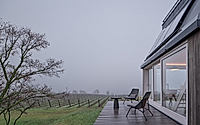
Two sides of the cabin fold outward into terraces, and once lowered they reveal sliding glass walls behind them. Daily life happens at the threshold. With these surfaces opened, the interior extends outward both visually and practically, increasing the usable area and making the cabin feel much larger than its footprint suggests.
That sense of continuity is central to the plan. The room does not read as a sealed container. Instead, the envelope shifts between protection and openness depending on weather, time of day, and how the cabin is being used.
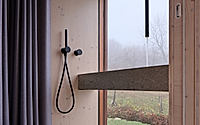
Behind the main living zone sits a compact kitchenette, followed by a bathroom with a shower. One detail slows the pace on purpose. A bespoke concrete sink is set directly into the window frame, turning a routine act into a moment oriented toward the forest.
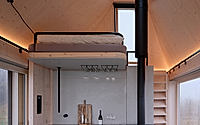
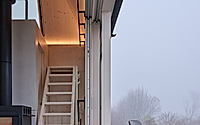
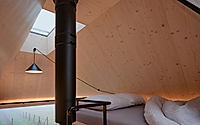
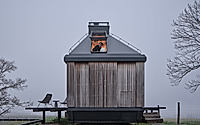
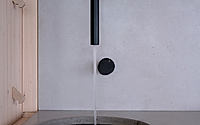
The sleeping area is handled with similar economy. A pendant hangs down from the loft, and its cable can be pulled so the lamp rises and reveals the bed above, concealed during the day. By avoiding a fixed stair, the upper level stays visually quiet; a retractable ladder hidden within the cabinetry appears only when needed.
Upstairs, the atmosphere changes. Glass gives way to enclosure. Rather than opening broadly to the view, the loft is wrapped by the solid roof shell, with a single skylight overhead that frames the night sky and tightens the sense of retreat.
The technical ambition is as compressed as the plan. This is a fully off-grid dwelling intended to operate through all four seasons, which in local climate conditions requires more than a symbolic level of independence. The energy system combines photovoltaic panels, battery storage, and a gas-powered backup source.
Appliances switch automatically between electricity and gas when battery capacity falls below a defined threshold. The logic is straightforward. Electricity is reserved for lighting and small devices, while more demanding functions such as heating and cooling adapt to the resources available at any given moment.
Water and environmental control are integrated just as carefully. Service water is stored in a concealed tank within the raised floor, alongside a separate wastewater reservoir. Overheating is managed through shading and controlled ventilation, with cooler air drawn from beneath the northern side of the floor in summer and warm air exhausted through a heat recovery unit below the skylight.
In winter, that process reverses and is regulated by CO₂ and humidity sensors to keep indoor conditions stable. Nothing is oversized. Each component is doing exact work, allowing the cabin to remain compact in volume yet capable across changing weather and seasons.
What emerges is not a small building trying to imitate a larger one. It is a tightly edited dwelling in which views, movement, furniture, and infrastructure are all asked to work harder. The result is an architecture of compression: lean in area, direct in use, and deeply tied to the land around it.
Photography by BoysPlayNice
Visit Ark-Shelter