Villa Ousia by Paly Architects
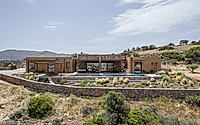
Villa Ousia is a house in Pitsidia, Greece, by Paly Architects. Set on a hillside above the settlement, it reads as a sequence of three offset volumes connected by glass passages. Local stone, earth-toned plaster, and regional materials shape the project’s calm, practical character, while the plan opens toward the pool, the plain, and the sea.


About Villa Ousia
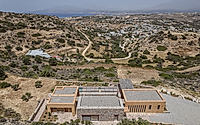
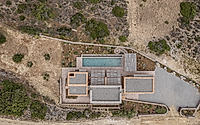
Villa Ousia sits on a hillside above a settlement, where the ground falls away toward the plain and the sea. Three offset volumes step across the slope, tied together by transparent links that keep the landscape in view.
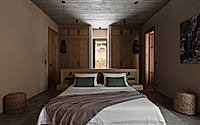
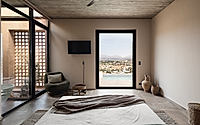
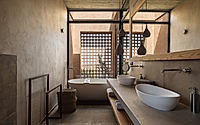
Paly Architects designs the house in Pitsidia, Greece, as a residence grounded in local materials and oriented to daily use. The central volume holds the entrance and shared living areas, while the flanking volumes contain the bedrooms and their bathrooms.
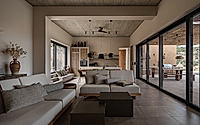
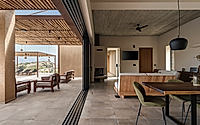
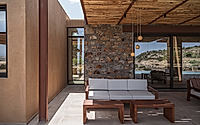
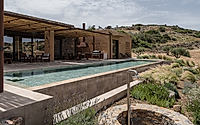
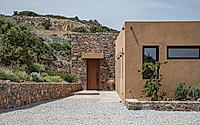
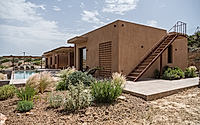
The middle block is built in stone. The two side volumes are finished in an earth-colored plaster, giving the composition a clear hierarchy without breaking its quiet profile. Sliding glass panels on the north and south sides of the central volume open the interior to cross ventilation and cooling, and they draw the living room, dining room, and kitchen toward the outdoors.
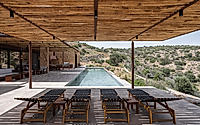
A large pergola stretches in front of the central volume and reaches toward the swimming pool. That covered run extends the living area outside, while a second pergola at the pool, a circular stone stair to the outdoor shower, and a planted courtyard give each exterior zone a defined role. The rear entrance and the offset layout form a wind-protected back yard, with freely placed stones marking the plot edges.
Natural materials do much of the work here: local stone, rust-colored metal, chestnut wood, straw-inflected exterior plaster in earth tones, beige interiors, cotto floors inside and out, black aluminum frames, iroko wood, and gravel in the entry, parking area, and rooftops. The result is a house that stays close to the site, using light, shade, and ventilation to connect everyday life with the hillside around it.
Photography courtesy of Paly Architects
Visit Paly Architects