Janošík Headquarters and Showroom by Jakub Janosik
Janošík Headquarters and Showroom sits in the Czech Rep., where the White Carpathians drop from forest to meadow, and it carries the hand of designer Jakub Janošík. The project converts a 1950s grain hall into an office and showroom for a windows-and-doors maker, binding daily work to distant views and a working landscape. It’s an office, yes, but also a live laboratory for openings, thresholds, and light.


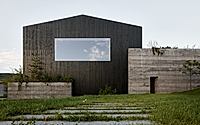
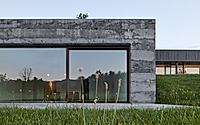
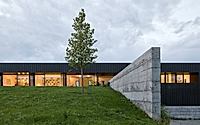
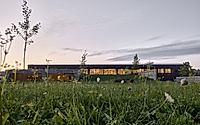
Wind brushes the black larch cladding as meadow grasses lean toward the gabled form. A sandstone-tinted concrete arm extends from the old hall, drawing the ground plane up to the threshold and turning approach into a quiet reveal of light and view.
This is an office and showroom in the Czech Rep., designed by Jakub Janošík through the adaptive reuse of a 1950s cooperative grain hall. The throughline is clarity: open a once-closed structure, stitch it to meadow and hills, and let windows act not only as products but as instruments that recalibrate work life to landscape.
Reduce And Reveal
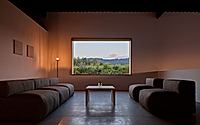
The original gabled volume is pared to essential lines, its steel structure insulated from the exterior and wrapped in black-painted larch. Four deep cut-outs carve the timber mass. A single large window on the main façade—measuring 9 × 3.2 metres (29.5 × 10.5 feet)—sets the interior on display and orients visitors from afar. On the opposite gable, a small picturesque opening answers with restraint.
Concrete Embrace To Meadow
A new concrete “embrace” opens the hall toward the landscape and pulls the meadow to the door. Offices sit five metres (16.4 feet) above grade, yet step directly onto planted ground where the addition meets the terrain. From three sides the ensemble reads monumental; toward the hills it relaxes into a light, horizontal line that recedes into the fold of grass and sky.
Windows As Instruments
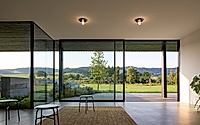
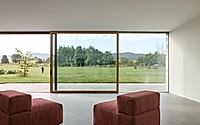
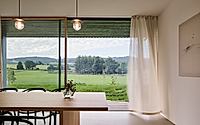
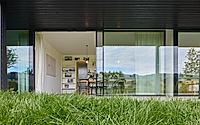
Across the building, window and door prototypes double as structure for daily use. Sliding large-format glass walls, pivot doors, and a seating window that retracts the pane place bodies at the garden’s edge. A levitating window set within a broader sheet of glass and sliding units riding an electromagnetic field extend the experiment into motion and touch. Brass- and corten-clad assemblies add material counterpoints without breaking the calm.
Climate By Form
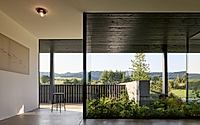
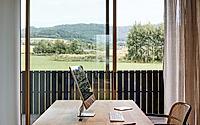
Loggias are recessed along the flanks, granting each office a direct outdoor perch while shading the interior in summer and admitting low winter sun. Roof overhangs tune exposure, and exterior insulation tightens the envelope after reuse of the existing structure. Solar panels sit flush on the roof, visually absorbed by the black volume; underfloor cooling is reserved for the hottest days, avoiding air conditioning in regular use.
Inside The Reborn Hall
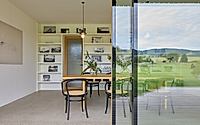
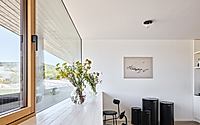
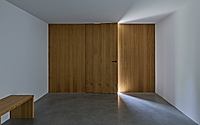
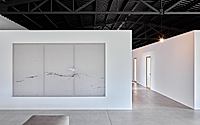
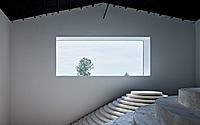
Within, a white interior reads like a gallery for the surrounding hills, warmed by bleached spruce, natural oak, dark grey concrete, and linen. The central corridor crosses the plan, with enclosed offices and meeting rooms along the sides and a communal ground—a kind of square—opening to the garden through a sliding wall.
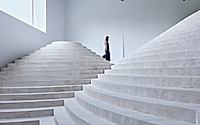
A double-height volume near entry spans 12 × 15 metres (39.4 × 49.2 feet), rising to 12 metres (39.4 feet), where the largest window amplifies scale. Maxim Velčovský’s stair-sculpture in solid pine—forty cubic metres (1,412.6 cubic feet)—sets a topographic counterform, a place to gather and watch the horizon. Nearby, Lukáš Musil’s cycle of paintings and DECHEM’s textured glass lights fold culture back into the raw shell.
The furniture is made to measure in the company’s workshop, with local metalwork and seating complementing the quiet palette. Decoration stays spare. Views do the rest.
At day’s end, the black timber dims against the hill, and the concrete band keeps its soft mineral tone. Light spills through one great opening, then fades—proof that the old hall now breathes with its meadow, bound by a clearer link between work and world.
Photography by Filip Beránek
Visit Jakub Janosik