Baw Beese: Multi-Generational Lake Retreat With Clever Cabin Wings
Baw Beese sets a quiet scene on the shoreline of Hillsdale, United States, where Disbrow Iannuzzi organizes a vacation retreat for several generations at once. The project divides the house into smaller cabin-like volumes so grandparents, parents, and guests can share the property or live independently, moving between them through glazed links. Each wing holds its own rhythm, yet the whole compound stays tied to the lake, the trees, and long weekends together.


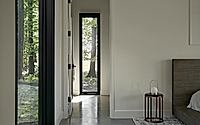
Light slides along dark timber siding as the low house lines the slope above Baw Beese Lake. Inside, polished concrete and pale oak carry that light deep into each room.
This retreat is a vacation house in Hillsdale, Michigan, arranged by Disbrow Iannuzzi as a series of cabins for one extended family. The project treats daily life as a shifting cast: grandparents, young children, friends, and remote workers move in different combinations, inhabiting connected but independent quarters. A single-level floor throughout keeps the routines of aging, childcare, and weekend hosting simple, while glass corridors pull the eye back to the water.
Splitting The House
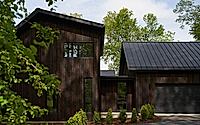
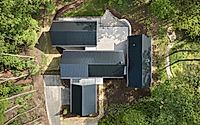
Instead of one large mass, the house breaks into four smaller volumes along the hillside. Three act as cabins and the fourth as a garage. This strategy softens the retreat’s presence from the lake and lets each wing function on its own, so different branches of the family can come and go without disturbing others. Walking the path between them, a visitor reads the program in sequence, moving from private quarters to shared life along the water.
Living Together, Separately
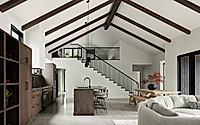
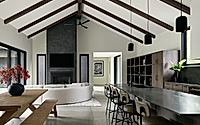
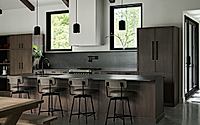
One cabin is tailored to the family’s matriarch, with a combined kitchenette and sitting room, bedroom, bathroom, and storage looking out toward the lake. She can stay here without opening any other part of the house, maintaining privacy while remaining near the larger clan. Another wing holds a young family of four, with two bedrooms, two bathrooms, dedicated HVAC, and its own storage, so bedtime, early mornings, and seasonal needs stay contained. The third and largest volume carries the main kitchen, living room, guest suite, and a lofted work area, drawing everyone back for meals, games, and late-night conversations.
Paths Of Glass And Light
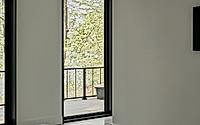
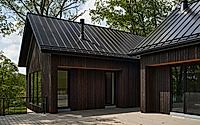
Clear corridors link the dark cabin volumes, turning what could be leftover area into bright transitional rooms. Daylight washes along the glass, turning short walks between bedrooms and kitchen into quiet pauses with views of trees and water. Because the floor level stays consistent across every wing, older relatives, kids, and guests move easily with luggage, strollers, or wheelchairs. The house reads as one continuous route, even as each cabin keeps its own rhythm and degree of solitude.
Material Calm, Daily Durability
Dark shou sugi ban wood wraps the cabins, visually folding them back into the glacial terrain and tall vegetation. Inside, slender oak rafters span above white walls, setting up a calm backdrop for simple artisan furniture and everyday life. Concrete floors handle wet feet, sand, and heavy use, while hydronic radiant heat turns that slab into a thermal battery that replaces gas-fired furnaces. High-performance wool insulation, shou sugi ban cladding, a standing seam steel roof, and robust windows keep interior air cleaner and temperatures steady for long stays.
Weekend Rhythms On The Lake
The house sits lightly on the land, pulling its volumes back as the contours slip toward Baw Beese Lake. Family members arrive for a weekend, choose their wing, and settle into their own routines before meeting again in the central living room. Some cook, some work from the loft, others drift through the glass corridors toward the shoreline. As light changes over the water, the clustered cabins hold that flexible pattern of gathering, retreating, and returning across seasons.
Photography by Three Photography
Visit Disbrow Iannuzzi