Palisades Redux ADU by Vertebrae
Palisades Redux ADU gathers a house, new accessory dwelling unit, and garage around a reshaped yard in Santa Monica, CA, United States, by Vertebrae. The project turns a typical residential lot into a communal court where angled volumes and laser cut aluminum screens choreograph views, privacy, and daylight. What reads as sculptural forms from the main home becomes intimate living quarters and support rooms tucked behind a responsive facade.


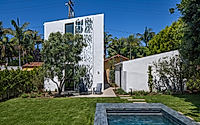
From the main house, the new volumes sit just beyond the glass, sharp-edged and bright against the yard. Angled walls, perforated metal, and a glinting pool turn an average suburban lot into a small stage for light.
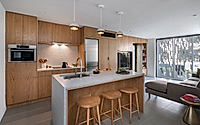
This house project in Santa Monica, CA, United States gathers an accessory dwelling unit and a new garage around an existing two-story home, with Vertebrae focusing on how built form controls privacy and openness. The family wants a shared outdoor room that connects every building yet protects daily life inside, so the additions read as crafted objects rather than background structures. Screens, roof planes, and the careful geometry of the yard carry much of the work.
Shaping The Courtyard Edge
Instead of aligning cleanly with the main house, the ADU and garage pivot away, their angled facades establishing an oblique datum across the lot. That move cuts the yard into a trapezoid, tightening the relationship between pool, deck, and outdoor kitchen so the family experiences them as one continuous court. Both the main house and the ADU face this central yard and share its surface, so outdoor life becomes the true middle of the property. It feels close but not cramped.
Screens As Living Boundary
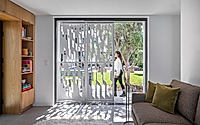
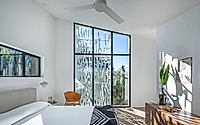
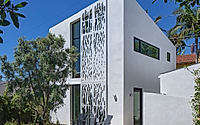
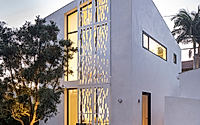
The accessory dwelling unit relies on laser cut aluminum screens that span the height of its facade, controlling what passes between interior and yard. When the operable panels slide open, the living area spills directly into the shared court, blurring the distinction between room and deck. Close them, and the perforated metal filters daylight, shielding the interior from constant views out of the main house while still holding a soft glow. At night, the ADU reads as a lantern, its patterned surface throwing light back into the courtyard.
Parametric Pattern And Privacy
Vertebrae links its art and architecture work through the development of those screens, relying on a computational process rather than a static motif. Custom software sets the porosity of each panel in response to program and proximity, tightening the pattern where bedrooms need seclusion and opening it where living areas invite connection. This parametric workflow supports a free-flowing interior layout while still delivering exactly calibrated layers of cover along the facade. The result is a single surface doing multiple jobs at once: veil, shade, and visual relief.
Rooflines And Solar Logic
Above the sculpted walls, the two new roof planes deliberately diverge rather than march in step. One orientation responds to total solar collection over the full day, while the other aligns toward peak demand hours to better match energy use. That quiet adjustment in angle gives the small buildings a distinct profile against the sky and a practical role in the property’s energy strategy. Geometry here is not only visual; it is tuned to performance.
Sculptural Forms From Within
From almost every vantage point inside the existing open-plan house, the new structures stay in view through large expanses of floor-to-ceiling glass. Vertebrae embraces this constant visibility by treating the ADU and garage as sculptural companions rather than background service volumes. Their faceted facades, rhythmic screens, and tight relationship to the water and deck give the everyday scene a clear order. What might have been generic outbuildings instead anchor the composition of the yard.
By night, perforated metal glows and reflections ripple across the pool, tying the three buildings into a single quiet ensemble. By day, sliding screens, hard shadows, and sharp rooflines keep the compact lot from feeling static. The project shows how a small additive construction—just two carefully tuned forms—can reset the balance between house, court, and sky.
Photography courtesy of Vertebrae
Visit Vertebrae