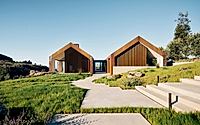
Amnesia House by Garde Hvalsøe
Amnesia House sets a low, steady line against the foothills of Napa Valley, California, United States, its form shaped by Garde Hvalsøe with Edmonds + Lee Architects. Conceived as a single-storey house for San Francisco clients seeking a counterpart to urban life, the project leans into resilient materials and crafted interiors. The result is a calm retreat where wildfire-conscious construction, Danish cabinetry, and the raw terrain hold equal weight in the daily rhythm of use.


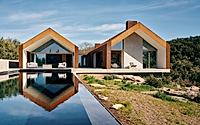
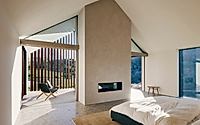
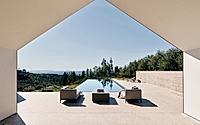
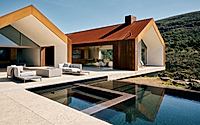
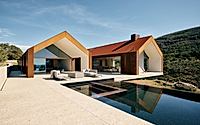
Light falls across the long terrace, catching the dark steel shell before sliding over terrazzo-ground concrete and into a low interior lined with oak. Beyond, the land drops away toward Napa Valley, and the house reads as two grounded gabled bars that sit quietly on their ledge.
Amnesia House is a single-storey house in Napa Valley, California, where Garde Hvalsøe and Edmonds + Lee Architects work together around material clarity and fire resilience. The project serves as a counterpoint to the owners’ vertical San Francisco residence, trading stacked floors for a horizontal layout tied closely to the ground. Materials, detailing and form respond directly to a wildfire-prone landscape, so construction becomes both shelter and long-term safeguard.
Steel Shell And Fire
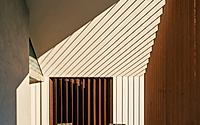
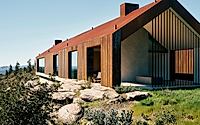
Two parallel gabled volumes run east to west, their weathering steel cladding forming a continuous, non-combustible envelope that resists ember intrusion. Joints are minimized and gaps eliminated, turning the façade into an armed skin that answers local fire conditions. An exterior fire sprinkler system and restrained roof penetrations reinforce this protective layer, treating safety as part of the architecture rather than an afterthought. Deep overhangs and louvres temper sun and glare, allowing light to wash interiors without loading the structure with heat.
Concrete Grounding The Retreat
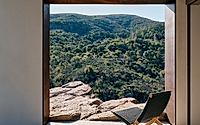
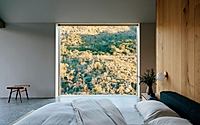
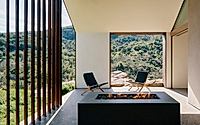
The house occupies a narrow ledge carved from steep topography, minimizing excavation and preserving existing drainage lines, vegetation and geological formations. Terrazzo-ground concrete floors run from interior rooms to exterior terraces, giving a consistent underfoot texture that visually stitches house and landscape. This continuous surface reads as both structural plate and quiet canvas for shadows, so changing light carries much of the visual drama. Limited site access sharpened decisions, and the compact footprint respects slope restrictions while still claiming broad valley views.
Oak Millwork In Every Room
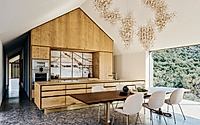
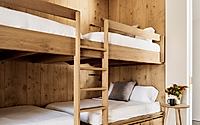
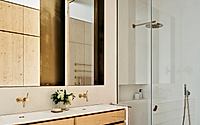
Inside, oak takes on the work of order and warmth, fabricated by Garde Hvalsøe across bedrooms, a private office, family room and closets. Bespoke bunk beds and cabinetry from the company’s Atelier department deepen this continuity, turning storage and sleeping niches into built-in elements rather than add-on furniture. A custom kitchen based on the Solid model anchors the social core, with bathroom furniture in the same material linking more secluded rooms back to shared areas. The consistent grain and tone calm the interior composition, even as the surrounding terrain stays rugged and raw.
Quiet Interiors, Clear Zoning
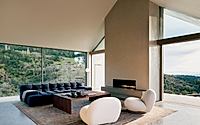
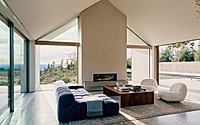
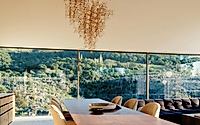
Programmatic zoning supports acoustic comfort, pulling private rooms away from the social heart without extra panels or heavy acoustic treatments. Social areas gather around the pool terrace and open-plan kitchen and dining zone, where a chandelier by Studio Drift hangs as both sculpture and light source. Flexform pieces and bespoke tables by Napa-based Studio Roeper sit on the concrete floors, their volumes kept low so sightlines to the valley stay open. Furnishings, chosen directly by the owner, echo the architecture’s emphasis on proportion and restraint rather than spectacle.
House In The Napa Terrain
Every major decision stems from the rocky, fire-prone hillside, from orienting the gabled bars for views to threading access through limited entry points. Local builders and craftspeople bring regional knowledge to the construction, tuning details so the house sits easily within the agrarian context. Steel, concrete and oak work in concert, carrying both environmental performance and a clear tactile presence. As daylight shifts across the ledge, the house keeps a steady outline, its material logic doing quiet work against a volatile climate.
In the late afternoon, the steel shell deepens to a rusted hue while the concrete terrace holds warmth from the sun. At that moment, the project reads as a single continuous object in the landscape, shaped by risk, craft and careful calibration.
Photography by Joe Fletcher
Visit Garde Hvalsøe