Raumplan House: From Garden to Atrium
Raumplan House stands in Singapore as an inter-terrace house by Formwerkz Architects, planned for a young family who straddles quiet everyday life and lively gatherings. The project navigates a sloping party-wall site with a sectional approach that pulls light, air, and planted volume into the heart of the home. Together, client and architect pursue a house that feels open yet still holds pockets for retreat and close conversation.


Sun pours down through the central opening, sliding across staggered floor plates and the tops of tall trees rooted below. A quiet hum of activity unfolds on different levels at once, with family members moving in view of each other yet finding their own corner. Light and movement stay in constant dialogue.
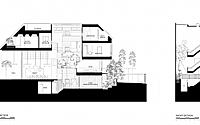
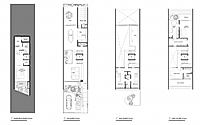
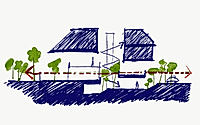
This inter-terrace house in Singapore, designed by Formwerkz Architects, adopts a sectional strategy that turns a constrained plot into a three-dimensional promenade. The project is for a young family of four who want generous, airy rooms for both intimate connection and lively entertainment. Plan and section align around a tall atrium so circulation, vistas, and everyday routines trace a continuous loop rather than a simple stack.
The site runs between two party walls with a front street edge and a rear outlook toward a lush black-and-white house estate. A natural slope from front to back lets the architects sink livable rooms toward the garden while keeping the roofline within neighborhood limits. Instead of flattening the terrain, they embed split levels that track the ground, breaking the house into a series of short, easy transitions.
Stepping Through Levels
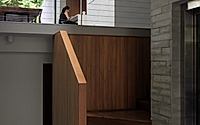
Entry from the street begins on an upper plate, then drops and rises in measured half-levels around the atrium. Each landing holds a distinct living zone, yet sightlines cut across so the family stays visually connected. Short stair runs manage the sectional jumps, turning what could be a vertical climb into a gentle internal walk. In daily use, that rhythm supports both casual encounters and moments of privacy.
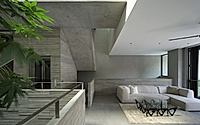
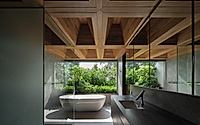
On the lower reaches, the staggered arrangement opens the basement and ground levels to become porous to the rear garden. Sliding boundaries facing the greenery bring in sunlight and wind, while the atrium draws air upward through induced stack effect. Social rooms spread across these levels, letting gatherings slip easily between inside and outside. Everyday activities orbit the planted core and the changing light overhead.
Atrium As Anchor
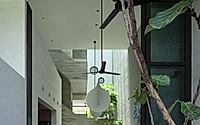
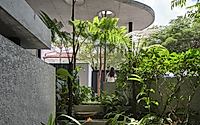
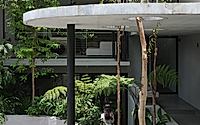
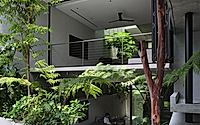
At the center, a voluminous atrium aligns the split floors and binds them into one interior realm. A skylight crowns this void, washing the stair edges and landings with consistent daylight. Sterculia foetida trees rise from the basement, their canopies shading lower rooms and softening the geometry with moving foliage. The void is not just a shaft; it is a lived vertical garden that marks time through sun and shadow.
As family members move from bedroom to study to living room, they repeatedly edge past this open core. Conversations drift between levels because sound and air share the same tall volume. At night, the atrium glows back toward the garden, reversing the daytime emphasis on incoming light with an outward lantern effect. Daily life keeps returning to this center point, even when activities diverge.
Shifting Public And Private
The staggered plates give the lower levels a distinctly open character, with social rooms exposed to landscape, breeze, and visiting friends. As the section rises, private abodes tuck behind a darker outer veil. An expanded metal mesh wraps the upper façade, tracing the internal sectional logic while filtering sun and views. From within, the family looks outward through a softened screen; from the street, those upper rooms read as a quiet, protected band.
This clear gradient from porous base to filtered top helps organize daily routines. Play and hosting gravitate toward the garden-connected floors, while rest and retreat happen above the mesh line. The plan uses vertical distance, rather than thick walls, to support different tempos of living. Movement between those zones stays short yet distinct.
Circulation That Adapts
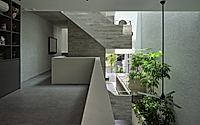
Split-level houses often struggle with accessibility, especially when rooms multiply around compact stairs. Here, the stair wraps a central lift core that has opposite door openings. That simple technical choice lets the lift stop directly onto multiple staggered landings instead of just full floors. Every key level in the house stays reachable without long detours or secondary corridors.
Stair and lift share the same vertical pocket, so movement by foot and by car stays legible and efficient. Children can run up short flights while grandparents glide between gatherings and bedrooms. The vertical sequence becomes inclusive rather than exclusive, sustaining the house as the family grows and ages.
As light fades over the black-and-white estate behind, the garden settles and air cools along the open lower edges. From an upper landing, one glance takes in several rooms stepping around the atrium, each carrying its own mood. The house reads as a continuous, looping journey, tying an urban terrace lot back to sky, slope, and planted volume through a clear sectional idea.
Photography courtesy of Formwerkz Architects
Visit Formwerkz Architects