Shell House: From Dune to City – a Rotating Courtyard Refuge
Shell House opens to Kuwait’s desert light with a quiet assurance, its curved envelope masking a complex inner life. AlHumaidhi Architects shape this house in Kuwait City’s Abdullah Al-Salem suburb as a climate-tuned courtyard residence where rotated floor plates, shaded terraces, and planted setbacks recalibrate daily living. Inside, layered volumes, travertine surfaces, and rooftop retreats support a contemporary way of life grounded in regional principles of shade, privacy, and outdoor connection.


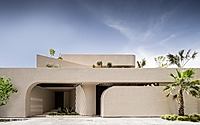
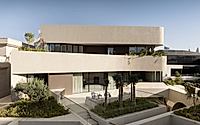
Late afternoon light slides across the curved facade, catching the stucco’s quiet grain and the soft shadows of planted setbacks. From the street, the house reads as a low desert form that holds its brightness just long enough before pulling visitors inward.
Behind that calm profile, Shell House unfolds as a layered courtyard residence tuned to Kuwait’s heat, dust, and sharp light. AlHumaidhi Architects organize the 1,788 sq m house around rotation, shade, and vegetation, reworking vernacular strategies into a contemporary composition. Climate is not a backdrop here; it is the primary brief, shaping where air moves, where shadows fall, and where daily routines settle.
This is a house for a dense urban neighborhood, yet its inner life is oriented to courtyards, setbacks, and planted roofs rather than the street. A near 90-degree rotation between successive floor plates drives the whole arrangement, cutting solar gain, drawing in breezes, and carving terraces that serve as outdoor rooms throughout the day.
Rotating Volumes Catch Breeze
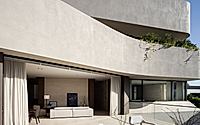
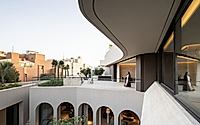
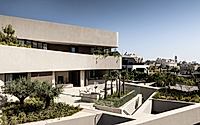
The project’s defining move is the spiraling stack of rotated floor plates, which shifts each level to form deep overhangs, shaded voids, and generous terraces. This rotation reduces direct solar exposure on the building envelope while aligning openings to capture cross-ventilation through the courtyard and setbacks. Outdoor terraces double as rooftop gardens, their planting softening glare and cooling surrounding surfaces through shade and evapotranspiration. From within, framed views cut across the urban fabric, turning a tight city grid into a series of long, composed perspectives.
Courtyard As Climate Core
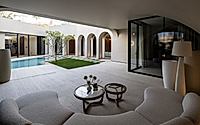
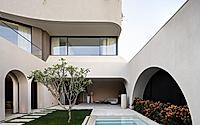
At the center sits a courtyard with a reflecting pool, functioning as both social heart and environmental engine. The pool tempers the microclimate, cooling adjacent areas and reflecting shifting daylight up into surrounding rooms. A calibrated light well at the entry eases the move from Kuwait’s intense exterior glare into softer interior illumination, letting the eye adapt without strain. Living areas and circulation loop around this core, so movement through the house repeatedly reconnects with water, planted edges, and air.
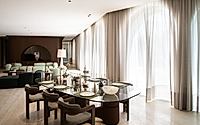
On the ground level, sliding panels open the primary living room, dining area, and kitchen to a setback garden and pool. Shade from rotated plates above, combined with vegetation in the setbacks, creates a cooled perimeter that acts as a buffer between the street and the family’s daily life. Upper floors continue this climatic logic with a generous balcony terrace extending the main living area, while the rooftop solarium—fully glazed yet wrapped by planted terraces—becomes an elevated retreat for night breezes and city views.
Light, Shade, And Thresholds
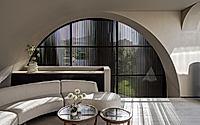
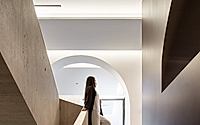
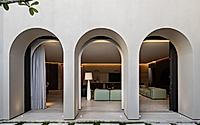
Entry is choreographed through a light well capped with a slatted wooden panel, which diffuses the sun and casts a shifting lattice of shade across the floor. This transitional volume prepares visitors for the more subdued interior brightness, replacing harsh contrast with a controlled, legible glow. Inside, a system of large sliding pocket doors and metal screens, reminiscent of mashrabiya, regulates privacy, airflow, and light. Opened wide, they draw breezes and connect rooms to gardens; partially closed, they filter views and break direct sun into patterned shadows.
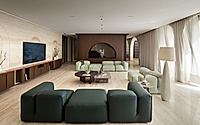
Interior rooms are sequenced in a rhythm of open social zones and quieter corners, responding to daily patterns and different times of year. Full-height glazing ties main living areas to outdoor terraces while remaining recessed to limit solar gain. Overhangs, deep reveals, and vegetated setbacks extend the cooling work that begins at the facade, so light is present yet rarely harsh.
Material Palette In Heat
Material choices deepen the environmental strategy instead of sitting apart from it. The exterior shell is finished in custom-colored stucco over a composite structure, tuned to echo Kuwait’s desert tones while resisting dust accumulation. Curved surfaces soften wind flow around the house, and their earthy color keeps glare in check during the brightest hours. Vegetated setbacks and rooftop planting expand this envelope, building layers of shade and evaporative cooling around the perimeter.
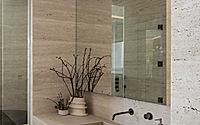
Inside, travertine becomes the primary material, selected for its durability and capacity to weather with grace. Walls carry a raw brushed finish that amplifies the stone’s texture, catching raking light from courtyards and windows. Floors use a semi-polished honed finish, cooler underfoot and easier to maintain across high-traffic rooms. Timber elements in walnut veneer joinery add warmth against the stone, while custom furniture interventions refine edges without breaking the calm.
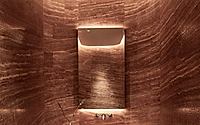
One red travertine powder room punctuates the otherwise muted interior palette, concentrating color and weight in a single compact volume. That intensity gives the rest of the house a reference point, so pale travertine, soft stucco, and desert planting read as calibrated choices rather than default understatement. Material calm supports the climatic work already underway: surfaces that diffuse light, absorb heat slowly, and invite air to move.
By the time visitors reach the rooftop solarium, the sequence from street to sky feels continuous yet distinct at each step. Desert light has been filtered, reflected, and reframed through curves, pools, and plantings. Shell House stands as a quietly assertive model for climate-responsive living in Kuwait’s dense suburbs, letting rotation, shade, and courtyard life guide every move.
Photography courtesy of AlHumaidhi Architects
Visit AlHumaidhi Architects