MS House: Brutalist Concrete Wrapped Around Nine Ancient Neem Trees
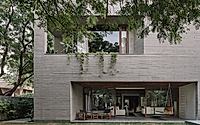
MS House by Studio Saransh rises among nine mature neem trees in Ahmedabad, India, turning a Brutalist concrete shell into a porous, climate-aware family home. The architects organize the house around a central double-height bay that frames the canopy, threading courtyards, verandahs, and shaded terraces so daily rituals stay in step with breeze, filtered sun, and the soft acoustics of water.


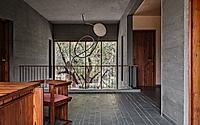
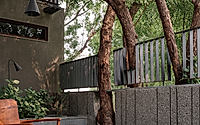
Concrete planes catch the filtered light as it slips through square punctures, scattering bright patches across the corridor floor. A neem branch dips low near the entrance, so close that the boundary wall curves to meet it instead of cutting it away.
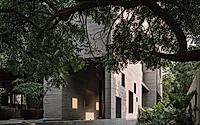
This is MS House, a Brutalist concrete residence in Ahmedabad by Studio Saransh that treats nine mature neem trees as its starting brief. The architects work with orientation, foliage, and climate to generate each move, from the walled approach to the social terrace. Rather than treat nature as borrowed scenery, they thread architecture around trunks and canopies so daily life unfolds in direct, often tactile dialogue with shade, breeze, and green volume.
Arriving Through Light And Shade
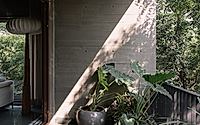
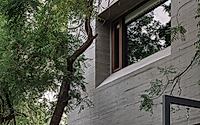
From the street, the house first reads as a textured concrete mass partially camouflaged by foliage. Then the sinuous boundary wall pulls back around a tree, signalling how the building yields to the existing grove. A narrow entrance corridor, cut with a matrix of square openings, leads visitors inward in a slow, cinematic sequence of light and shadow. Dappled sun pours through these punctures, projecting crisp grids and leaf silhouettes along the walls, while oblique views to the planted exterior keep the passage visually porous and gently ventilated.
At this moment of arrival, Brutalist heft softens against filtered daylight and the rough tactility of wooden-strip textured concrete. The raw material carries strong weight, yet the corridor feels animated by shifting patches of brightness that slide across the flooring over the course of the day. What could have been an austere passage instead becomes a calibrated threshold, setting up the project’s core attitude: concrete holds its ground, but trees and sun dictate the experience.
Living Around The Central Neem Bay
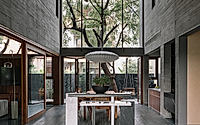
Inside, the plan pivots on a double-height central bay that frames a neem tree as a living anchor. This tall volume sits on an East–West axis, drawing in morning light while the canopy moderates glare and heat. Family life concentrates here: breakfast, informal meals, and everyday conversations gather beneath leaves and branches that reach back toward the concrete envelope. Around it, the house divides into two distinct wings that respond to program and orientation.
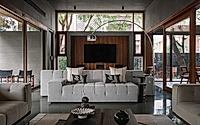
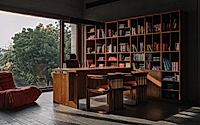
The front wing holds the living room, verandah, and garden, extending social activity toward the street while still shielded by trees and deep overhangs. The opposite side carries the guest room, kitchen, and supporting rooms, creating a more utilitarian band set within the same environmental logic. Above, the central bay shifts into a study overlooking the dining level, so work and reading inherit the same sightlines into the foliage. Vertical openness keeps air moving and helps draw cooler shaded air from lower levels upward.
Rooms Tuned To Trees And Climate
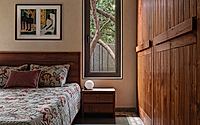
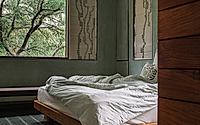
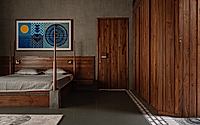
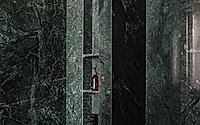
Each bedroom negotiates its own relationship to the grove and to light. The master bedroom sits directly over the living room and opens to a shaded balcony that looks into the neem crowns rather than out at the street. Deep recesses and chamfered sills temper the strong sun, so daylight arrives softened and indirect. Toward the quieter rear, the daughters’ rooms face the backyard, drawing calmer views and cooler air, with individual palettes that range from graphite tones to sage green and terrazzo flecked with green marble.
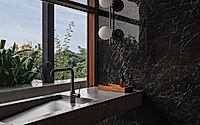
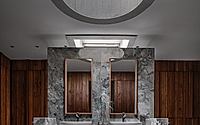
Above, the second floor evolves into a social terrace, where a family lounge, bar, and powder room gather above the canopy line. Here, evenings unfold under open sky while the trees temper wind and filter dust from the air. The black terrace powder room turns into a small drama of its own: full-height glazing looks toward Champa trees that ring the exterior, with a custom concrete basin floating off the wall so glass can drop uninterrupted to the floor. Wood blinds step in when privacy is needed, reinforcing the balance between exposure and enclosure.
Concrete, Kota And Interior Calm
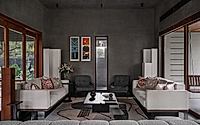
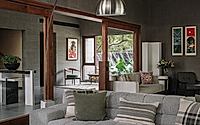
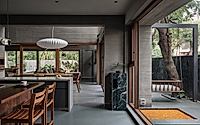
Within the house, a restrained material palette lets light, trees, and proportion do most of the expressive work. Concrete, lime-plastered walls, and grey Kota stone create continuity between exterior and interior, so circulation reads as one continuous architectural field. In the central bay, leather-finished Kota follows the rhythm of concrete planks above, making the floor feel almost like an exterior courtyard pulled inside. Where walls shift to ply-cast concrete, the Kota transitions to a polished finish, catching more sheen and reflecting a softer luminosity.
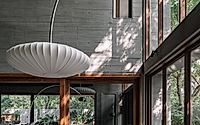
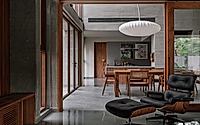
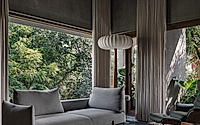
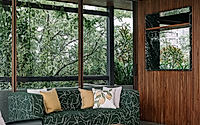
Furniture and objects stay custom, specific, and grounded in craft. A long wooden dining table with rosewood detailing mirrors the linear grid of concrete and stone underfoot. Teak and wicker chairs, an Eames lounge, and an Arco lamp gather in the living room, where ribbon windows frame precise slices of foliage rather than broad glazed expanses. Two seating clusters allow the room to move between intimate family use and more formal gatherings, while ethically sourced Valsadi teak panelling warms the concrete without competing with it.
Landscape, Texture And Environmental Performance
Outside, the landscape strategy extends the architectural commitment to the original trees. Beyond the preserved neem grove, layers of tropical and local species build depth in the planting, so views always carry foreground texture and a cooler microclimate. A water element near the entrance adds a layer of sound and reflection, catching fragments of sky and leaves on its surface. On upper parapets, creepers are placed to eventually drape over sharp concrete profiles, softening corners and adjusting the thermal performance of exposed edges.
Environmental thinking sits inside the envelope as much as around it. The house leans on orientation, shaded openings, and cavity walls before mechanical cooling, pairing laminated double glazing with deep reveals to manage gain and glare. A solar-powered gazebo roof handles most of the electrical demand, and lime plaster removes the need for plastic-based paints, reducing embodied toxins. Resourcefulness continues in the way leftover timber becomes custom tables and marble remnants turn into a drawing room console, so the construction cycle closes with minimal waste.
In the end, the Brutalist expression stays unapologetically concrete yet is constantly edited by trees, light, and climate. Greenery folds into chamfered recesses, runs along parapets, and slips through view corridors, softening the house without diluting its structural clarity. As days pass from sharp morning light to long evening shadows, MS House reads as an ongoing conversation between a rigorous architectural system and a living grove that refuses to be background.
Photography by Ishita Sitwala / The Fishy Project
Visit Studio Saransh