Casa A: Terraced Living on a Steep Urban Hillside in Braga
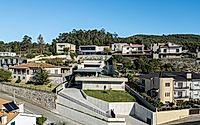
Casa A occupies a steep urban plot in Braga, Portugal, where L2C Arquitectura studies the slope instead of fighting it. The house steps down the hillside in quiet terraces, aligning itself with stone walls, streets, and long southern and western views. This measured approach turns a difficult Barros plot into a layered domestic landscape, with exterior rooms and interior volumes sharing the same grounded, horizontal rhythm.
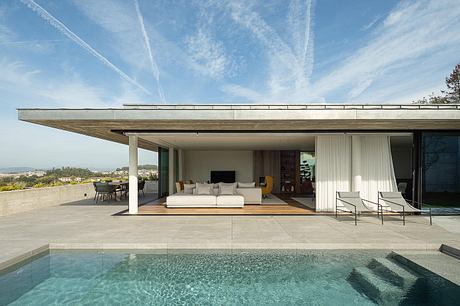

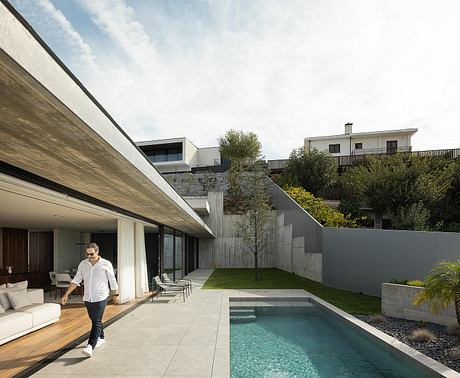


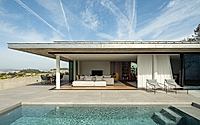
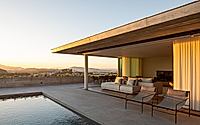
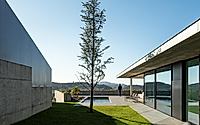
Light tracks along the stepped roofs before finding the water. From the street, the house reads as a calm extension of the stone and asphalt around it.
Casa A is a house in Braga, Portugal, drawn out of a demanding hillside by L2C Arquitectura. The project responds to a sloping urban void by shaping terraces, plateaus, and retaining walls that bind the plot to its streets. Every move studies the way ground, sun, and horizon meet, so domestic life grows directly from the terrain rather than sitting on top of it.
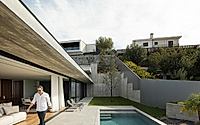
Two horizontal volumes rest on the incline, slightly staggered, and follow the land instead of correcting it. This approach turns a difficult topography into a sequence of inhabitable levels, with outdoor areas as carefully weighed as the interior rooms.
Terracing The Slope
The original Barros plot reads as a tangle of inclinations and hard boundaries, hemmed in by a stone wall to the east and streets to the west. Rather than cut a single platform, the architects carve terraces and plateaus, like broad steps that steady the descent from street to pool. Each level finds its own equilibrium, turning raw gradient into ordered ground. Exterior surfaces are not leftover margins; they are carefully ranked outdoor rooms that share the house’s daily rhythm.
Working With Stone And Street
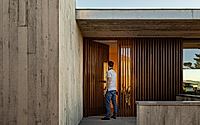
To the east, the strong stone wall pulls the eye and anchors the edge of the property. On the west, the streets write a firm limit that the retaining walls quietly accept. Those new walls align with existing lines, stitching gaps in the urban fabric without noise. Material choices stay discreet and basic so the construction settles into its context, letting the old masonry and surrounding roofs hold visual authority.
Roof As Landscape
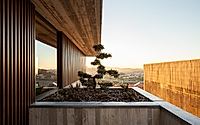
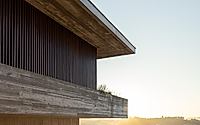
The roofs imitate the neighboring silhouettes, a conscious mimicry that softens the house’s profile against the hillside. From above, they read as another layer of Braga’s roofscape, more plateau than object. This disguise helps the volumes breathe with the ground instead of projecting as isolated masses. At the same time, the stepped roofline underlines the terraced strategy, tracing the land’s movement in built form.
Approach And Outlook
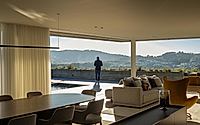
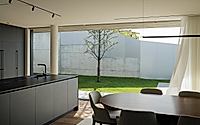
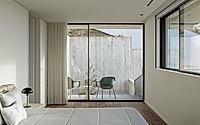
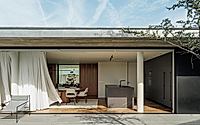
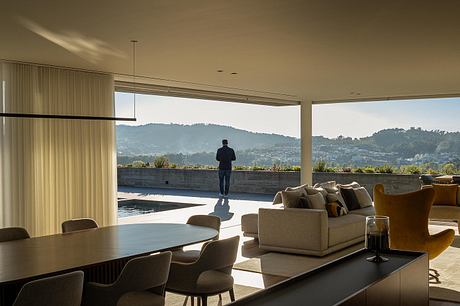
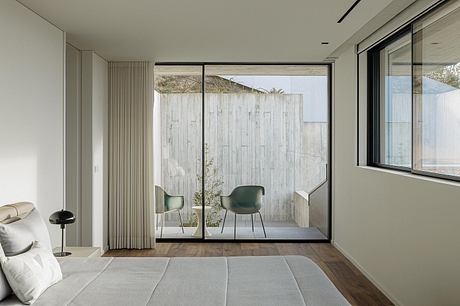
Access begins on Rua de Barros, where a ramp negotiates a six-meter difference in height between street and dwelling. That descent is not just a technical solution; it becomes a slow passage from public realm to private refuge, framing new perspectives at each bend. Once inside, rooms open decisively to the south and west, like a plant turning toward the light. Wide, unobstructed views slide in as living paintings, rewarding the house’s deference to the slope.
Exterior Rooms And Water
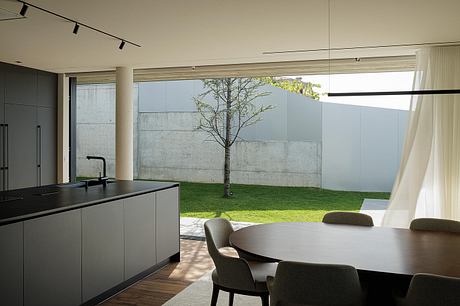
Outdoor ground is carefully valued and ranked, so courtyards, terraces, and the pool hold clear roles along the descent. Close to the water, the land flattens just enough for rest, letting bodies linger under Braga’s sky. That pool terrace marks the moment where containment and horizon meet, held by retaining walls yet open to light and air. Every exterior room ties back to the hillside, treating the once-stubborn slope as daily terrain for living.
As day fades, the terraces and roofs fold into the broader hillside, their outlines barely distinct from the surrounding construction. Light slides off the stone wall, across the pool, and up the staggered planes. Casa A stands as a measured answer to a difficult plot, finding calm in the shared line between ground and horizon.
Photography by Ivo Tavares
Visit L2C Arquitectura