Pavilion Essoa: Double-Curved Roof Cools a Lagoon-Edge Retreat Home
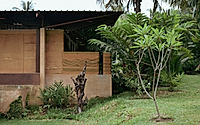
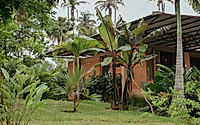
Pavilion Essoa stands on the lagoon in Jacqueville, Côte d’Ivoire, a house by MOYÉSOA shaped by tropical vernacular thinking and bioclimatic craft. Set within a vast botanical garden, the villa breaks into independent volumes linked by courtyards that invite movement and air. The plan pursues self-sufficiency and modular living, translating local materials and know-how into a quiet, contemporary rhythm that meets the coast’s heat and humidity head-on.


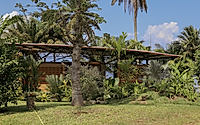
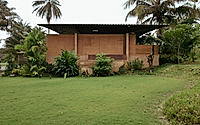
Morning light slides across water as the path skirts the lagoon’s edge. A low form lifts under a double-curved roof, its shadow patterning the ground in slow, shifting bands.
On an 8,000 m² (86,111 sq ft) site, this house in Jacqueville threads living rooms, terraces, and bedrooms through a 7,500 m² (80,729 sq ft) botanical garden. MOYÉSOA leans into coastal climate and daily rituals, arranging independent volumes around planted courts that pull breeze and soften heat. The project treats ventilation, shade, and material mass as the core brief, not an afterthought.
Lagoon Edge Approach
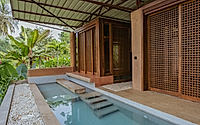
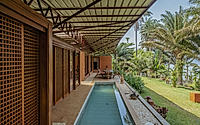
The villa sits low to the water with a generous terrace acting as hinge between inside and out. From the pool, a swimmer reads the horizon in a clean line, an illusion of floating with the lagoon beyond. An underwater bench links directly to the kitchen, turning the water’s edge into a social threshold where cooking, talk, and a quick dip stay in easy reach.
Courtyards Draw Breeze
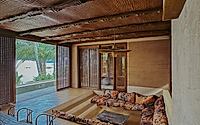
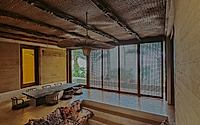
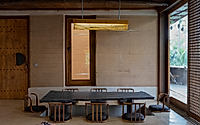
Independent rooms connect by planted passages that temper glare and carry wind through the plan. Recessed living and dining areas frame long, layered views across water and garden, keeping movement shaded through the day. Three bedrooms hold their privacy yet stay aligned by a shared axial opening, maintaining sightlines and a sense of continuity across the ensemble.
Roof Guides Light
A refined double-curved roof does the heavy climate work while setting the project’s silhouette. Solid and transparent metal sheets, fixed to a light structure, filter sun and spark a quiet play of shadow across walls and floors. The roof’s lift encourages pressure differences that speed cross-ventilation, which trims reliance on mechanical cooling during peak heat.
Mass, Shade, and Touch
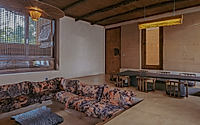
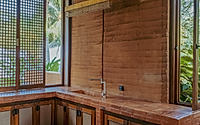
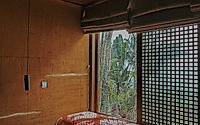
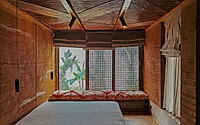
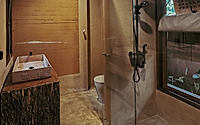
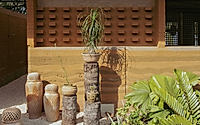
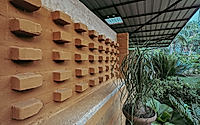
Rammed earth walls and raw earth brick store coolth through the day, smoothing indoor temperature swings; terracotta underfoot adds durable warmth under a bare heel. Interior surfaces blend earth resin and lime stucco for a firm, low-gloss finish that reads calm. In bathrooms, tadelakt provides a waterproof sheen, while woven rattan ceilings and carved solid wood bring tactility and local craft into daily reach.
Adjustable Enclosure
Wooden screens fitted with removable plexiglass panels fine-tune airflow when the weather turns; they hold a middle ground between open ventilation and insulation. Curtain wall assemblies follow bioclimatic principles tuned to coastal humidity, balancing shaded transparency with deep overhangs. Across rooms, earthy tones sit against lush greens, grounding the ensemble without competing with the garden’s density.
Autonomy on Site
Photovoltaic panels provide energy, and a private well secures water, backing a self-sufficient routine built for the long haul. Custom-made fittings and furniture keep proportion and material language consistent—an artisanal thread that ties service zones to gathering rooms without noise.
Late sun sifts through the metal roof and rattan, laying a loose grid across terracotta and earth plaster. Air moves, leaves shift, and the horizon holds steady. The house works with the climate it meets, trading mass, shade, and air for comfort day after day.
Photography courtesy of MOYÉSOA
Visit MOYÉSOA