Day House by IF Architecture
Day House sets a Victorian home in Malvern, Melbourne, Australia into a new rhythm for contemporary living. IF Architecture reworks the historic residence and later addition into a layered family house that pairs restored character with a composed modern palette. Across garden-facing rooms, poolside terraces, and reconfigured interiors, the project builds a calm sequence where period detail, crafted joinery, and considered material shifts give each room its own clear mood.


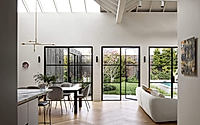
Morning light moves from the restored verandah through to the pool, catching on herringbone timber and soft plaster. At the back, dark-stained timber frames garden views while white walls hold the brightness inside.
Day House is a reworked Victorian house in Malvern, Melbourne, reimagined by IF Architecture as a generous family home. The project extends an earlier Nicholas Day renovation, reshaping rooms and adding a contemporary extension while preserving the heritage shell. Interior character rests on a carefully tuned palette: restored period detail at the front, calm neutral rooms at the center, and richer color in private quarters toward the rear.
Original street-facing rooms keep their Victorian presence, yet the mood shifts as soon as the front door opens. The entry sequence quickly pulls sightlines toward the contemporary extension and garden, threading together old and new through light and surface.
Restoring The Victorian Core
At the front, the facade and verandah regain clarity, with period detailing treated as the first layer of the interior story. Restored architraves, cornices, and fireplaces hold their formality, but the surrounding landscaping softens the edge, letting planting bring a relaxed, organic counterpoint to the architecture. Inside, scale and function shift to suit contemporary family life, so heritage rooms now support new programs without giving up their proportion. The result is familiar yet refreshed.
Refining The Central Rooms
Past the threshold, the hall opens quickly toward framed views of the garden and the Nicholas Day addition. Solid timber herringbone flooring runs through these central rooms, its pattern adding rhythm while still in conversation with the era of the house. The floor’s warmth grounds the interior, tempering white walls and making the shift to the modern extension feel measured rather than abrupt. Light, material, and view do most of the work.
Composing The Garden Living Zone
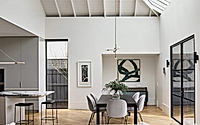
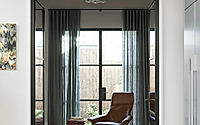
The original rear extension is pared back and clarified, with its gable roofline and skylight now expressed through simple planes and discreet uplighting. Dark steel-framed windows cut sharp outlines against white walls, turning each garden prospect into a deliberate composition. Here, an open-plan kitchen, living, and dining area runs along the landscape, guided by elevated yet restrained materials in a neutral palette that quietly supports the clients’ furniture and art.
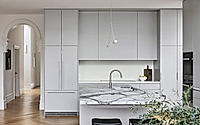
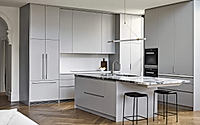
In the kitchen, a substantial stone bench with a cantilevered breakfast bar anchors daily life, with a concealed appliance cupboard allowing surfaces to remain calm. Two large new windows shift the aspect to capture morning light, giving the cooking zone its own distinct character. Above, suspended lights in brass and marble bring a finer grain of detail, adding gleam and tactility without disrupting the overall restraint.
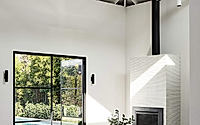
The living area centers on a simplified fireplace where feature stone meets the rougher texture of Japanese ceramic tiles. That pairing gives a clear focal point, balancing weight and texture while echoing the project’s broader conversation between historic and contemporary layers.
Extending Into Landscape And Color
A new tertiary extension reads as the most contemporary element, set in dark stained timber with a clean silhouette oriented to gather daylight. Large glazed openings and integrated elements such as a concealed BBQ keep the composition quiet, so attention stays on the pool and organic planting. Continuous paving draws movement from interior rooms to the water’s edge, turning the garden into a daily living zone rather than a backdrop.
Upstairs and deeper into the plan, palette becomes more expressive. The master bedroom and ensuite work with soft pink tones, keyed to the colors of original leadlight. Pink Australian marble, threaded with apricot, grey, and copper, guides the choice of tiles, tapware, and furnishings, giving the suite a gentle warmth. Children’s rooms lean into green, their identity reinforced by a restored marble fireplace that ties new color to an inherited element.
By rebalancing heritage fabric, modern interventions, and a precise material story, Day House operates as a cohesive whole. Light, color, and crafted surfaces move in concert from verandah to pool, allowing family routines to unfold along a clear, legible sequence. The house feels rooted in its Victorian origin yet tuned to contemporary life.
Photography courtesy of IF Architecture
Visit IF Architecture