Hollywood Hills House — Industrial Warmth For A Hillside Family Home
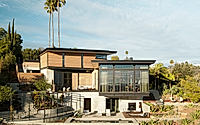
Hollywood Hills House steps down a steep Los Angeles, United States hillside with a cinematic sense of arrival shaped by Mutuus Studio. The house compresses at entry, then opens toward wide city views as industrial surfaces and old-world references fold into a compact family plan. Every level feels choreographed, from the secret garden bridge to the lower guest rooms, yet the sequence stays intuitive and grounded in daily life.


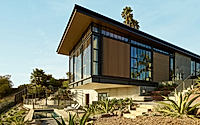
From the street, a wood and steel bridge skims above the slope and leads to a hidden garden carved into the hillside. Light pools in this outdoor room before visitors push through a monumental bronze door and descend toward the main hall, trading the exposed approach for a deep interior framed by concrete, timber, and dark metal.
This is a house on a 45 percent incline, yet the route through it feels more like choreography than navigation. Mutuus Studio organizes the compact Los Angeles residence as a sequence of linked episodes, each tuned to a different degree of enclosure, view, and ritual. The plan rejects a simple stacked layout in favor of a layered descent, borrowing from the clients’ memories of Irish castles while responding to contemporary California routines.
Crossing The Secret Garden
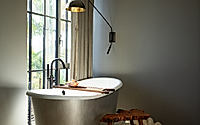
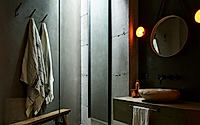
Arrival starts at the top of the site, where the bridge spans a planted court that sits slightly out of view from the street. The garden stays covered, so shafts of daylight filter down through a skylight and slip into the guest bath, building a sense of shelter rather than exposure. That small compression of height and view primes the visitor for what follows: a shift from open hillside to something closer to a protective fortress. The bronze door marks that threshold with weight, turning the simple act of entering into a clear first chapter.
Descending To The Great Hall
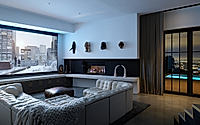
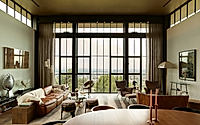
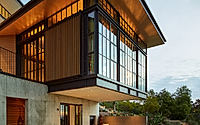
Beyond the door, a stair draws guests down into the primary living level, conceived as a contemporary great hall for gathering and daily life. Kitchen, dining, and lounge hold a single volume, yet subtle devices shape functional zones without walls. A circular dark hearth anchors the center, acting as a quiet boundary between cooking and sitting, while caramel leather chairs and a Finn Juhl table set a more formal note for meals. Black steel windows pull generous southern light across antique fumed oak floors, turning the long living room into a linear promenade toward the city panorama beyond.
Windows As Moving Parts
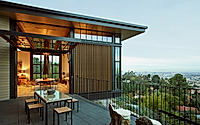
Along the glass wall, one heavy metal gear-and-chain pivoting window becomes both mechanism and gateway. Its movement underlines the idea of constantly shifting relationships between interior and terrace and between social zones and quieter corners. When open, the panel connects the hall to an eastern terrace and a secondary dining area, setting up a zigzag route that carries people outdoors before leading them down toward the pool. The window’s industrial character aligns with blackened steel cabinetry, brass accents, and scattered artifacts, tying mechanical drama to the room’s tactile composition.
Splitting Public And Private
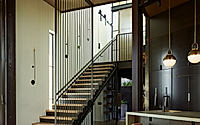
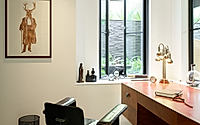
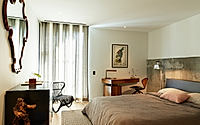
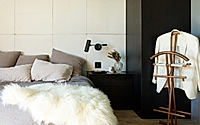
Deeper into the house, a double stair divides movement between social rooms and secluded quarters, reinforcing the sense of a staged procession through the hillside. One flight continues down to a media level and guest rooms, extending the public route closer to the pool and lower terraces. The other bends toward private bedrooms that sit back into the mountain, where cast-in-place concrete and stained cedar siding envelop more intimate routines. Each landing marks a pause, a moment to turn, shift orientation, and register the distance from the bright bridge overhead.
Elemental Material Rhythm
Throughout, an elemental palette keeps the circulation legible, even as the route bends and layers. Antique fumed oak treads warm the stairs, while concrete walls and blackened steel edges outline the primary paths through the house. Copper and walnut surfaces add depth next to industrial metal, echoing the project’s balance of old-world reference and contemporary construction. That clarity of material rhythm supports an efficient plan that still accommodates a luxurious California lifestyle, where daily movement reads as a quiet performance repeated over time.
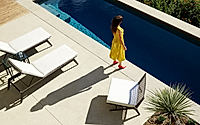
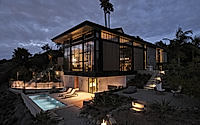
By the time visitors reach the lower levels, the city view has widened and the sense of fortification softens into open terraces and poolside rooms. The memory of the secret garden and the weight of the bronze door still register, giving each ascent and descent a subtle narrative frame. As light shifts across oak, concrete, and steel, the house continues its slow choreography down the slope, tying family life to the contours of the Hollywood Hills.
Photography by Kevin Scott
Visit Mutuus Studio