Cabin in Woods by Ediz Demirel Works
Cabin in Woods stands on a hillside above the Kozak Plateau in Bergama, Türkiye, conceived by Ediz Demirel Works as a compact, short-term rental retreat. The cabin leans into the contrast between an existing dry stone terrace wall and a prefabricated steel shell, pressing visitors closer to the terrain while holding them inside a precise metal envelope. Within this tight footprint, everyday rituals orbit a sunken gathering core and its framed landscape views.
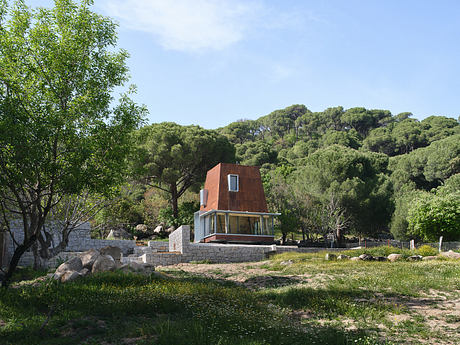
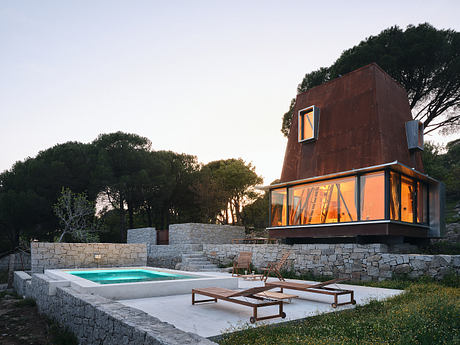
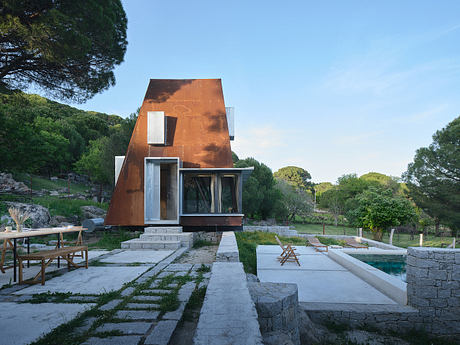
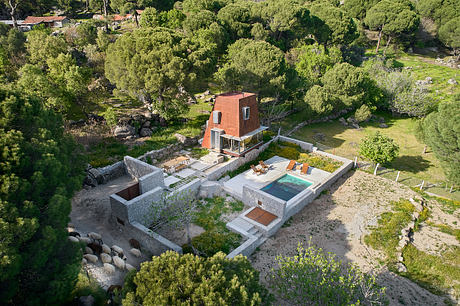
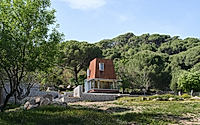
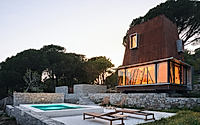
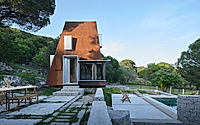
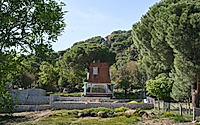
Visitors arrive along the Kozak Plateau and meet a crisp metal volume resting on a rough stone terrace wall. Light catches the corten shell, while the land holds its cool, irregular texture.
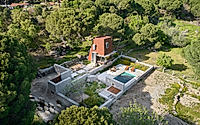
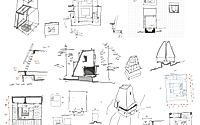
This modest cabin in Bergama functions as a short-term rental, yet it behaves like a careful study of structure and ground. Ediz Demirel Works sets a sunken core into the old vineyard terrace, pairs it with a prefabricated steel frame above, and lets the conversation between stone, concrete, and corten define how the cabin feels and performs day and night.
Anchoring Into Stone
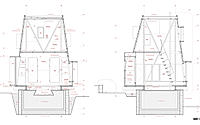
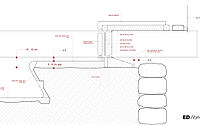
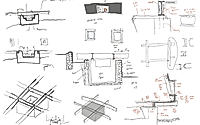
The project starts with what was already there: a dry stone terrace wall from a former vineyard, reinforced rather than replaced. In-situ reinforced concrete is poured into this irregular base, turning the wall into both foundation and conversation pit while preserving the rough geometry of the terrain. The new structural system sits lightly on top, detached from the topography so the heavy work of contact with the land belongs to the masonry and concrete alone.
Raising The Steel Shell
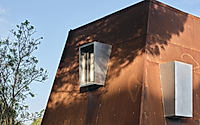
Above this grounded base, a tent-like steel frame holds a corten shell that reads as one clear, protective volume. Structural members and façade panels are prefabricated in the workshop, then brought to the hillside for assembly with minimal disturbance to the plateau. The controlled geometry of the shell deliberately opposes the irregular stones beneath, setting up a legible split between engineered precision and the looseness of the inherited terrace. That split gives the small cabin a strong presence without overwhelming the rural setting.
Carving The Sunken Core
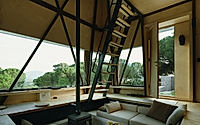
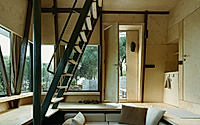
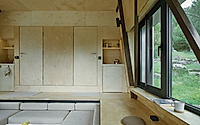
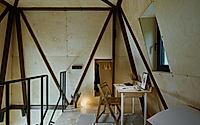
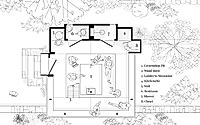
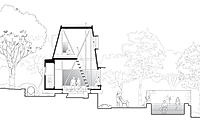
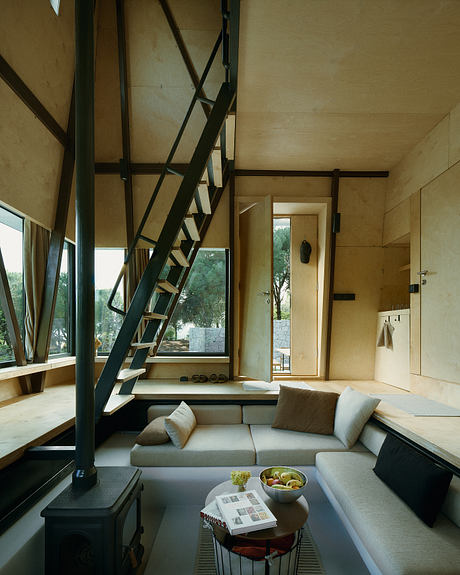
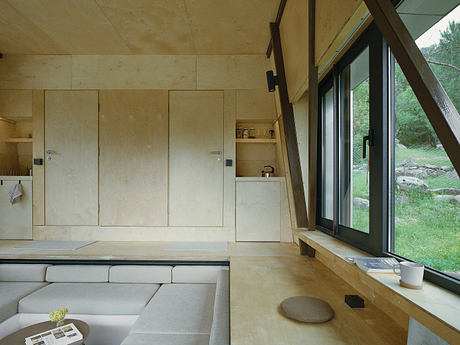
At the heart of the plan, the sunken core forms a contemporary conversation pit embedded in the terrain and encircled by the steel shell. Seating steps drop users below the main floor, where they gather around a fire to share warmth and eye level with the land. Wet rooms and service zones attach to this central void as extensions, leaving the pit as the experiential anchor that ties daily use back to the hillside.
Framing Light And Views
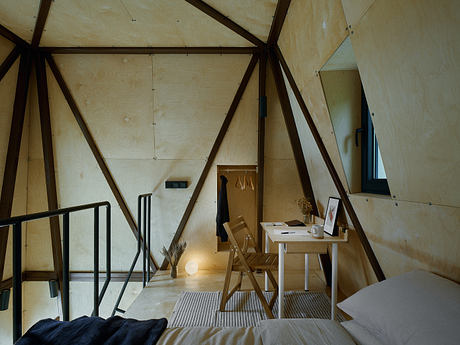
A long horizontal cut in the metal envelope runs across the shell, trimming a panoramic view of the Kozak Plateau and its layered terrain. From the sunken core, occupants read the horizon as a continuous band, while from the mezzanine sleeping and working level, the same opening feels like a distant, lifted landscape strip. Projecting apertures on the façade stand out like sculptural boxes, extending the interior outward and thickening the threshold between cabin and hillside.
The result is a clear dialogue between two tectonic attitudes: one rooted in the plateau’s stone culture, the other in prefabricated steel and corten panels. Inside that dialogue, guests sit low in the conversation pit, lean against concrete that feels part of the slope, and then climb up into the lighter shell above. The cabin holds its ground quietly, shaped by the ongoing tension between what is local and what arrives from elsewhere.
Photography courtesy of Ediz Demirel Works
Visit Ediz Demirel Works