Curved Apartment by Eklekt Atelier
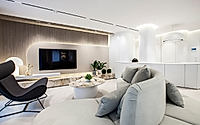
Curved unfolds as a 70-square-meter apartment in Kraków, Poland, drawn from the curved envelope of a contemporary building and refined by Eklekt Atelier. The interior reorganizes a once-standard layout into an open, flowing sequence for weekend living, where day and night zones slip past one another behind soft partitions and discreet storage. Calm light, restrained materials, and careful detailing ground the project in quiet urban comfort.


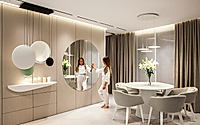
Light glides along the curved perimeter, catching on pale furniture panels and soft textiles as it moves from kitchen to bedroom. Corners fade out, replaced by gentle arcs that carry the eye in one continuous sweep.
This apartment sits within a contemporary, cornerless building in Kraków, where Eklekt Atelier treats the curved envelope not as a constraint but as a guide. The project reconfigures a 70-square-meter interior into a weekend retreat, organized around fluid movement rather than fixed thresholds. Every decision turns on how one room unfolds into the next, how daily routines track along that ellipse.
Curved functions as a compact private residence, with an open living area combining kitchen and dining, and a separate bedroom with an en-suite bathroom. The original partitioning is removed so the new arrangement can follow both the building’s geometry and the client’s needs, from cooking and conversation to resting and bathing. Planning centers on clear zoning rather than enclosed rooms, using built-in furniture, curtains, and concealed doors to choreograph levels of intimacy.
Flowing Daytime Sequence
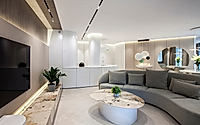
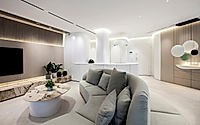
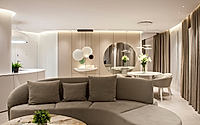
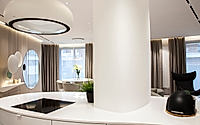
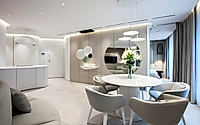
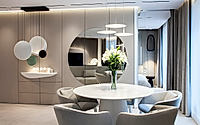
The living area reads as one continuous volume, where cooking, dining, and lounging link together without conventional doors. Movement traces a soft loop: past integrated kitchen fronts, along curved cabinetry, toward the window line and back again. Functions are distinguished through sequencing and built elements instead of hard partitions, so a change in ceiling light, a shift in finishes, or a slight offset in built-in depth signals a new zone.
In the kitchen, fully integrated sliding systems hide appliances behind smooth fronts, which maintains a clean visual run and keeps daily clutter out of sight. This gesture reinforces the feeling of an uninterrupted band of storage that supports the open plan. As the fronts close, the room reads as a quiet living environment rather than a working kitchen.
Curved Geometry As Organizer
Extensive custom MDF furniture tracks the building’s elliptical perimeter, turning a potentially awkward wall line into a precise organizing tool. These built-ins wrap structural elements and ventilation routes, absorbing irregularities so the perceived volume remains smooth and legible. Storage tucks behind continuous fronts, which keeps the floor clear and reinforces an easy reading of the plan.
Curving units mediate between circulation and use: a radius cabinet might conceal a column on one side while presenting shelving or wardrobe on the other. This dual role supports compact living, where every centimeter must balance function and openness. The result is a quiet clarity in movement, with no abrupt stops or leftover corners.
Transition From Day To Night
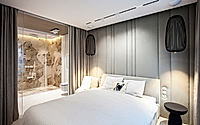
A long wall of built-in wardrobes acts as the hinge between public and private zones. Within this volume, concealed sliding glass doors allow the bedroom and en-suite bathroom to close down without announcing themselves. When the doors slide away, circulation extends, and the apartment feels like a continuous loop again.
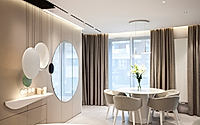
Curtains on hidden tracks add another layer of control, softening views and muting light when needed. A simple pull can transform the reading of the plan, turning an open suite into a more secluded retreat. This layered threshold gives the resident choices in how connected or withdrawn each moment feels.
Light, Texture, And Routine
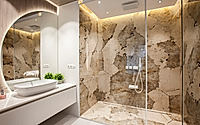
A restrained palette of stone, fabrics, and furniture panels underpins the planning strategy by avoiding visual noise along the circulation paths. Surfaces carry a tactile, textile-like quality that tempers the crisp geometry and keeps attention on proportion and alignment. Lighting is treated as a structural element, with concealed tracks and small points directing emphasis along routes and at key functional nodes.
Different lighting scenarios support the apartment’s weekend role, from brighter, ergonomic arrangements for cooking to softer, more diffuse scenes for late-night reading or conversation. Almost every fixed element, aside from select seating, is custom designed for this interior, reinforcing a sense that the plan and its furnishings form one continuous system.
By leaning into the building’s curved shell, Eklekt Atelier shapes an interior where movement feels intuitive and calm. Light, storage, and circulation work together, allowing the resident to drift between day and night zones without abrupt breaks. On a quiet evening in Kraków, the gentle arcs and soft thresholds frame a compact yet generous way of living.
Photography courtesy of Eklekt Atelier
Visit Eklekt Atelier