House in Itabashi by TERRAIN architects
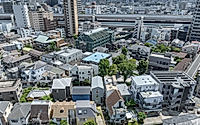
House in Itabashi sits in a tight residential pocket of Tokyo, Japan, where TERRAIN architects rethinks how a family house meets the street. On a narrow plot close to central Tokyo, the three-story wooden home experiments with vertical light, layered thresholds, and a new kind of window depth to mediate daily life in a dense neighborhood.


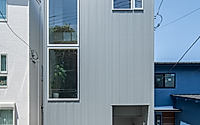
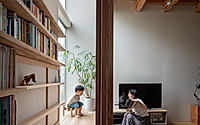
Morning light slides down the tall vertical window, catching the grain of the wooden structure as it travels from street level to the upper rooms. Inside, the narrow atrium breathes between floors, setting up a gentle pause between the bustle outside and the routines of a family of four.
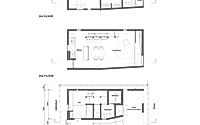
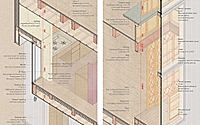
This compact house in a residential quarter of Tokyo is a three-story wooden home planned on a 70 square meter plot for a family household. TERRAIN architects works with the hyper-dense surroundings by inserting what they call Deep Pockets, pockets of depth at windows and thresholds that hold light, air, and a buffer from the street. Rather than chasing sheer floor area, the project studies how a measured margin between private interior and public city can change everyday urban living.
Shaping Margins In The City
Tokyo’s density often pushes houses tight against one another, leaving little distance between neighbors and rooms. On this narrow six-meter-wide site, the volume could have felt pressed right up against its edges, no matter how many square meters the plan delivered. Deep Pockets answer that pressure by inserting a sliver of depth wherever the home meets the outside, so the edge is no longer a thin pane of glass but a layered, inhabitable zone. That margin becomes the project’s real luxury in a context where physical and psychological distance is scarce.
Vertical Atrium And Window
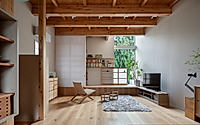
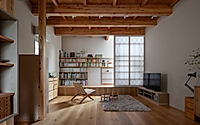
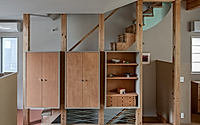
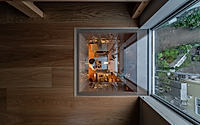
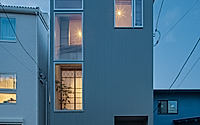
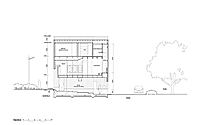
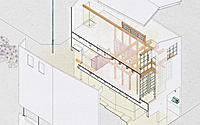
Along the street, a tall vertical window draws the eye, running across two upper floors and opening the house toward a nearby park. Within this aperture, a narrow atrium links the second-floor living room with the third-floor bedrooms, so family members share light, sound, and air even when they occupy different levels. A large movable shoji screen lines this atrium, creating a soft enclosure that turns the void into a filter rather than a gap. Light, wind, and distant street noise gather in this pocket and then drift into adjoining rooms, giving the interior a looser, more breathable edge.
Movable Shoji As Boundary
The tall shoji elements reinterpret a familiar domestic component for a rougher urban role. Instead of delicate paper, sturdier materials and tension fabric hold up to daily use and constant adjustment. Residents slide and position the screens to tune privacy, views, and ventilation, shifting the line between inside and outside according to time of day or mood. This adjustable boundary turns the Deep Pocket into an active part of household life, not just an architectural gesture held at the facade.
Entrance As Alley Pocket
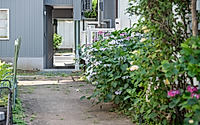
At ground level, the idea of the margin becomes horizontal. A passage-like Pocket stretches between the two streets that flank the site, working almost like a small alley running through the plot. Rather than a single front door that cuts a sharp line, the entrance sits within this in-between zone, so arrival unfolds as a gradual shift from public to private. The front and back of the house blur a little in this shared corridor, giving the family a softer, more social threshold in a tight neighborhood grid.
Urban Comfort On A Compact Lot
In many dense quarters, generous floor plates alone cannot offset the feeling of being hemmed in by neighboring walls. Here, the subtle depth of the Deep Pockets lets rooms feel owned right up to their edges, because the boundary is buffered rather than abrupt. This margin supports both emotional ease and practical climate response, catching breeze and daylight while screening views. The house uses that extra thickness at its perimeter to hold a calmer relation to the city beyond.
By day, light moves through the vertical pocket, grazing the shoji and landing deeper inside. As evening settles over the neighborhood, the same tall opening glows softly toward the park, hinting at life within but keeping a respectful distance. The house stays close to its neighbors yet maintains a measured gap, proving that on a small urban lot, a few well-placed pockets can change how an entire home feels against the city.
Photography courtesy of TERRAIN architects
Visit TERRAIN architects