Vollerup Atrium House by Jan Henrik Jansen
Vollerup Atrium House stands in a meadow near Nykøbing Sjælland, Denmark, where Jan Henrik Jansen shapes a calm second home from stone, timber, and sky. The house extends a Danish couple’s life beyond their inner-city apartment, giving their family a coastal retreat that also supports remote work. It reads as both refuge and outpost, with an inward-looking atrium balanced by long views toward the water and surrounding trees.


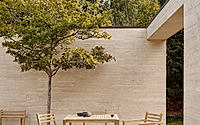
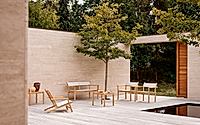
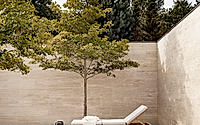
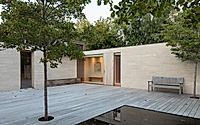
Travertine walls rise from the meadow, catching the coastal light as it moves across the day. Inside the carved square of the atrium, hawthorn branches lean over water and stone while the wind from Sejerø’s channel passes just beyond the trees. One moment feels exposed to the horizon, the next deeply enclosed.
This house is a second home and working base for a Danish couple and their extended family, set within a traditional summerhouse area yet pursuing a very different rhythm. Conceived by Jan Henrik Jansen as a precise travertine prism with a generous void at its heart, the project prioritizes interior atmosphere and the way materials hold light. Life organizes around the atrium, and the rooms turn inward to calm, controlled surfaces of stone and oak.
Travertine Prism In Meadow
From a distance, the house reads as a monolith placed in the small meadow, its travertine surfaces held low and horizontal against the irregular vertical trunks of coastal pines. The stone’s soft, porous texture tempers the strong geometry, catching shadows and moisture so the volume settles into the surrounding grass and oaks. Arrival is deliberately abrupt. A largely closed wall of travertine faces visitors, broken only by two immense oak-panel sliding gates that conceal the garage and, beyond, the atrium.
Atrium As Everyday Ground
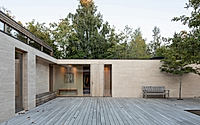
Passing through the oak gates, the atrium opens as a large, flexible courtyard that stands between the house and the weather. This central ground holds smaller pockets: places aligned with hawthorn trees, edges gathered around a reflection pond, and calm corners that suit any time of day. It works as refuge when Danish rain comes across the coast, yet it also stages family gatherings where movement passes easily from one sheltered pocket to another. The surrounding program—garage, covered terrace, guest rooms, and main dwelling—wraps this void so that almost every daily act returns to the stone court.
Oak-Lined Egoistbolig
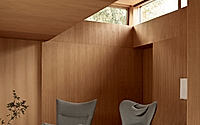
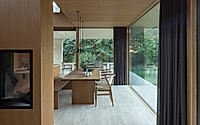
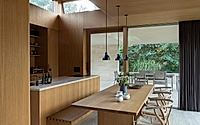
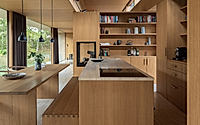
Along the northern edge of the atrium sits the primary dwelling, modest in size yet carefully tuned. Jansen describes it as an egoistbolig, a suite of intimate rooms that foreground the owners’ own rituals rather than entertaining scale. Oak linings wrap walls, built-in furniture, window frames, and a bespoke acoustic ceiling, forming a continuous timber shell against which mid-century pieces sit with quiet clarity. Within this shell, joinery subtly partitions cooking and eating, lounging, and sleeping, while a concealed sliding wall can fully close the bedroom when desired.
Light, Lantern, And Views
Although the dwelling’s footprint remains compact, long northerly views stretch out from the rooms toward the landscape beyond the atrium. This reach gives a sense of calm grandeur that counterbalances the intimacy of the oak surfaces and close detailing. Above, a raised ceiling lantern with remotely operable south-facing windows introduces indirect sunlight, washing uninterrupted travertine floors and timber planes with a soft, even glow. The quality of light shifts through the day, yet glare remains controlled, reinforcing the sense of retreat suited to both rest and work.
Guest Wing In Reserve
Wrapping the remaining sides of the courtyard, a concealed guest wing and covered terrace complete the ensemble. The guest rooms comfortably accommodate up to six visitors, allowing extended family to share the house without overwhelming the couple’s daily patterns. Crucially, this wing can be isolated and visually concealed, so that when it is empty the core dwelling returns to an almost solitary character. Even with its multiple roles—holiday house, pandemic refuge, remote workplace—the project maintains a quiet center.
As evening comes, the travertine shell cools and the oiled oak interiors take on a deeper tone under indirect light. The reflection pond picks up fragments of sky, while the hawthorn trees mark slow seasonal change. In this measured setting, material, light, and family life stay closely intertwined.
Photography by Jose Campos
Visit Jan Henrik Jansen