A Touch of New by Aristides Dallas Architects
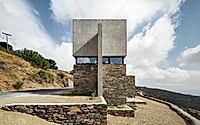
A Touch of New brings a quietly radical house to the Tinos Regional Unit in Greece, where Aristides Dallas Architects work directly with the island’s dovecote heritage. The residence steps across two levels on the hillside, setting a hovering concrete cube against the weight of existing stone to negotiate old fabric and new construction.


Wind brushes the stone walls and concrete surfaces as the house catches the slope, the two levels reading clearly against the rugged terrain. Light slips through a deliberate horizontal opening, cutting a bright band between old and new volumes.
This residence is a house in the Tinos Regional Unit, conceived by Aristides Dallas Architects as a dialogue with the island’s traditional stone dovecotes and additive building methods. The project stays close to its landscape, using a subtractive approach and minimal intervention so the existing stone mass remains present. Material joins and calibrated openings carry the story of how a contemporary structure can rest on, and argue with, a rural Greek foundation.
Stacking Volumes In Balance
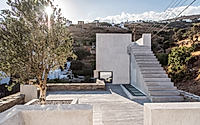
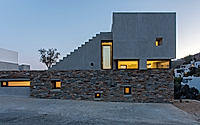
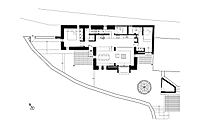
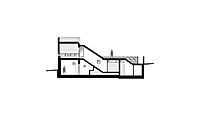
The house organizes itself in two levels that read as a bipolar bond, a grounded stone base and a concrete cube hovering above it. This vertical stacking refers to the way traditional dovecotes grew by height additions, one layer at a time, rather than by spreading across the land. The hovering upper volume keeps its geometry taut so the existing masonry remains legible, turning the junction between them into an architectural hinge. Gravity feels redirected upward through this pair of volumes, while the hillside still anchors the composition.
Cutting Light Between Old And New
Between the existing stone structure and the added concrete mass, a continuous horizontal opening forms a thin, luminous band. This cut is more than a pause in the envelope; it becomes a transparent zone that pulls daylight deep into the interior. Views stretch outward through this slot, so daily movement inside always meets the distant horizon rather than a solid joint. The gap turns the meeting of eras into a frame, quiet but insistent.
Framing Yard And Horizon
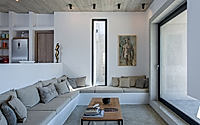
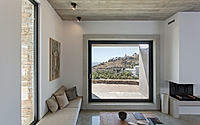
On the ground level, a large square opening breaks through the stone wall in front of the sitting-room. The cut acts like a screen, releasing the view while maintaining the clarity of the masonry surface. Just outside, this move shapes a small berm that works as an outdoor sitting-room, a compressed yard carved from the slope. Interior and exterior lean toward each other here, so daily life slips easily between couch, threshold, and terrace.
Marking Time Through Material
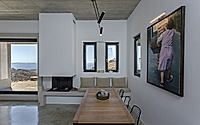
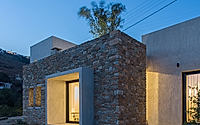
Material shifts register the project’s temporal layers without resorting to imitation. Existing Tinian stone holds the ground floor, its texture and color rooted in local construction traditions. Above and alongside, fare face ochre plaster wraps the additions, standing apart from the grey fare face concrete cube that crowns the composition. Old and new remain clearly distinguished, and that clarity lets a contemporary architectural vocabulary sit with traditional and modernistic traits of the Greek countryside in one coherent ensemble.
As the day turns, light traces the edges of stone joints, grazes the plaster planes, and softens the underside of the hovering cube. The house keeps its profile calm against the hillside, even as the band of glazing and the square cut on the yard continue to draw the eye outward. In this measured play of mass and aperture, a rural structure absorbs a new layer without losing the weight of its origins.
Photography courtesy of Aristides Dallas Architects
Visit Aristides Dallas Architects