Villino RV by MAMESTUDIO
Villino RV refits an unassuming 1980s terraced house in Lido di Ostia, Italy, into a calm and legible home by MAMESTUDIO, led by Maria Elena Amori and Matteo Bernardi. Across four compact levels, the architects organize family life into clear vertical bands while threading a single interior landscape that stays visually connected. Each floor supports a different rhythm of the day, yet the domestic story reads as one continuous sequence of rooms and light.


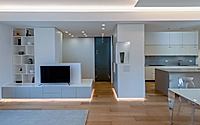
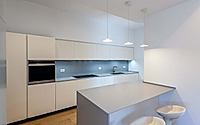
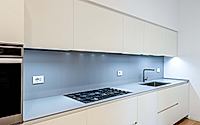
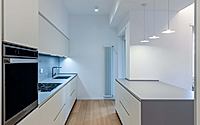
Light runs along the floor and up the cabinetry, tracing a quiet line from entrance to kitchen. A long living level unfolds in front of it, open yet carefully edited.
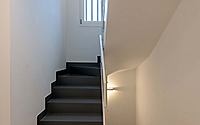
Within this domestic panorama, a once-fragmented 1980s townhouse becomes a clear and generous family house. Villino RV in Lido di Ostia arranges its four floors into distinct but connected realms, shaped by MAMESTUDIO’s precise orchestration of rooms, built-in volumes and light. The project treats circulation as a narrative, turning movement between levels into a sequence of linked views, functional moments and places to pause.
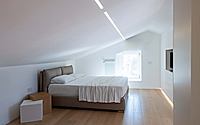
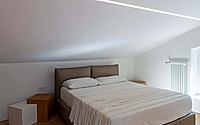
At the base, everyday life gathers around the garden, with convivial rooms and a hobby area framing the outdoor edge. One level up, the first floor carries a broad, open living level that stretches without internal partitions, held together by custom furniture and a continuous ceiling line. Above, the second floor and attic hold the sleeping quarters, including a suite-like top room that reads as an intimate retreat. Across this vertical stack, the plan leans on one strong organizing band, letting furniture, light and proportion describe how each room is used.
Stacking Daily Life
The terraced house keeps its four-level shell but reorders how daily routines sit within it. Social rooms close to the garden encourage gatherings that spill outside in warmer months, while the wide living level above holds shared routines from morning to night. Sleeping rooms rise higher for greater privacy and quiet, with the attic turned into a generous suite that reads as one long, calm volume. Each floor takes on a clear role, so the family knows instinctively where to cook, work, play and withdraw.
Axis Through The Home
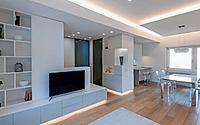
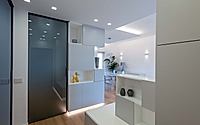
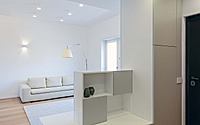
On the main living level, the plan condenses around a precise 7.5-meter axis running from entrance to kitchen. Along this line, custom cabinetry, pocketed doors, suspended ceiling planes and linear lighting form a single architectural gesture that ties the room together. From the sofa, the composition reads in one sweep: wardrobe with seat by the door, bookcase and TV volume in the middle, service element wrapped around a structural pillar, and snack counter near the kitchen. This sequence organizes circulation and sightlines, screening different functions without completely closing them off.
Volumes Shape Rooms
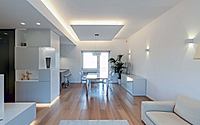
Rather than interior walls, double-sided volumes choreograph how the house is used. The central block at the living level absorbs a structural pillar and turns into a multi-faced element that stores tableware toward the kitchen, hides various household items toward the entrance and frames a display niche facing the sitting area. At the dining end, a suspended sail-like ceiling marks the table as a focal point and anchors gatherings close to the kitchen. The lounge end aligns with the TV unit and entrance, so guests step straight into an arranged yet relaxed sitting room.
Light As Guide
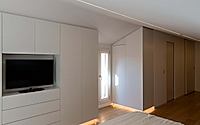
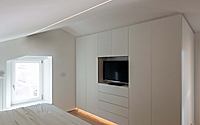
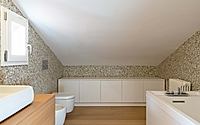
Throughout the house, light reads as another organizing device. LEDs tucked into plinths emphasize each block as both independent object and part of a broader interior landscape, while controlled gradients of brightness clarify depth and hierarchy. In the attic bedroom, one ceiling cut of light and a continuous line along the wardrobe base stretch the room’s perceived length, turning simple white, handle-less cabinets into a quiet backdrop. Across corridors, stairs and rooms, a balance of direct and diffuse fixtures keeps routes legible and allows different lighting scenes for entertaining, reading or resting.
At the technological level, a smart home system simplifies control of lighting, blinds and energy, so complex routines distill into a few clear gestures on a phone. The underlying domestic landscape stays legible even when the sun drops, with each level still reading as part of one consistent whole. In the end, Villino RV becomes a house where movement, light and custom volumes align to support both shared life and private moments, from garden to attic.
Photography by MAMESTUDIO
Visit MAMESTUDIO | Maria Elena Amori + Matteo Bernardi