Apartment MO Reframes Industrial Living for Flexible São Paulo Life
Apartment MO sets a calibrated industrial tone high above the Jardins neighborhood in São Paulo, Brazil, where Zalc Arquitetura reworks a compact apartment for flexible living. Conceived for an owner who lives abroad yet may return, the renovation balances rental practicality with the possibility of future personal use through a precise reorganization of social and private areas. Its compact footprint now frames a generous daily routine rather than a constrained plan.


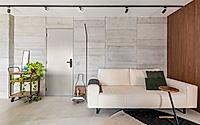
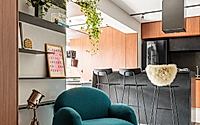
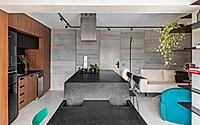
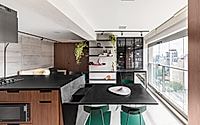
Concrete panels catch the light along a continuous living room wall, guiding the eye toward the terrace that now folds into daily life. Morning moves easily from kitchen island to cantilevered dining table, then out to the bar and wine display where the city hums beyond the glass.
This 70 m² apartment in Jardins is reshaped as a flexible rental property, with every move guided by a future possibility of personal occupation. Zalc Arquitetura reorganizes the original layout to expand the social area, draw the terrace into the living room, and carve out a more generous suite. Plan decisions favor integration and clear routes, so circulation feels intuitive rather than squeezed.
Reorganizing The Core
Targeted interventions recalibrate the compact footprint without heavy structural drama. Walls shift just enough to open the living room, stretching the social area so conversations can drift from sofa to terrace bar without interruption. The terrace becomes part of the interior sequence, its former boundary dissolved into a single continuous environment that supports different uses from breakfast to evening drinks.
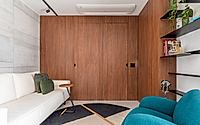
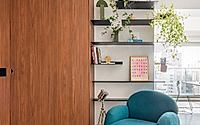
In this reorganized core, the living room takes on a central, connective role. Furniture arrangement responds to the new flow, encouraging movement between lounge, kitchen, and outdoor edge instead of locking activities into corners. The service area tucks discreetly behind a folding panel, which keeps circulation clear while maintaining visual continuity where the social rooms meet more utilitarian functions.
Kitchen As Anchor
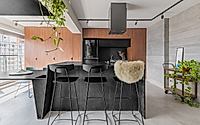
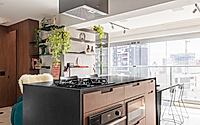
The kitchen operates as the true hinge of daily life. A firm-designed island gathers tasks and social interaction, acting as prep zone, informal counter, and visual anchor between living area and terrace. Attached to it, the cantilevered dining table extends the island’s axis, creating a long gesture that organizes movement while keeping the floor open.
Between island and table, a diagonally embedded champagne cooler introduces a precise functional cut. Its integrated drain manages melted ice water, so entertaining remains easy even in a compact plan. This triangular cut-out repeats selectively in other elements, turning a single geometric idea into a subtle guide that threads different rooms together.
Industrial Shell, Warm Sequence
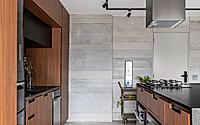
A balanced industrial character frames the reorganized layout. Exposed concrete and cement flooring run across key floors and walls, set against a restrained gray palette that keeps focus on proportion and circulation. Wood details and measured color accents temper the harder surfaces, giving the apartment a steady, lived-in rhythm rather than an overtly raw atmosphere.
Along the social perimeter, concrete panels of varying dimensions form a long backdrop. This paneled wall enhances perceived depth, while the entrance door painted in the same tone almost disappears into the surface. Lighting on black tracks and wall sconces reinforces the industrial shell yet directs a softer, indirect glow that follows the main paths through the apartment.
Private Suite Sequence
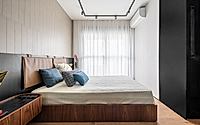
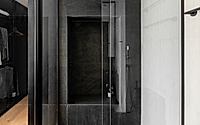
In the private zone, the plan shifts from efficiency to generous proportion. Reducing the second bedroom unlocks a larger suite with a dedicated walk-in closet and a clearer relationship between sleeping area and bathroom. A glass partition links bedroom and bath visually, so the suite reads as one extended volume rather than two isolated rooms.
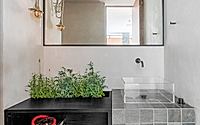
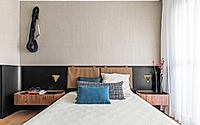
Porcelain tiles on the bedroom walls are cut into strips that continue across the headboard and into the bathroom, stitching the sequence together through a single economical finish. The curved leather headboard, formed by two freestanding modules, gently wraps the bed and allows easy maintenance while anchoring bedside tables that were designed for this specific layout.
Terrace And Service Edge
Along the former exterior edge, the terrace now completes the social circuit. A bar with a wine display extends the kitchen’s role, giving guests a clear destination at the end of the living room’s long axis. This move turns what was once a peripheral strip into a fully integrated part of the daily route.
Behind this active front, the service area hides in plain sight. A panel with a folding door conceals utilities, so the eye tracks across a calm, continuous surface instead of broken thresholds and exposed equipment. That quiet concealment supports the project’s main intent: a compact apartment organized around clear, adaptable sequences suited to both frequent guests and future long-term living.
Concrete, light, and deliberate geometry now steer movement from door to terrace, from island to suite. The apartment reads as a concise route stitched together by repeated forms and controlled textures. Each adjusted partition and crafted junction sustains a layout ready for tenants today and for a returning owner tomorrow.
Photography by Guilherme Pucci
Visit Zalc Arquitetura