Hybrid Interior BXB studio: Warsaw Workshop Apartment Reinvented
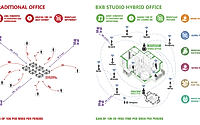
Hybrid Interior BXB studio anchors BXB studio Boguslaw Barnas’s Warsaw base in a modest apartment recast as both open office and compact retreat. Located in the Praga district of Warsaw, Poland, the project turns 70 m² into a workplace for a dispersed team and a configurable micro-apartment for short stays. The result pairs remote-era working habits with an environment tuned to art, daylight, and flexible routines.


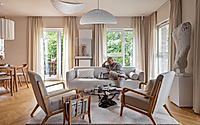
From the stair landing, the apartment opens toward tall windows where trees press close to the glass and dapple light across oak, graphite tones, and wool. A quiet threshold gives way to a room that works hard, serving as both creative hub for an architectural studio and discreet pied-à-terre when the day ends and the folding glass wall slides shut.
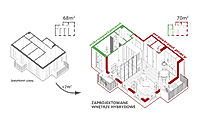
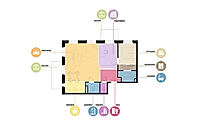
This apartment-based headquarters in Warsaw’s Praga district is planned as a hybrid between workplace and micro-apartment, reflecting the studio’s remote-first model. BXB studio Boguslaw Barnas organizes 70 m² into two main zones: an open office of about 50 m² and a 20 m² private suite that reconfigures as needed. Program, rather than decor, drives decisions—circulation, storage, and the daily rituals of work and rest determine what each room does at different times.
Reworking The Plan
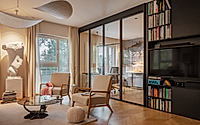
The unit once held four conventional rooms and tight corridors. Now, almost all interior partitions are demolished. One sentence stays short. Two generous open areas replace the previous layout, gaining nearly 2 m² and foregrounding the building’s regular grid of windows, which pull daylight deep into both office and micro-apartment. Between corridor and office, a built-in veneer volume stands in for a wall, forming wardrobes, storage for equipment and printers, and illuminated shelves that stage architectural models as part of everyday circulation.
Within this thickened divider sits Puff Uff, the studio’s first furniture prototype that works as both seat and compact storage. The office zone itself runs as an open field of table, sofa, and desk, where the team meets clients, works side by side, or shifts to quieter tasks. When focus or privacy is needed, a folding glass wall provides acoustic separation without sacrificing visual continuity, maintaining a sense of one shared environment across the day.
Configuring The Micro-Apartment
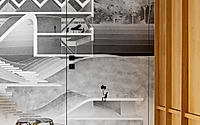
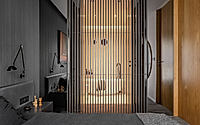
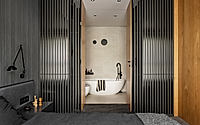
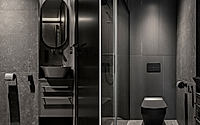
Behind a muralled wall, a discreet door leads to the 20 m² micro-apartment. This small suite behaves almost like a switchboard. It can read as three compact rooms—bedroom, wardrobe, and bathroom—or transform into an open bathing lounge when tall doors swing wide and divisions slide away. Another setup links wardrobe and bedroom while keeping the bathroom self-contained, matching different patterns of work trips, guests, or late nights after deadlines.
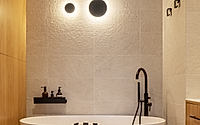
Custom partitions and ceiling-height double doors define this graphite-toned enclave. The second bathroom in this zone shifts the mood with light colors, oak textures, sand-hued tiles, and black details set against white sanitaryware and a sculptural freestanding tub. Sliding lattice panels across the wardrobe modulate views and light, while large mirrors expand the perceived volume, letting a very compact footprint feel generous enough for unhurried morning and evening routines.
Workplace As Gallery
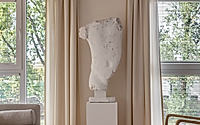
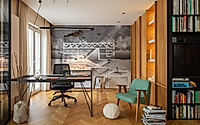
Art and models are not decoration here; they are tools and daily company. One sentence lands crisp. The wall dividing studio and micro-apartment carries an original mural, an interpretation of the House with a Cave project tied to the Wawel Dragon legend, with a dragon sculpture mounted above and a concealed door cut into the composition. In the sofa area, a scorpion-shaped coffee table doubles as sculpture and symbolic link to the studio’s nuclear shelter concepts.
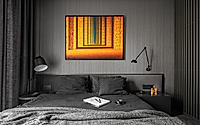
Elsewhere, ceramics, cups, trays, and vases with varied textures sit within easy reach on shelves and tables, supporting working lunches and impromptu discussions. An easel stands ready for new paintings, while a vivid work from the Library series hangs over the micro-apartment bed, its strong color field punctuating an otherwise monochromatic room. Throughout, more than ten architectural models—among them eco-tower and farmstead prototypes—line illuminated shelves, turning the office into a three-dimensional archive of built and unbuilt work.
Light, Climate, Routine
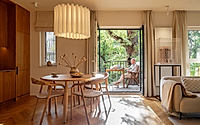
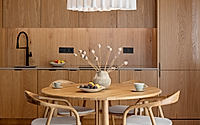
Muted earthy tones, beiges, and oak wood set a calm base for long working days and occasional overnight stays. A short line frames the scene. At the main table, oak chairs with linen seats face an AXO Light pendant that anchors the axial view from the hall and throws soft, fabric-filtered light across meetings and model reviews. Minimalist desks and a transparent glass wall keep the office legible, while wool rugs and oak armchairs warm the more relaxed seating zone.
Seasonal changes outside shape the daily rhythm inside. Large windows open toward trees that stand just beyond the balconies, where wooden outdoor furniture extends work to the open air in summer. Solar-powered external shutters with adjustable blinds regulate heat so effectively that air conditioning becomes unnecessary, while interior blinds along the western wall give precise control over glare for screen work and model photography. Task lighting, from New Works lamps near the sofa to spot and linear fixtures over models, supports focused work into the evening without harsh contrast.
At day’s end, the folding glass wall closes, concealed doors click shut, and the studio side slowly quiets. Light softens as it moves from office to micro-apartment. Within this modest apartment, the routines of remote-era practice—video calls, model making, writing, short stays between trips—find a compact, carefully tuned home base.
Photography courtesy of BXB studio Boguslaw Barnas
Visit BXB studio Boguslaw Barnas