Hata-Mazanka: Scenic Eco-Minimalist Retreat in Central Ukraine
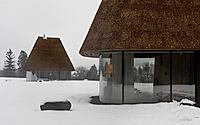
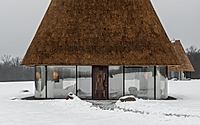
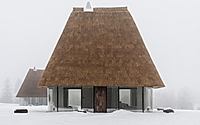
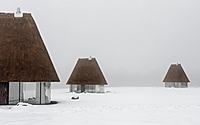
Hata-Mazanka stands on a private estate near Kyiv, Ukraine, where YOD Group reimagines the archetypal rural mazanka as a contemporary guesthouse experience. The project translates traditional whitewashed walls and thatch into glass-walled volumes beneath a sweeping roof, creating a quiet setting for short stays rooted in local craft. Guests move between bedroom and living room as the landscape presses close, blurring the threshold between interior comfort and open countryside.


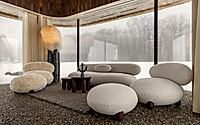
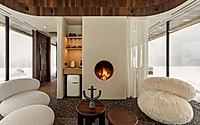
Under the broad thatched roof, light filters through fully glazed walls and pools across the stone-textured floor. A single concrete core anchors the room while the dome of timber tiles rises overhead, pulling the eye up.
These guesthouses, conceived by YOD Group on a private estate in central Ukraine, reinterpret the traditional mazanka through glass façades, an oversized thatched roof, and a pared-back interior palette. The project treats vernacular references as raw material for a new kind of rural stay, where tactility and light shape the experience more than objects. Every move follows a clear ethos: eco-minimalism tuned to local memory.
Recasting The Mazanka
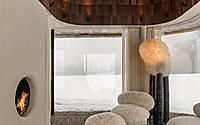
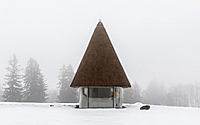
Traditional mazanka houses rely on thick whitewashed walls, small openings, and thatched roofs maintained through regular plastering as an act of care. Hata-Mazanka inverts that formula, trading opacity for uninterrupted glass while keeping the roof as the dominant gesture. The tall, sculptural roof reads from afar like an exaggerated rural hat or a giant mushroom emerging from the landscape, giving the compact plan a strong silhouette. Inside, the emotional connection to the stove becomes a minimalist fireplace, its circular opening framing firelight as the evening’s main attraction.
Instead of a television, guests sit with the rhythm of flames and the view beyond the glass, an intentional push toward informational detox. The emphasis falls on sensory experience rather than distraction.
Glass Walls, Floating Roof
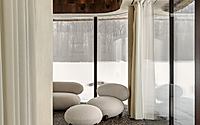
The plan orbits a central concrete block that holds the bathroom, freeing the remaining volume for open living. Bedroom and living room unfold on either side of this core, their boundaries defined more by furniture and light than by solid partitions. During the day, the fully glazed façades visually dissolve, leaving the oversized thatched roof to read as a floating element above field and garden. This visual lightness contrasts with the roof’s physical heft, reinforcing the idea of shelter without enclosing the view.
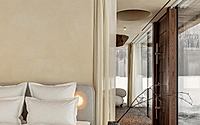
Floor finishes play a quiet but significant role. A continuous stone-carpet surface runs inside and outside, giving a gentle massage under bare feet and tying terrace and interior into a single tactile field. When privacy is needed, dense yet visually light curtains draw across the glass, sliding at the touch of a control panel by the bed.
Eco-Minimal Rooms With Local Craft
Inside, the palette narrows to natural tones and textured surfaces that foreground proportion and light. Furniture by Ukrainian brand Noom, black clay decor by Guculiya, and carefully placed wooden elements bring regional craft into a pared-back interior. The absence of visual clutter keeps attention on materials and the changing daylight, rather than on decoration.
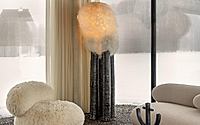
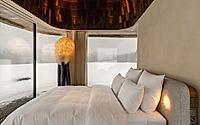
One key accent in the bedroom is a large custom floor lamp made from ceramics and natural fibers, which reads as both sculpture and light source. Its warm glow softens the tall volume at night, counterbalancing the vertical pull of the dome. Every object earns its place, supporting a calm, cohesive atmosphere rather than competing for attention.
Roof As Interior Landscape
The inner surface of the dome is finished with small wooden tiles that recall traditional wooden shingles from older Ukrainian rooftops. Rising to 10 meters at its apex, the roof volume stretches the room vertically while keeping walls clear for glass and textiles. Engineering systems retreat into this thickness: air-conditioning integrates with supply ventilation, working through narrow slots in vertical grilles and discreet outlets in the dome and central core.
A heat pump system stabilizes temperature through changing seasons, leaving the interior visually quiet and free of exposed hardware. Guests simply read the effect in the steady comfort and the uninterrupted surfaces overhead.
As day fades, the thatched roof becomes a dark canopy, and reflections in the glazing pull the lamp glow and firelight back into view. The guesthouses sit between vernacular memory and present-day restraint, using local craft and controlled material choices to frame the rural landscape. In this measured setting, time stretches, and the interior palette does the quiet work of helping guests tune back into their senses.
Photography by Mykhailo Lukashuk
Visit YOD Group