Alsace by Studio Patrick Martins
Alsace opens onto the quays of Gare de l’Est, a compact Paris, France apartment reworked by Studio Patrick Martins. Generous ceilings, original moldings, and a monumental marble fireplace set a historic frame for a new sequence of rooms that favors reception. Within this 55 sqm shell, a precise intervention pulls the kitchen to the entrance and tucks the bedroom deeper inside, turning everyday circulation into a quiet choreography.


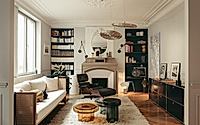
Sun spills across the parquet and catches on carved moldings before landing on the marble fireplace. From the quays of Gare de l’Est, the living room feels unexpectedly deep. Light tracks across the ceiling height and pulls the eye past the historic details toward quieter rooms beyond.
Alsace is a 55 sqm apartment in a characterful Paris building, reworked by Studio Patrick Martins as a clear sequence from reception to retreat. The project respects the existing Haussmannian frame—moldings, fireplace, tall openings—while introducing a contemporary layout that never competes with it. Plan, thresholds, and circulation do the work, turning a compact footprint into an apartment that reads as generous and ordered.
Framing The Double Living Room
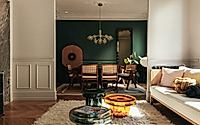
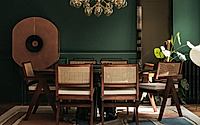
At the center, the double living room gathers the apartment’s social life around the imposing marble fireplace. Two consecutive rooms read as one long volume, so the historic hearth becomes an anchor rather than a backdrop. Large openings facing the quays pull daylight deep into the plan, sharpening the relief of moldings and wall planes. Despite the modest overall area, this central sequence feels broad and legible, with furniture and circulation arranged to preserve a clear sweep from one end to the other.
Entering Through The Kitchen
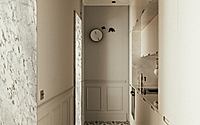
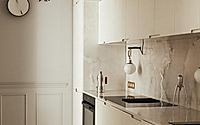
Instead of a discrete back room, the kitchen folds into the entrance and greets anyone stepping inside. Graphic cement tiles on the floor mark this zone with a strong rhythm, visually separating it from the timber and soft tones of the living rooms. The cooking line runs along bespoke full-height cabinetry, so this band of storage sets the apartment’s organizing spine. Daily routines start here—coat dropped, meal prepared—before moving toward the more ceremonial double living room that still reads as the primary reception area.
Filtered Path To Rest
Beyond the kitchen and storage wall, the circulation shifts from public to private. The linear furniture system thickens into what the architect calls an inhabited thickness, a built element that acts as both storage and partition. Passage to the bedroom happens only through this volume, so movement itself becomes a filter rather than a simple doorway. As one passes through, sightlines compress, sound from the street softens, and the plan tilts away from the city toward the courtyard.
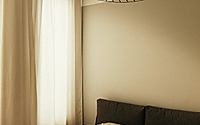
Set back from the quays, the bedroom occupies the quietest part of the apartment, facing the inner courtyard instead of the busy station. Light is more subdued, surfaces read calmer, and the same built furniture organizes the bed, storage, and circulation with controlled precision. This room stands apart from the living areas not through ornate contrast but through its degree of exposure and its measured hierarchy of uses. Private life stays here, just beyond the depth of that inhabited wall.
Thresholds And Hierarchy
Across the apartment, transitions matter as much as individual rooms. Floors, built elements, and shifts in openness mark the move from entrance to reception to rest without heavy construction. The project sets out a clear hierarchy: a front-of-house realm structured by the double living room, and a withdrawn bedroom that stays off-stage until needed. In this way, Haussmannian heritage and contemporary restraint share one continuous plan, each giving the other clarity.
By the time evening falls, the quays glow beyond tall windows while the courtyard side stays hushed. One axis faces the city, the other anchors daily rituals in a quieter register. Within this small footprint, sequence and light carry much of the work, making the apartment feel generous, coherent, and distinctly urban.
Photography by Oracle Paris
Visit Studio Patrick Martins