Perchée: Elevated Forest House Embracing Quebec’s Northern Light Fully
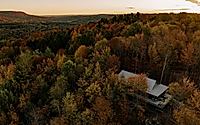
Perchée stands in a maple-wooded valley in Québec, Canada, conceived as a restrained house by Matière Première Architecture that barely touches the ground. The project threads itself along the slope, holding back from excessive clearing so daily life stays immersed in the forest. Interior rooms and covered terraces trade square footage for atmosphere, treating the surrounding trees as the constant companion to every movement through the house.


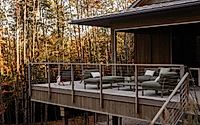
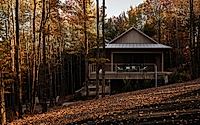
The approach moves under maples and along a gentle slope before the house comes into view, stretched lightly above the ground. Extended floors and roof planes hover over understory growth, so the first impression is of a building more suspended than anchored.
This restrained house in Québec, Canada, is conceived by Matière Première Architecture as an elevated residence that treats topography, climate, and forest as its primary constraints. Rather than reshape the land, the project rides the existing grade and preserves mature trees, limiting clearing to what is strictly necessary for inhabitation. Interior rooms, covered terraces, and shaded walkways work together as one continuous realm, with daily life unfolding as much in the filtered air beneath the roof as behind glass walls.
Suspended On The Slope
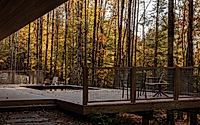
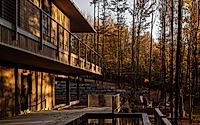
The key move is a longitudinal cantilever that pulls the volume along the slope instead of digging into it. By suspending much of the house, excavation is reduced near the structure, softening impact on root systems that knit the hillside together. This projection creates a peripheral walkway where residents can circle the house while staying sheltered, always in close contact with trunks and foliage. At garden level, the eight-foot-deep band beneath the cantilever reads as a continuous porch facing the pool, an intermediate realm neither fully inside nor entirely exposed.
Rooms In The Understory
Life here unfolds beneath an extended envelope, which stretches beyond the conditioned volume to define outdoor rooms in the understory. Covered exterior areas nearly match the interior footprint, so moving outside feels less like departure and more like a subtle temperature shift. The car shelter follows the same logic: instead of a closed garage, it remains a covered volume in reserve that can act as terrace, threshold, or gathering room when empty. Everyday routines—arriving home, stepping out to the pool, lingering under the overhang—happen in direct dialogue with the forest floor and the filtered light under the canopy.
Light As Climate Filter
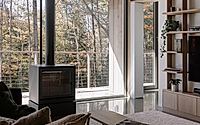
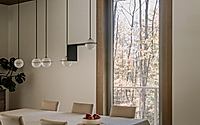
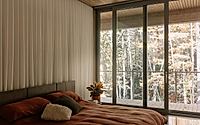
Inside, generosity comes from height and continuity rather than excess area. Ten-foot ceilings and a thirty-inch clerestory band detach partitions from the roof plane, allowing daylight to slip over interior walls and connect rooms. Roof overhangs manage sun and shade, muting harsh summer glare while still permitting low winter light to reach deep into living areas. The result is a house filled with luminous, tempered rooms where changes in weather register through shifting bands of brightness rather than direct heat.
Wood In Conversation With Weather
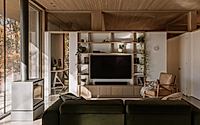
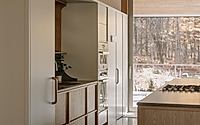
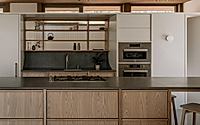
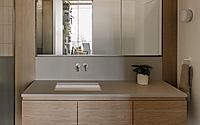
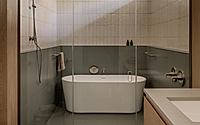
Material choices extend the project’s quiet stance toward its setting, relying on a precise palette anchored by regional timber. Indoors, select spruce from Northern Quebec forests wraps walls and built-in elements, lending a steady warmth that stays consistent from one room to the next. Outside, each species takes on a specific role: red cedar marks the larger structural components, while white cedar—treated with a weathering accelerator—clads the envelope and develops a quick patina that folds the house into the changing bark tones around it. Custom millwork, from wood-framed glass panels to the library surrounding the television, balances solidity and fineness against pale gypsum and lacquer, keeping wood present without visual heaviness.
Stepping back to the valley, the house reads as a slender body laid along the grade, neither dominating the slope nor retreating from it. Long planes of roof and floor mediate between forest and inhabitation, framing measured clearings rather than open lawns. Perchée acts as a quiet observatory for the movement of light through trees, finding equilibrium by inhabiting the land’s natural fall instead of correcting it.
Photography by Ian Balmorel
Visit Matière Première Architecture