ST House by Roberto Lebrero
ST House stands on a sloping hillside in Spain, where Roberto Lebrero works with the terrain to frame long views and precise interior rhythms. Conceived as a house for three siblings, the project breaks the domestic brief into distinct volumes that drift across the slope, tying private life, shared rooms, and the surrounding valley into one measured composition.


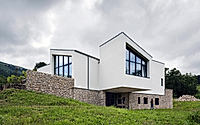
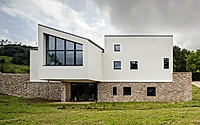
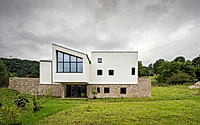
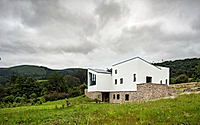
A narrow road drops away and the hillside opens, revealing five quiet forms stepping across the contours. Light catches the pitched timber roofs and the stone base, tracing each volume as it lifts from the ground. Mist from the valley stream hangs low in the morning, and the house reads as a measured line between terrain and sky.
This is a family house in Spain, set above the rural settlement of Santibáñez and planned as a shared dwelling for three siblings. Roberto Lebrero organizes the rooms into five interrelated volumes that respond to slope, orientation, and view rather than a single, centered block. Structural rhythm, sectional repetition, and a clear hierarchy between base, walls, and roofs drive the project, turning domestic life into a study in geometry and sequence.
Sequencing The Volumes
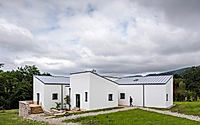
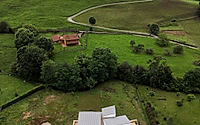
Five regular forms step across the hillside, each one rotated slightly to catch views and negotiate the changing levels. Three volumes hold the private quarters, giving each sibling an independent wing with its own outlook and entry. The remaining two concentrate the communal rooms, where daily life gathers along the slope and looks out toward the Pasiego valleys. Between them, interstitial strips consolidate circulation and storage, working as calibrated joints rather than leftover gaps.
Interlocking Family Wings
Each domestic wing reads as an autonomous unit, yet none stand apart as an isolated object. Doors, short corridors, and shared thresholds slide privacy on a spectrum, allowing solitary routines to sit close to collective meals and gatherings. This arrangement lets different patterns of occupation unfold over time, from all three siblings in residence to partial use without large empty rooms. Autonomy and togetherness are etched into the plan, written in the way volumes touch, overlap, and pull away.
Envelope As Instrument
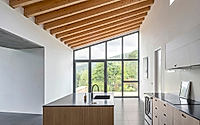
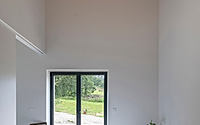
The building envelope carries much of the environmental work, pairing compact massing with a carefully layered section. High thermal inertia internal walls sit behind generous external insulation, tempering daily swings while still engaging the hillside climate. Openings are positioned to draw winter sun deep into the rooms and to drive cross-ventilation along the length of each volume. Because every bar functions as its own energy unit, consumption can be tuned to occupation, so unused parts rest without dragging the whole house.
Stone Base And Timber Rhythm
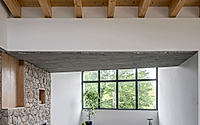
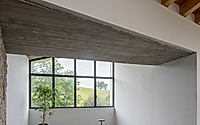
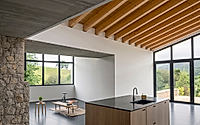
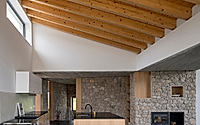
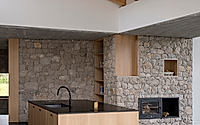
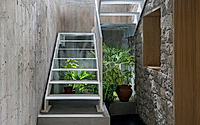
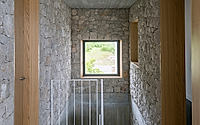
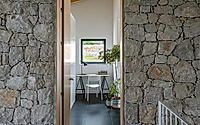
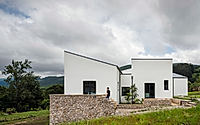
A base of locally sourced stone bites into the slope, tying the project to the ground and absorbing the small shifts in level between terraces. Above this plinth, single-pitch timber roofs run in a repetitive rhythm, giving the five forms a shared structural pattern even as their lengths adjust to programme. A flat concrete slab gathers the interstitial bands, reading as a continuous datum between the more expressive volumes. Inside, exposed timber and concrete keep structure and domesticity in direct conversation, where every beam and wall registers how the house stands.
Terraces, Planes, And Landscape
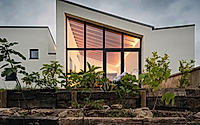
Terraces and retaining walls step down from the stone base toward the stream, turning the fall of the land into usable ground and outdoor rooms. Façade planes slide past one another, offsetting slightly as they track the valley’s undulating topography and dissolving the bulk of the composition at its edges. This shifting skin echoes local rural buildings without copying them, folding contemporary construction into a familiar hillside silhouette. Geometry does the quiet work of negotiation here: between volumes, between family members, and between house and landscape.
As the sun drops behind the Pasiego ridges, long shadows collect under the rooflines and along the terraces. The five volumes hold their positions on the slope, calm but clearly articulated against the stone and grass. What reads from a distance as a simple cluster resolves up close into a tightly argued structure, where every joint, plane, and volume underwrites daily life on the hillside.
Photography by Imagen Subliminal
Visit Roberto Lebrero