Beverly Crest by Whipple Russell Architects
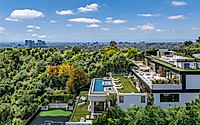
Beverly Crest traces a steep Beverly Hills, CA, United States hillside with the confidence of a seasoned local. Whipple Russell Architects shapes the house as a sequence of terraces, bridges, and rooms, each tuned to the ridgeline and city views. What begins as a quiet entry across water opens into a layered home where a Mediterranean-inflected retreat meets Los Angeles energy over five descending levels.


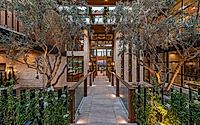
A low bridge skims a reflecting pond, drawing visitors toward the front door with water on one side and the hillside falling away beyond. Light glances off glass and stone at the entry, hinting at how the house will keep folding down the slope in measured stages rather than one grand gesture.
This house in Beverly Hills, CA, United States, by Whipple Russell Architects, takes the hillside as its starting brief and its constant boundary. Instead of forcing a single vertical stack, the team organizes the home as five distinct levels, each one keyed to the terrain, sun, and setback lines. The result is less an object and more a walkable sequence, where circulation routes, rooms, and terraces knit together step by step.
Stepping Down The Hill
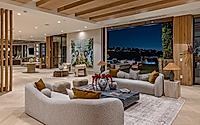
From the street, the house reads as calm, though it holds a complex section within. Geologic constraints rule out a simple three-story form, so the plan answers with a cascade of levels that slide down the ridgeline instead of pushing upward. Each terrace responds to its immediate conditions: one aligns with the entry bridge and pond, another receives the main living rooms, while still others peel away to hold lounge, spa, and recreation. The rhythm of stepping down keeps the mass low against the slope and gives each level a clear role.
Connecting Daily Life
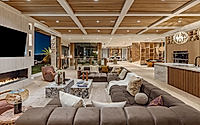
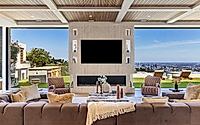
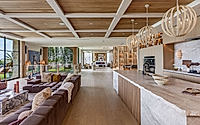
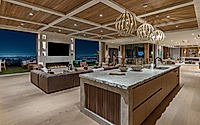
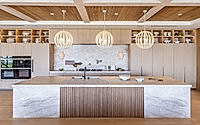
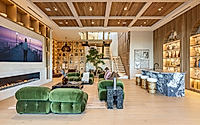
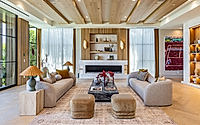
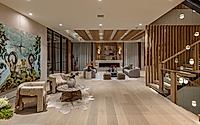
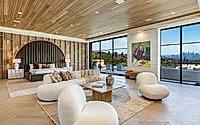
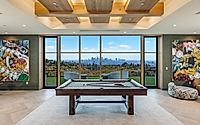
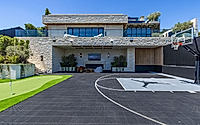
Inside, the plan pivots around the main floor, where kitchen, breakfast nook, and social rooms anchor daily routines. From this hub, circulation splits into two distinct stair experiences, giving residents a choice between practical movement and theatrical descent. One stair drops in an S-curve, passing an Audrey Hepburn portrait before arriving at the lounge, bar, theater, indoor spa, and basketball court, turning a simple trip downstairs into a small event. The other rises toward the rooftop terrace while also linking to the lower level, so choreographed routes keep views, activity, and quiet corners in balance.
Hidden Rooms And Routes
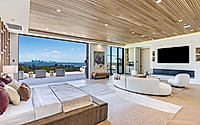
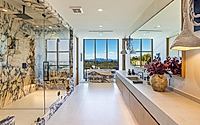
Below the entry, a 500-square-foot basement lounge sits recessed beneath a courtyard, out of view from the street and wrapped in near-complete stillness. Arrival there happens by choice rather than accident, reinforcing the sense of retreat built into the plan. In the primary suite, circulation folds into the architecture again: the route to the bath disappears behind flush wood paneling, where concealed doors within the headboard wall swing open only for those who know where to push. These moves turn movement into discovery, so private areas feel protected yet still connected to the larger sequence.
Outdoor Levels In Sequence
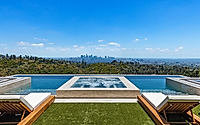
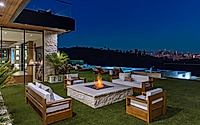
Outside, the hillside becomes a continuation of the plan rather than a backdrop. The pool aligns with one of the mid-level terraces, its mirror-image steps drawing swimmers in from both sides while sculptural fire elements mark the water’s edge. A waterfall at the infinity lip sends water down to ponds beside the lower lounge, tying upper and lower levels with sound as much as sight. Other terraces hold a spa, gym, and mini golf, each on its own elevation, so outdoor rooms unfold one after another instead of collapsing into a single yard.
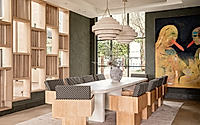
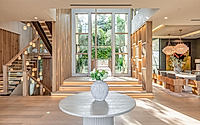
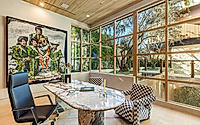
Throughout the house, warm modern materials reinforce how each level feels distinct yet related. Rich woods, green velvet, natural stone, and white venetian plaster repeat across floors, stairs, and terraces, giving continuity to a layout that bends and drops with the terrain. By the time someone reaches the rooftop terrace and tilts their head toward downtown or the ocean, the route they’ve taken up and down the hillside is as memorable as the view itself.
Photography by Simon Berlyn
Visit Whipple Russell Architects