Scho’s House on Theux Hills: Quiet Contemporary Valley Living at Edge
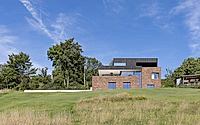
Scho’s House sits on the edge of Theux, Belgium, where a residential street meets open farmland and the valley beyond. Crahayjamaigne shapes a compact three-level house that treads lightly on the steep terrain, pressing stone volumes into the hillside and setting timber-clad living areas above them. The result is a measured rural dwelling that balances long valley views with a quiet presence at the boundary of town and field.


Car access arrives at street level, where the land falls away and the valley pulls the eye across open fields. A compact volume meets this edge, stone and timber balanced above the slope.
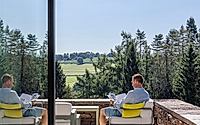
Beyond the first glimpse, the house breaks into terraces that track the hillside, each level catching a different slice of horizon and ground. Light moves across stone walls and deep glazing, tying interior rooms to the long rural view.
This house in Theux sits at the meeting point of residential plots and agricultural land, and the project uses that threshold as its main thread. Crahayjamaigne arranges a three-level composition that works with the steep slope, embedding lower floors in stone while setting timber-clad volumes above. The architecture leans on context: local vernacular cues, the demanding topography, and the wide valley landscape shape both the form and the daily experience.
At the base, the lower ground floor and part of the middle level push into the natural terrain so the house holds the hillside rather than surging over it. Stone cladding reinforces this sense of anchoring, giving the embedded levels a weight that matches the agricultural valley below. Above, the upper ground floor and the remaining portion of the middle level sit on these stone platforms, their timber skin reading as lighter construction. The stacked volumes step with the slope, so the composition follows the oblique geometry of the buildable area instead of forcing a flat cut into the land.
Shaping The Valley Edge
The house stands at a boundary: houses on one side, productive fields on the other. Its compact volume at street level keeps the presence modest, leaving views toward the valley open for neighbors and passersby. A flat roof maintains a low profile along the road, so the landscape beyond stays legible rather than hidden behind an assertive silhouette. The project reads as part of the edge condition, not a barrier drawn across it.
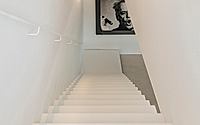
The carport at this level stays fully open, easing the threshold between public street and private entry. Air and light pass through, softening what could have been a blunt front. From here, movement shifts downward through the house, following the slope toward rooms that sit closer to the valley floor and the changing light.
Stone Base, Timber Crown
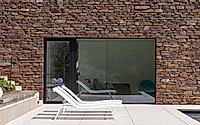
Material choices respond directly to both terrain and local building habits. Stone wraps the lower levels that sink into the hillside, echoing traditional rural construction and giving a durable shell where soil and structure meet. Openings in this base stay carefully controlled, punctuated rather than broad, which reinforces the sense of a grounded plinth.
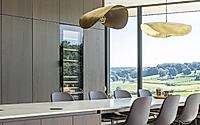
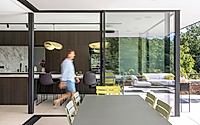
Above, timber cladding defines the lighter upper volumes that rest on the stone. Here the facade opens up: large continuous glazed bands stretch across elevations, oriented toward the valley and the agricultural landscape. This contrast between measured stone apertures and expansive glazing in the timber levels sets up a clear reading of base and crown, solid and open, ground and horizon.
Framing Interior And Exterior
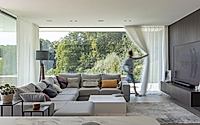
The project places the relationship between interior rooms and exterior terraces at the center of daily life. Broad glazed openings in the timber-clad volumes connect living areas directly to the valley, so morning light and long-distance views define the character of everyday routines. Rooms align with outdoor platforms that extend along the slope, pulling activity outward in good weather.
Smaller, carefully placed openings in the stone-clad levels frame more focused views toward ground, garden, and immediate surroundings. This difference in aperture scale creates a gradient from sheltered, inward-oriented rooms at the embedded levels to outward-reaching living zones above. Across the three tiers, residents move between moments of retreat and expansive outlook.
Calm Lines In Rural Context
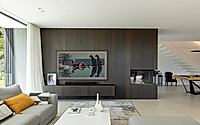
Contemporary geometry meets vernacular reference without noise. The calm lines of the stacked platforms, their restrained tones of stone and timber, and the controlled openings reference local farm buildings while clearly belonging to the present. Edges stay clean, with little ornament, so the valley and sky remain the most animated elements in view.
Clients describe the result as a haven of peace. Set between residential fabric and agricultural land, the house uses its careful siting and layered levels to tune everyday life to the slope, the light, and the broad valley landscape.
Photography by Caroline Dethier
Visit Crahayjamaigne