Sky House by Klas Hyllen Architecture
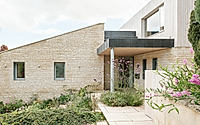
Sky House transforms a tired 1970s house in South West England, United Kingdom into a rigorously updated family home by Klas Hyllen Architecture. The project turns a once-confusing layout into two clear volumes linked by glass, pairing super-insulated construction and triple glazing with vast views of shifting English sky. Inside, contemporary minimalism meets warmth and color as the retrofit aligns daily life with ambitious low-energy performance.


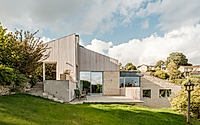
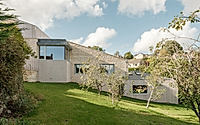
Clouds race across the southern horizon while pale stone and larch sit firmly in the hillside hollow. From the main room, the land simply falls away to sky.
This is no new-build statement, but a deep retrofit of a 1970s house in South West England by Klas Hyllen Architecture that treats the existing structure as a resource. The project turns a muddled suburban relic into a clear, low-energy family home, using reuse, insulation, and airtightness as primary tools. Every move responds to the existing fabric and the steep site, tying environmental performance to a daily experience of weather and view.
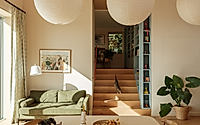
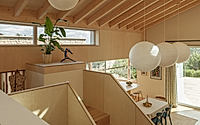
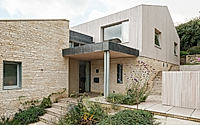
Under its new envelope, the dwelling shifts from a tangle of interlocking rooms to a straightforward pairing of volumes that supports contemporary life. One volume concentrates shared living, dining, and kitchen activity, the other holds the more private bedroom wing, while a glazed link between them pulls light across the plan and sets up long views through. This reorganization makes the house read as a calm, legible composition instead of a patched-on extension story.
Reworking A 1970s Shell
The retrofit keeps the vast majority of the original building fabric, choosing conservation of structure over demolition and replacement. New super-insulated walls and triple-glazed openings wrap that core, sharply lifting thermal performance without discarding the embedded carbon already spent in the frame. Layers of added insulation and careful re-cladding change both the appearance and the behavior of the house, turning a leaky relic into a controlled interior climate. The result respects the original bones while rewriting how the envelope meets wind, rain, and cold.
Pursuing Extreme Performance
Performance figures here are not incidental. An embodied carbon reading of 266 kgCO2e/m2 places the project comfortably within the RIBA 2030 Climate Challenge, underlining the value of reuse as a core strategy. On the operational side, airtightness of 1.9 m³/(h·m²) at 50 Pascals sharply reduces uncontrolled heat loss, a notable achievement given the original 1970s cavity walls and complex geometry. Designed for a 90% cut in operational energy use, the house outperforms that target, recording just 36 kWh/m2/year in its first year of occupation.
Systems Supporting Daily Life
Technical systems back up the envelope so that comfort holds through the seasons. All residual energy demand runs through a fossil-free air-source heat pump, avoiding direct combustion on site and simplifying the mechanical set-up. An MVHR system quietly recovers heat while supplying fresh air, keeping temperature steady and humidity balanced across rooms used at different times of day. These moves fold performance into routine living, so warmth, air quality, and low bills align with the project’s environmental brief.
Material Calm Inside And Out
Outside, a tight palette of pale buff Creeton limestone, whitewashed British larch, and dark grey slate sets up a grounded, almost geological presence on the hillside. Stone and timber catch changing light across the day, their textures reading clearly against the broad sky to the south. The quiet roof plane anchors the composition, letting the cladding handle the conversation between rugged landscape and refined construction. Nothing shouts, yet every surface works hard with sun, cloud, and shadow.
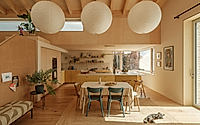
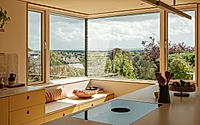
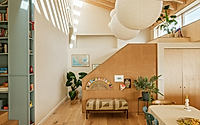
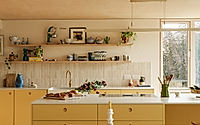
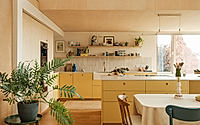
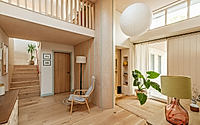
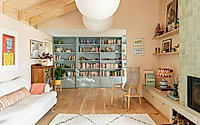
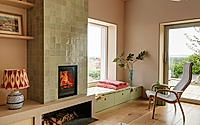
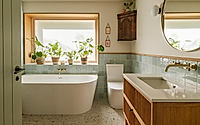
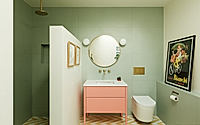
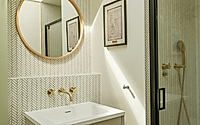
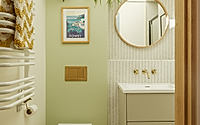
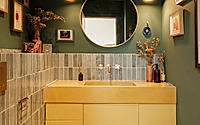
Inside, the retrofit continues as an atmospheric exercise rather than a purely technical upgrade. Rooms lean toward contemporary minimalism but avoid chill through warm timber, color, and playful touches that soften precise detailing. Light is directed toward the southern views while secondary areas remain calm, so family routines can unfold without constant glare. The transparent link becomes both a circulation hinge and a viewing platform, reminding anyone crossing it of the house’s suspended position above the falling ground.
By the time dusk settles, limestone cools to gray and larch deepens, while interior windows read as measured rectangles of light against the hillside. From within, the family looks out past super-insulated walls and high-performance glass to the same broad sky that first defined the brief. The retrofit proves that rigorous environmental upgrades, when tied to reuse and careful assembly, can reset an ordinary house for a new century without severing its past.
Photography by Dave Watts
Visit Klas Hyllen Architecture