The House of Collected Time Shapes an Eclectic Delhi Apartment
The House of Collected Time is a 9,500-square-foot apartment in Delhi, India, designed by Disha Subramanium. Conceived as a home with visible layers rather than a fixed single language, it brings traditional craft, classical proportion, Deco motifs, and modern composition into active conversation. Across its rooms, art, material contrast, and varied atmospheres give the residence a sense of character built over time.


About The House of Collected Time
The House of Collected Time, a 9,500-square-foot residence in Delhi, offers a clear answer to the problem of anonymity. Envisioned by Disha Subramanium, founder and principal designer of her eponymous studio, the house begins with a simple resolve: to feel layered, as if its character has been accumulated through years of inhabitation.
From that starting point, the interior resists a single architectural lineage. Traditional craft, classical proportion, Deco motifs, and modern composition are brought into deliberate conversation, giving the home expressive depth. In its unfolding, The House of Collected Time settles into an eclectic interior that feels as though it has gathered its own patina.
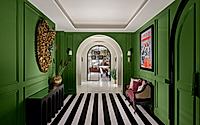
The journey inward begins at the lift lobby and moves gently into a foyer wrapped in vivid green walls that announce the home’s expressive spirit. From here, the plan branches with clarity. One side leads to the private wing, where four suites, including two master suites, are shaped around the character of their inhabitants. The circulation also extends toward a family lounge and a fifth bedroom before opening into the living and dining areas at the far end. Large windows draw the surroundings into view, allowing greenery to remain a steady presence within.
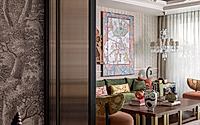
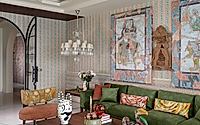
In the living room, details reveal themselves gradually. A series of pastel abstract paintings by Ram Dongre, commissioned for the home, forms the main focal point. Handwoven carpets add a traditional layer beneath contemporary furniture silhouettes, while eclectic prints and collectible objects bring variation without breaking the room’s composure.
Beyond this, the dining room reads as a room completed through the slow accumulation of objects and memory. Sepia-toned walls running from floor to ceiling create a continuous backdrop for the family’s artworks, setting the tone for meals and conversation. In the foreground, copper and brass antiques anchor the dining ensemble, their worn patina catching the amber glow of chandeliers overhead.
A curated palette shapes the powder room. Hand-beaten metal, handmade tile, natural stone, and wallpaper come together in a compact setting where material contrast carries the room.
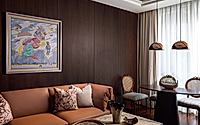
The family lounge turns warmer and more intimate in mood. Wood wraps both walls and floor, creating a more enclosed feeling, while minimal furniture forms keep the room calm and grounded. Against that quiet base, eclectic notes appear in measured ways: a framed Hermès scarf introduces a note of play, and handwoven textures soften the overall composition.
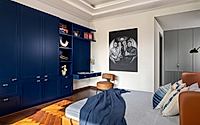
The master suite is rendered in a muted gray palette, with subtle classical detailing and a sense of symmetry reinforcing its calm atmosphere. The children’s bedrooms move in a different direction. Their language is more youthful and contemporary, shaped through cleaner lines and pared-back compositions. In the daughter’s room, a terracotta-upholstered bed sits against monochrome botanical walls, with a small sitting nook made for quieter moments. The son’s bedroom takes on a more grounded character through a tan leather bed, deep navy tones, and metal accents.
Rather than flattening identity into one visual language, the residence makes room for difference through a controlled and deliberate approach. Its distinct character comes from depth formed over time—and from rooms that appear ready to keep unfolding.
Photography by Atul Pratap Chauhan
Visit Disha Subramanium