El Born Loft by Roman Izquierdo Bouldstridge
El Born Loft transforms a former commercial interior in Barcelona, Spain, into a residence by Roman Izquierdo Bouldstridge. Designed in 2026, the loft centers on the idea of void, using a reused ash wood system, exposed masonry, and a nearly five-meter-high interior to shape movement, light, and flexible daily use. Old structure and new domestic life remain in clear, measured balance.


About El Born Loft
The conversion of an old commercial space into a dwelling in Barcelona’s El Born district is conceived as an exploration of the void. The project aligns with the spatial idea articulated by Lao-Tse:
“We make a vessel from a piece of clay; it is the empty space inside that gives it its utility. We build doors and windows for a room; but it is these empty spaces that make it habitable. Thus, while the tangible has its advantages, it is the intangible from which the useful emerges.”
The concept is developed through four interrelated dimensions of the void: time, space, material, and program.
The Void in Time: Transformation of a System
The modular ash wood system was not originally designed for this loft. Over the course of ten years, it has taken on different configurations, first as commercial infrastructure and later as office furniture, adapting to new needs without losing its structural logic.
This approach goes beyond simple reuse. At each stage of its life cycle, the system takes on a new meaning. The structure is successively reinterpreted as commercial support, workplace furniture, and finally as a domestic element with symbolic value. The wood retains marks, tonal variations, and traces that register the passage of time, turning age into an architectural quality.
Architecture here accepts impermanence. The continuity of the system over time depends not on permanence in one place, but on its capacity to adapt to new forms and functions while maintaining its identity. A void exists in time: even as structure and use change, the underlying logic remains intact.
The Void in Space: A Succession of Three Torii
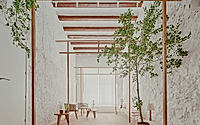
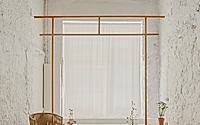
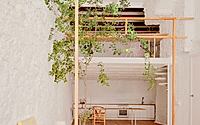
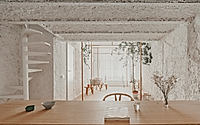
The project creates a new scene through a sequence of three torii, the traditional Japanese gateways that mark a passage from the profane to the sacred. Their role lies not in material function, but in the shift in perception they create. Between these thresholds, intervals and pauses emerge, forming a landscape with an interior path.
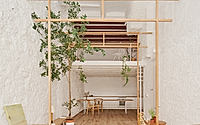
The Japanese concept of ma underscores the importance of the in-between as a generator of meaning. It is not the isolated element that defines the place, but the relationships and distances between elements. Repetition introduces a rhythm that alters spatial perception. The sequence culminates in a staircase leading toward natural light, intensifying the sense of arrival.
Although the visible element is the torii, the essential condition lies in the void each one frames.
The Void in Material: White as a Field of Possibility
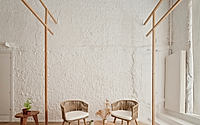
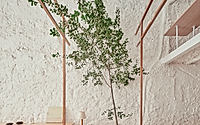
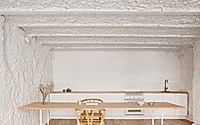
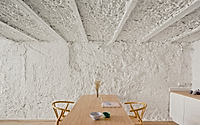
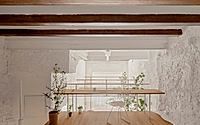
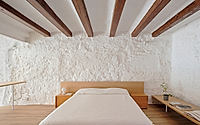
The intervention begins by removing as much as possible and adding only what is strictly necessary. The walls are stripped back to reveal the existing stone and brick masonry, false ceilings are removed to expose the wooden beams and Catalan ceramic vaults, and the entire envelope is unified under a layer of white. White does not act as a finish, but as the visual equivalent of the void: not an absence of color, but a field of possibility to be inhabited.
Stone, wood, and ceramics emerge from this neutral surface, intensifying their presence within an abstract language. Boundaries dissolve and natural light spreads, drawing attention to the wood of the torii and creating a warm atmosphere. Reduction here is not simple subtraction, but a concentration of architecture around light, room, and material.
The Void in Program: Flexible and Interchangeable Use
The layout follows the same logic of containment. A single open interior, nearly five meters in height, is organized by a mezzanine and forms a continuous floor plan in which the bathroom is the only enclosed room. No hierarchies or partitions are imposed, producing an open program. The project does not assign fixed functions, but establishes a flexible framework capable of changing over time. The loft is currently a residence, yet it could be converted into an office, shop, or another use without altering its architecture.
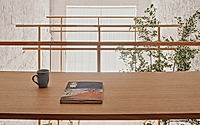
The furniture is resolved through an elemental structure: panels on four legs, varying in height and proportion according to use. The reuse of a system, the minimal construction intervention, the reduction of resources, and the overall flexibility do not arise from a defined sustainability agenda, but from a search for simplicity. Within that restraint appears the beauty of the minimum, where a large tree and plants act as living elements that occupy the void without fixing it. The architecture does not present itself as an object, but as a quiet support: a blank interior that allows matter, light, and life to enter in balance.
Photography by JOSÉ HEVIA
Visit Roman Izquierdo Bouldstridge