Pomponazzi by RAAR—Radicioni Architetto
Pomponazzi reworks an apartment in Milan, Italy, by RAAR—Radicioni Architetto, returning order and identity to a home inside an elegant 1930s building. Designed in 2024, the renovation begins with the original cement tile floors, using their 20×20 cm (7.9×7.9 in) module to recalibrate rooms, openings, and color across the interior.


About Pomponazzi
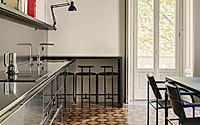
The project begins with the aim of restoring coherence and identity to an apartment in an elegant 1930s building in Milan. Its defining element was the original cement tile flooring, compromised over time by a forced subdivision of the rooms driven by the need to turn the property into an income-producing asset.
The core idea is expressed clearly in the plan of demolitions and new construction. Partitions that cut through the cement tile carpets were removed, and from that move a precise ordering principle took shape.
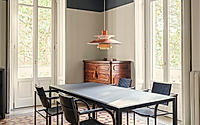
The 20×20 cm (7.9×7.9 in) dimension of the original tiles became the base module for a new design grid, used to recalibrate the updated rooms. The goal was twofold: to return the decorated floors to the center of the project and, at the same time, to rebuild a sense of harmony throughout the home through a quiet rhythm that informs both the concept and the drawing.
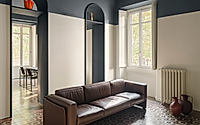
Because the apartment could rely on original flooring with such a strong presence, the work focused on restoring a 1930s architectural language through a reinterpretation of the interior envelope. Here, that envelope takes on an active role: not a simple background, but the reference structure for the insertion of contemporary elements.
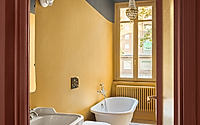
The recovery of the internal shutters and sliding louvers, paired with new handcrafted wood windows decorated on site, establishes material and chromatic continuity with the wall surfaces, all treated in a uniform plaster tone. The result removes the visual separation between construction elements and finish.
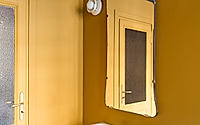
The doors, also original to the period, were selected from builders’ salvage yards and reintroduced into the apartment with stylistic consistency. Their presence reinforces the continuity of the whole rather than reading as isolated historic fragments.
The entry works almost like a theatrical scrim. From here, the cement tile carpets of the different rooms appear at once, making the material and chromatic complexity of the interior immediately legible.
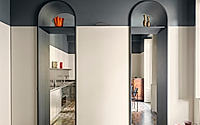
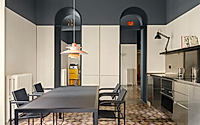
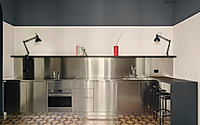
The project organizes a unified living area whose compositional center is an equipped wall that acts as a diaphragm between kitchen and sitting room, redefining functional boundaries without interrupting spatial continuity. The wall works by subtraction: it marks limits without closing them, organizes the kitchen’s storage elements without putting everything on view, and becomes a quiet presence that supports the overall balance of the apartment.
Arched openings become devices of measure. They emphasize the height of the rooms, draw perspective axes, extend the grout lines, and introduce unexpected depth.
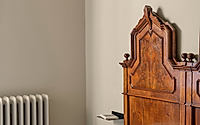
The colors, sampled room by room from the existing cement tiles, reinforce the idea of the home as a sequence of architectural boxes, each with its own chromatic identity yet still coherent with the whole.
Photography by Anna Positano
Visit RAAR—Radicioni Architetto